
Self-custody vs custodial wallets when selling crypto
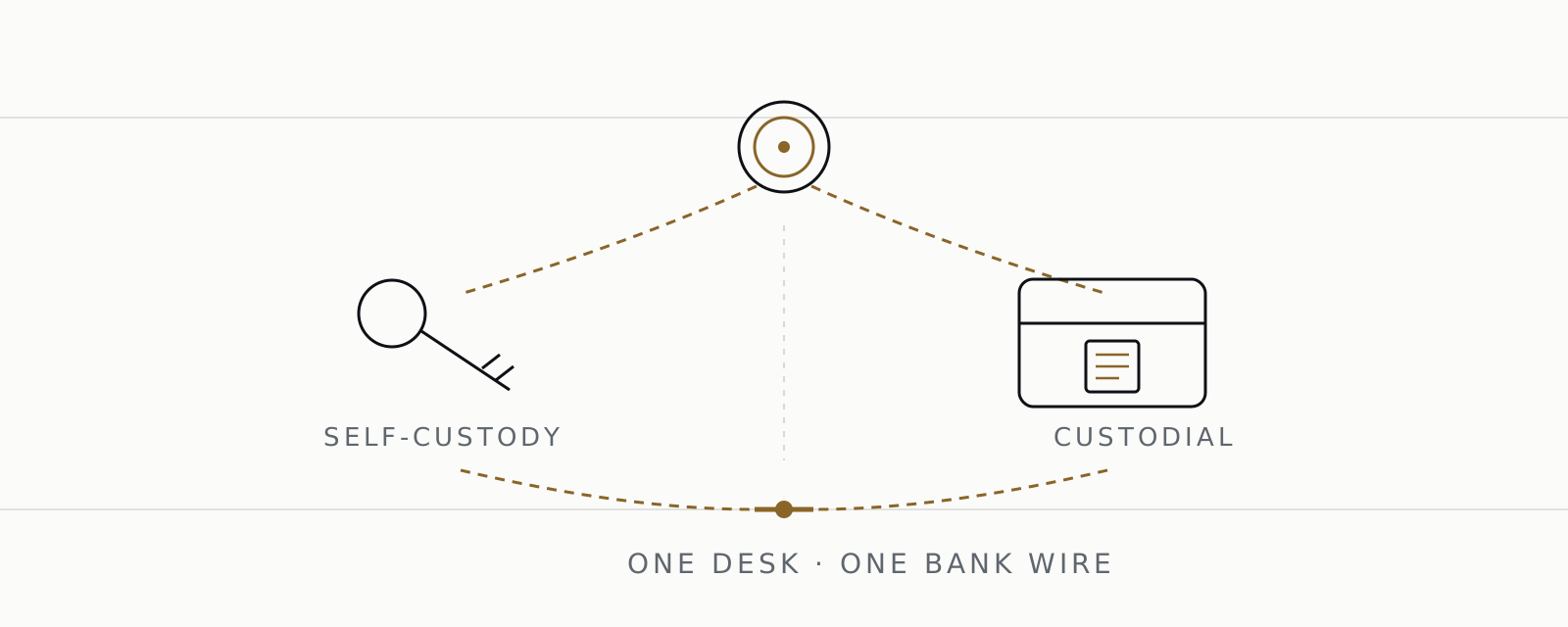
Where your crypto sits changes three things when you sell: how you prove ownership, which documents the desk asks for, and who carries the risk until settlement. From self-custody you prove control by signing or sending; from a custodial account the platform's records speak for you. Price and bank settlement are identical.
KEY FACTS
| Proof from self-custody | Signed message or test send from your address |
|---|---|
| Proof from a custodial account | Platform statement plus the withdrawal itself |
| Core documents (both cases) | Passport and proof of address within 90 days |
| Self-custody-specific risk | A wrong-address send is irreversible |
| Custodial-specific risk | Withdrawal holds and platform solvency |
| Settlement at a licensed desk | Identical: AED same business day (UAEFTS) |
Source: Meridian OTC dealing desk practice, as of September 2026.
What changes between self-custody and custodial when you sell?
Custody changes the evidence you bring and the risk you carry before the trade — not the trade itself. Once the coins reach the desk, the quote, the spread and the bank wire work exactly as in any bank-settled OTC trade. Everything before that moment depends on who holds the private keys.
Self-custody means you hold the keys, on a hardware device, a phone wallet or paper backup. Custodial means a platform holds them for you: an exchange, a broker app or a qualified custodian — see custody in our glossary for the formal split.
| Aspect | Self-custody wallet | Custodial account |
|---|---|---|
| Who holds the private keys | You | The platform |
| Proof of ownership | Signed message or test send from your address | Account statement and transaction history |
| Extra step before selling | None — you broadcast the transfer yourself | Withdrawal, subject to the platform's limits |
| Main failure mode | Irreversible wrong-address or wrong-network send | Withdrawal review, freeze or platform insolvency |
| Documents at the desk | Passport, proof of address, source of funds | The same, plus platform statements |
The desk's price and settlement are identical on both rows; custody only changes what happens before the coins arrive.
How do you prove ownership from a self-custody wallet?
From a self-custody wallet you prove ownership by showing control of the sending address: a signed message, a small test transaction, or the full send from an address with a visible history. The desk matches that address against the name on your approved account. A screenshot of a balance proves nothing and no licensed desk accepts it as proof.
A signed message is the cleanest method. Your wallet signs a short text the desk gives you — the signature verifies against the address on the public blockchain, the private key never leaves the device and no funds move. Hardware wallets support this, and our guide to selling from a hardware wallet to a bank account walks the full route.
Expect one follow-up question either way: where the coins came from. An address funded by years of your own exchange withdrawals reads differently from one funded yesterday by an unknown wallet, so keep your acquisition records before you need them.
What changes when the coins sit with a custodian?
When coins sit with a custodian, the platform's records are your proof. The desk asks for an account statement or transaction export showing the balance and how it was built up, then you withdraw to the desk's deposit address. The platform, not you, executes that last step — and its rules apply.
Three frictions are common: daily or per-transaction withdrawal limits can sit below your ticket size, and some platforms hold freshly whitelisted addresses for a set period — Binance, for example, lets you choose a 24-, 48- or 72-hour hold on newly added addresses. A first large withdrawal to a new address can also trigger a manual review; platforms do not publish how long these take, so allow for it rather than planning around a fixed number.
The heavier risk is the custodian itself: a freeze, an outage on settlement day, or insolvency while it holds your coins. In Dubai, VARA-licensed custodians must segregate client assets from their own, which you can check against the VARA public register; an offshore platform answers to a different rulebook, or none.
Which documents does a licensed desk ask for?
The document list is the same on both sides, because it verifies you, not your storage. An individual provides a passport and proof of address issued within 90 days; a company provides its trade licence and ownership documents. Account approval takes one business day in most cases — the full list is in our onboarding section.
On larger tickets the desk adds source of funds: evidence of how the coins were acquired, such as exchange statements, past trade confirmations or sale contracts. Our guide to source-of-funds checks for crypto covers what passes and what does not. Custodial sellers already have most of this inside the platform; self-custody sellers should assemble it in advance.
Who carries the risk between quote and settlement?
Risk splits into two legs: getting the coins to the desk, and getting the money to your bank. On the second leg there is no difference — a licensed desk settles AED by UAEFTS the same business day and pays only to an account in your own name. The whole comparison lives in the first leg.
From self-custody you control the coins until the moment you broadcast, and a mistake is yours alone: a wrong address or wrong network is irreversible. Send only after accepting a written quote, and match the network exactly — TRC20 and ERC20 addresses look alike and are not interchangeable.
From a custodial account the platform controls the coins until the withdrawal lands, so its solvency, its review queue and its uptime sit between you and the trade. A desk can lock a price for a defined window; it cannot make a frozen platform release your coins inside that window.
The bottom line on self-custody vs custodial
Neither storage model wins outright: self-custody gives you control and speed at the price of irreversibility, while custodial storage outsources key management and imports a counterparty. The trade itself is identical, so choose storage for how you live with crypto, and plan the sale around its frictions. Open the desk account, gather the documents and, if the coins sit on a platform, start the withdrawal before you need the money.
FAQ
Do I get a better price selling from self-custody than from an exchange account?
No. The desk prices the trade, not the storage. At Meridian the all-in spread is 0.08% to 0.40% by ticket size, as of September 2026, identical whether the coins arrive from a hardware wallet or a platform account.
Can I sell crypto directly from a hardware wallet at an OTC desk?
Yes. You sign a message or send from the device itself, so the coins never need to touch an exchange first. That removes one counterparty and one withdrawal queue from the route to your bank account.
What if my exchange limits how much I can withdraw?
Withdraw in tranches inside the limit, or complete the platform's enhanced verification to raise it. A desk cannot pull coins out of a custodian for you, so start the withdrawal before you book the trade.
Is it safe to give a desk a signed message?
Yes. A signature proves you control the key without revealing it and without moving any funds. Sign only the plain text the desk gives you, never a transaction or approval you do not understand.
Sell from any wallet, settle to your own bank account
Meridian OTC is a VARA-licensed Broker-Dealer in Dubai. All-in spread 0.08–0.40% by size, from 100,000 USDT. AED by UAEFTS the same business day, from self-custody or a custodial account alike.
SOURCES
- VARA public register — licensed custodians and segregation obligations, accessed 11 September 2026.
- Ethereum.org — wallets, keys and self-custody, accessed 11 September 2026.
- Binance Support — withdrawal whitelist — 24/48/72-hour holds on newly added addresses, accessed 14 September 2026.
- Central Bank of the UAE — payment systems (UAEFTS), accessed 11 September 2026.
- Meridian OTC published pricing bands and onboarding requirements — this site, September 2026.
This guide is informational and is not legal, tax or investment advice, nor an invitation to buy or sell any virtual asset. Rules and figures are as of September 2026 — re-check the sources before acting. Virtual assets may lose their value in full or in part and are subject to extreme volatility.