
Enhanced due diligence on large crypto conversions: when it triggers and how to clear it
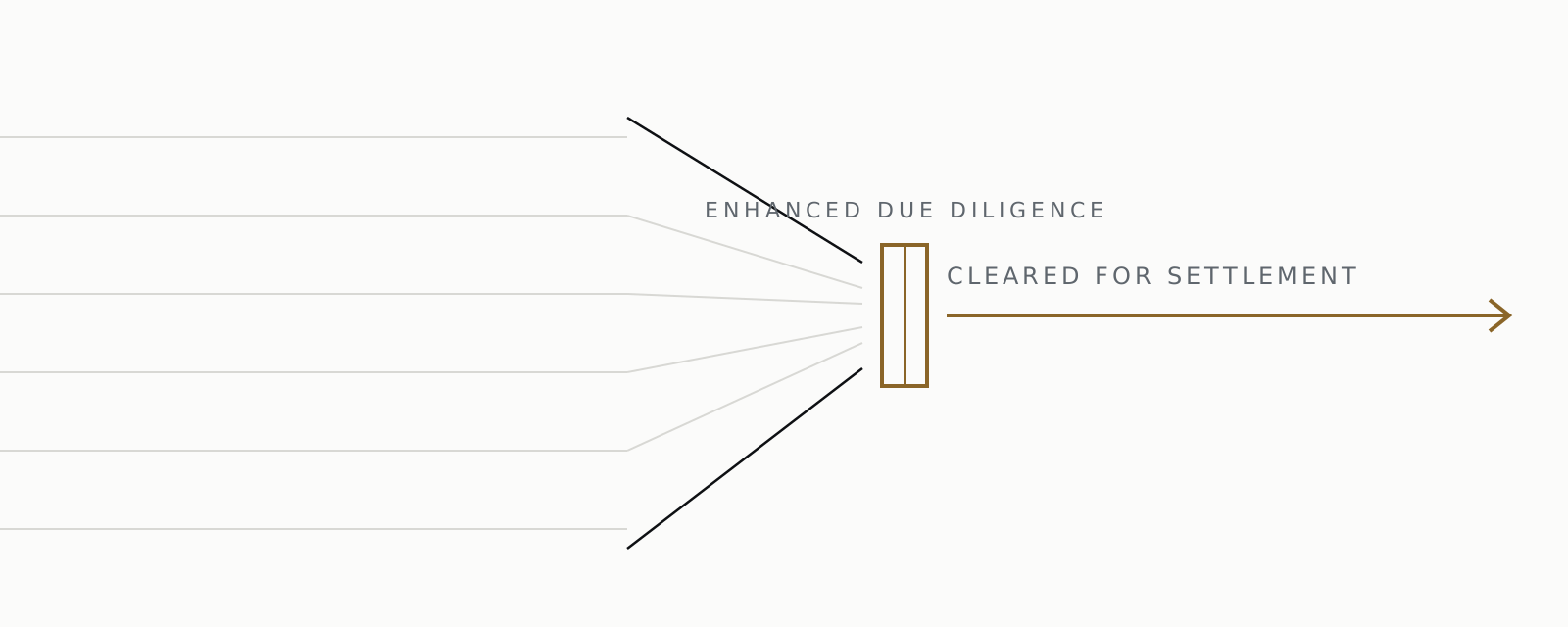
Enhanced due diligence (EDD) is the deeper source-of-funds review a licensed desk runs before executing a large or unusual crypto conversion, required by UAE anti-money-laundering law. It asks how you acquired the assets, takes two to five business days in most cases, and usually clears in one round when the file is complete.
KEY FACTS
| Legal basis | Federal Decree-Law No. 20 of 2018; VARA Compliance and Risk Management Rulebook |
|---|---|
| Statutory threshold | None published — the review is risk-based |
| Common trigger size | From around 100,000 USDT (desk practice) |
| Typical duration | 2–5 business days with a complete file |
| Cost to the client | None — a compliance step, not a fee |
Source: UAE AML legislation, VARA rulebooks and Meridian OTC onboarding practice, as of September 2026.
What is enhanced due diligence on a crypto conversion?
Enhanced due diligence on a crypto conversion is an extended review of who you are and where the assets came from, run by a regulated provider before it accepts a large trade. It builds on standard KYC — passport and proof of address — and adds evidence about the origin of the specific funds.
Standard onboarding takes one business day at most licensed desks; the standard onboarding document list is short. EDD starts only when the file or the transaction is large or unusual enough to need a second look.
The obligation is legal, not commercial. Federal Decree-Law No. 20 of 2018 requires enhanced measures for higher-risk relationships, and VARA's Compliance and Risk Management Rulebook applies them to virtual-asset providers in Dubai. A desk that skipped EDD on size would be putting its VARA licence at risk.
When does enhanced due diligence trigger on a large conversion?
Enhanced due diligence triggers when a conversion is large relative to the client's profile, or when several risk factors stack up. The UAE publishes no fixed dirham threshold: the law requires a risk-based approach, so each desk sets internal bands. In practice, conversions from around 100,000 USDT routinely draw enhanced questions, as of September 2026.
Screening starts before you send anything: wallet addresses are checked against sanctions lists and blockchain analytics, and your declared profile is compared with the ticket size. The common triggers are:
- A ticket size materially above the desk's minimum flow of around 100,000 USDT.
- A first-time client with no transaction history at the desk.
- Funds arriving from mixer-linked, darknet-linked or sanctioned addresses on blockchain analytics.
- Corporate structures with layered ownership or unclear beneficial owners.
- Politically exposed person (PEP) status, adverse media, or links to high-risk jurisdictions.
- Structuring: splitting one large conversion into smaller tickets to stay under review bands — itself a red flag.
What documents will a licensed desk ask for?
A licensed desk running EDD on a crypto conversion asks for two categories of evidence beyond standard KYC: source of funds, covering the specific assets being converted, and source of wealth, covering how you built your position overall. Most requests resolve into six document types, as of September 2026:
- Exchange statements or CSV exports showing how the assets were acquired.
- Wallet addresses and transaction hashes for the major on-chain inflows.
- Sale agreements behind the funds: property, a business, or other assets.
- Corporate files for companies: trade licence, register of beneficial owners, audited accounts.
- Salary, dividend or inheritance records where wealth is employment- or investment-based.
- A one-page signed narrative walking from income to wallet.
Example: a client converting 2,000,000 USDT bought on an exchange in 2021 with proceeds from a business sale supplies the exchange CSV, the sale agreement and the one-page narrative. That file reads cleanly in one pass; the same conversion backed only by screenshots of a wallet balance does not.
How long does enhanced due diligence take?
Enhanced due diligence at a Dubai desk takes two to five business days in most cases, as of September 2026. A complete, well-organised file often clears in one or two; a file that needs several clarification rounds, or documents that require translation, can run to two weeks.
| Stage | What happens | Typical time | What shortens it |
|---|---|---|---|
| Pre-screening | Blockchain analytics on sending wallets; sanctions and PEP checks | Same day | Send only from wallets you can document |
| Document request | The desk issues an evidence list tailored to your case | Same day to 1 day | Ask for the full list up front |
| Review | Compliance reads the file; one clarification round if needed | 1–3 days | Submit everything as one package |
| Decision | Cleared, conditionally cleared, or declined | Same day after review | The one-page source-of-funds narrative |
The review clock is mostly in the client's hands: desk-side steps are measured in hours, and the waiting happens between incomplete submissions.
Once EDD clears, it is not repeated for every trade. Later conversions are screened against the approved profile, and only a material change — a new wallet origin or a much larger ticket — reopens the file.
How do you clear EDD in one round?
Clearing EDD in one round is a packaging problem, not a negotiation. The desk's compliance team needs a file it can defend to VARA without guessing; give them that file on the first submission and the review is short. Four habits make the difference:
-
STEP 1
Declare the size and origin up front
Tell the desk the amount and how the assets were acquired before you onboard. A conversion that matches the declared profile moves through screening without stops; a surprise is what starts follow-up rounds.
-
STEP 2
Submit one indexed package
Statements, transaction hashes, agreements and the one-page narrative, named and dated. Compliance officers read hundreds of files; the one they can verify without email ping-pong is the one they clear first.
-
STEP 3
Answer follow-ups in writing within 24 hours
Speed reads as cooperation; silence reads as evasion. If a document does not exist, say so and offer the closest alternative — a bank statement where a contract is missing.
-
STEP 4
Keep every account in your own name
Settlement goes only to an account matching your KYC name — the same rule that applies when selling USDT through a licensed desk. Third-party accounts are the fastest way to get a file declined.
Why does EDD protect you as the client?
Enhanced due diligence protects the converting client in three concrete ways, not just the desk. The review feels like friction at the front of the trade; it works as insurance at the back of it.
First, your bank. A large inbound wire triggers your bank's own AML review, and a licensed desk's payment references and compliance file give the bank the paper trail it needs — the difference between a credited settlement and a frozen one. The same logic holds for every route for cashing out crypto in Dubai legally: the paper trail is the product.
Second, your counterparty. A desk that screens everyone is not commingling your settlement with funds that could be frozen mid-route. Third, your record: the source-of-funds file you assemble once is reusable evidence for future bank queries, audits or property purchases.
The bottom line on EDD for large crypto conversions
Enhanced due diligence on a large crypto conversion is a one-time review of two to five business days that asks you to document where the assets came from. Submit a complete, indexed file in one pass and it becomes the shortest step in the whole trade. A desk that never asks these questions is not saving you time — it is telling you what your bank will ask later, with your settlement frozen while it does.
There is no charge for the review itself. The only cost of the trade is the desk's spread — 0.08–0.40% by ticket size in our published pricing bands.
FAQ
Is there a fixed amount that triggers enhanced due diligence in the UAE?
No. Federal Decree-Law No. 20 of 2018 and VARA's rulebooks require a risk-based approach, so each desk sets internal bands. In practice, conversions from around 100,000 USDT commonly attract enhanced questions, as of September 2026.
Will my bank or the authorities see my EDD file?
The desk keeps your file confidential. UAE law requires it to report suspicious transactions to the Financial Intelligence Unit through goAML, and your bank runs its own review of any large inbound wire — but the desk does not forward your file to the bank.
What happens if I cannot document the source of funds?
The desk must decline the conversion: it cannot execute a trade it cannot justify to VARA. Your assets remain yours — the desk simply will not act as counterparty. Assemble the evidence first, then re-apply.
Does EDD delay my AED settlement?
No. The review completes before you trade, not after. Once cleared, settlement follows the standard rails: AED by UAEFTS the same business day, USD by SWIFT in two to five business days.
Pass EDD once, then trade on an approved profile
Meridian OTC is a VARA-licensed Broker-Dealer in Dubai (licence VL/24/03/017). We issue the full evidence list before you commit, review complete files in days, and settle AED by UAEFTS the same business day once your conversion clears.
SOURCES
- VARA — Virtual Assets and Related Activities Regulations 2023 and Rulebooks (Compliance and Risk Management Rulebook), accessed 10 September 2026.
- The Official Platform of the UAE Government — Combatting money laundering, accessed 10 September 2026.
- FATF — Updated Guidance for a Risk-Based Approach to Virtual Assets and VASPs, accessed 10 September 2026.
- Meridian OTC onboarding requirements and published pricing bands — this site, September 2026.
This guide is informational and is not legal, tax or investment advice, nor an invitation to buy or sell any virtual asset. Rules and figures are as of September 2026 — re-check the sources before acting. Virtual assets may lose their value in full or in part and are subject to extreme volatility.