
What is custody in crypto? Keys, custodians and segregation
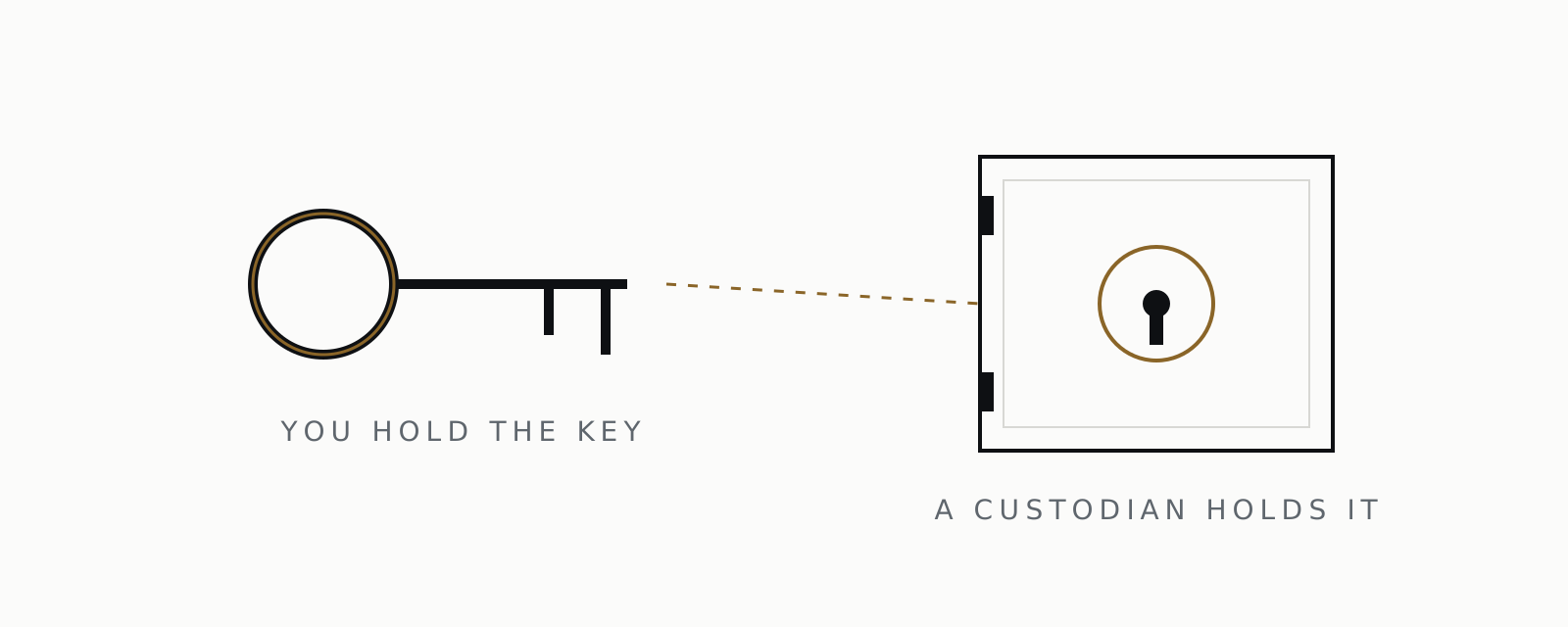
Custody in crypto is the holding of the private keys that control your coins — whoever holds the keys controls the assets. You can keep custody yourself (self-custody) or hand it to a licensed custodian, and the choice decides who can move, freeze or lose your USDT.
KEY FACTS
| Term | Custody — control of the private keys |
|---|---|
| Self-custody | You hold the keys (hardware or software wallet) |
| Custodial | A licensed third party holds the keys for you |
| Dubai regulator | VARA (outside the DIFC), licence VL/24/03/017 |
| Meridian flow | From ~100,000 USDT; your keys until settlement |
Source: VARA rulebooks and Meridian OTC published pricing bands, as of September 2026.
Self-custody vs custodial: who holds the keys?
Self-custody means you hold the private keys yourself, usually in a hardware or software wallet; custodial means a third party holds them for you. Self-custody removes counterparty risk but makes key loss permanent, while a custodian adds counterparty risk in exchange for professional controls.
The trade-off matters most at size. If you hold USDT to sell rather than to store long-term, our guide on selling USDT in Dubai with bank settlement shows where custody sits in that flow.
| Model | Who holds the keys | Main risk | If access is lost |
|---|---|---|---|
| Self-custody | You, in your own wallet | Lost seed phrase, theft of the device | No recovery — the coins are gone |
| Custodial | The custodian's systems | Custodian failure, freeze or hack | Account recovery process, if regulated |
Self-custody concentrates the risk in you; custodial spreads it to a counterparty you must be able to verify.
How does crypto custody work in the UAE?
In the UAE, crypto custody is a regulated activity, not a grey area. In Dubai outside the DIFC, the Virtual Assets Regulatory Authority (VARA) licenses custodians under a dedicated custody rulebook; the DIFC and Abu Dhabi's ADGM are covered by their own regulators, the DFSA and the FSRA.
VARA's custody rules require client assets to be segregated from the custodian's own holdings. Segregation means your coins sit in wallets separate from the firm's money, so they should not be available to the firm's creditors if the firm fails.
A licence is the starting point, not the finish line. Any provider you use should name its licence number; ours — VARA VL/24/03/017 — is linked from the licence section of our main page, and you can check any Dubai custodian in VARA's public register yourself.
Why does custody matter when you sell USDT?
When you sell USDT at an OTC desk, custody changes hands only for the settlement window. You keep your keys until you accept a written quote, transfer the agreed amount, and the desk wires AED to your own bank account — in our case the same business day by UAEFTS.
That window is where counterparty risk lives. A desk that settles the same day limits your exposure to hours; a desk that asks you to send coins and wait a few days extends it without adding anything for you.
Account approval happens before the trade, so paperwork does not stretch the custody window. The document list is in our onboarding section; approval takes one business day in most cases, and the flow starts from around 100,000 USDT. For what a legal end-to-end route looks like, see cashing out crypto in Dubai legally.
Worked example: selling 500,000 USDT from self-custody
Suppose you hold 500,000 USDT on a hardware wallet and want AED in your own account — the route our guide to cashing out from a hardware wallet follows. The figures below are illustrative, as of September 2026 — not a quote.
-
STEP 1
Before the trade: keys stay with you
The 500,000 USDT sits in your hardware wallet under your keys. The desk has no access to it at any point before settlement.
-
STEP 2
Quote accepted: custody still yours
You accept an all-in written price at a 0.15% spread, held for a defined window. The coins remain under your control until you choose to send.
-
STEP 3
Transfer: custody passes to the desk
You send 500,000 USDT on the agreed network and the desk confirms receipt on-chain. This is the one moment custody changes hands.
-
STEP 4
Settlement: custody ends in dirhams
At the 3.6725 peg, 500,000 USDT is AED 1,836,250; minus the 0.15% spread, AED 1,833,496 goes out by UAEFTS to your own-name account the same business day. Why the peg holds near 3.67 is covered in the USDT to AED rate guide.
Total time in the custodian's hands: one settlement window of a business day — not the days an exchange withdrawal queue can take.
What to ask a counterparty about custody
Five questions separate a verifiable setup from a promise:
- Where are client assets held during settlement — segregated client wallets or a pooled house wallet?
- Which licence covers the custody activity, and does it resolve in the regulator's public register?
- How long between on-chain receipt and the bank wire leaving?
- Which bank sends the wire, and does it go only to an account in your own name?
- What happens to client assets if the firm fails?
A regulated desk answers all five in writing. Silence on the first and last questions is itself the answer.
FAQ
Is self-custody safer than using a custodian?
Neither is automatically safer. Self-custody removes counterparty risk but makes a lost key or seed phrase a permanent loss. A licensed custodian adds counterparty risk but replaces key-loss risk with professional key management, insurance arrangements and segregation rules.
Does a VARA licence mean client assets are segregated?
For custody as a regulated activity, yes: VARA's rulebooks require client virtual assets to be held separately from the custodian's own assets. Check that the licence in VARA's public register actually covers custody before relying on this.
Do I give up custody of my USDT when I sell at an OTC desk?
Only during settlement. You keep your keys until you accept a written quote, then transfer the agreed amount to the desk; the desk wires AED to your own bank account the same business day, ending its custody of the coins.
What happens to my crypto if a custodian fails?
With proper segregation, client assets should not form part of the failed firm's estate and should be returned to clients. Without segregation, coins can be treated as the firm's property in insolvency — which is why segregation is the question to ask first.
Sell USDT with custody that ends the same day
Meridian OTC is a VARA-licensed Broker-Dealer in Dubai. You keep your keys until you accept a written quote; AED lands in your own account by UAEFTS the same business day. All-in spread 0.08–0.40% by size.
SOURCES
- VARA public register — licence status check, accessed 10 September 2026.
- VARA rulebooks — custody as a regulated activity and segregation requirements, accessed 10 September 2026.
- Central Bank of the UAE — payment systems (UAEFTS), accessed 10 September 2026.
- Meridian OTC published pricing bands and onboarding requirements — Meridian OTC published pricing bands, September 2026.
This guide is informational and is not legal, tax or investment advice, nor an invitation to buy or sell any virtual asset. Rules and figures are as of September 2026 — re-check the sources before acting. Virtual assets may lose their value in full or in part and are subject to extreme volatility.