
From hardware wallet to bank account: cashing out self-custody in the UAE
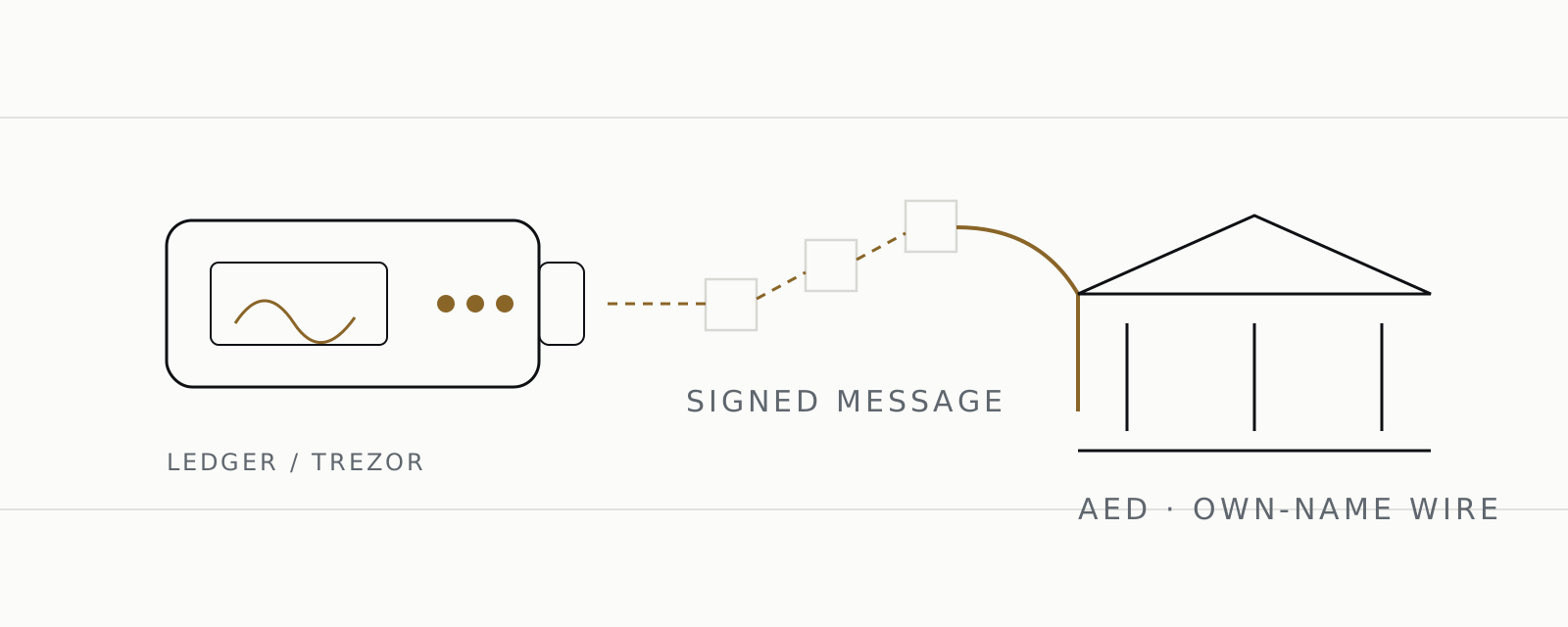
You can cash out crypto straight from a Ledger or Trezor to a UAE bank account through a VARA-licensed desk. The desk checks your identity, asks you to prove ownership by signing a message from your address, reviews where the coins came from, and wires AED to your own account the same business day.
KEY FACTS
| Ownership proof | Signed message from the sending address |
|---|---|
| Source of funds | Purchase records plus on-chain history |
| Meridian minimum ticket | From around 100,000 USDT |
| AED settlement | Same business day (UAEFTS) |
| USD settlement | 2–5 business days (SWIFT) |
Source: Meridian OTC onboarding and dealing practice, as of September 2026.
Can you cash out straight from a hardware wallet?
Cashing out crypto from a hardware wallet in the UAE works through a VARA-licensed OTC desk that accepts transfers directly from self-custody addresses. Account approval takes one business day in most cases, and you do not need to move the coins back to an exchange first. The desk verifies your identity, confirms you control the sending address and pays dirhams to your own bank account.
Self-custody changes one thing: there is no exchange to vouch for you. With a custodial account the platform's statements do half the compliance work; with a Ledger or Trezor you supply that evidence yourself, and the desk's checks replace the exchange's paper trail.
Legally, self-custody is not a special case in Dubai. VARA regulates the desk you trade with, not the wallet you hold, so the analysis in the legal route for cashing out crypto in Dubai applies unchanged — the counterparty's licence is what matters.
How do you prove ownership of a self-custody address?
Ownership of a self-custody address is proven by signing a message with the private key stored on the device. The desk gives you a short unique phrase — typically your name, the date and a reference code — and you sign it inside Ledger Live or Trezor Suite. The desk then verifies the signature against the address you will send from; no coins move and no keys are exposed.
The signature itself is a plain text string. You paste it into a form or send it to your dealer, and it authorises nothing on its own — the embedded date and reference make it useless anywhere else. Both Ledger and Trezor document message signing for Bitcoin and Ethereum addresses in their official support material.
Where wallet software does not support signing for a network — Tron is the common case for USDT — desks often fall back to a small test transfer from the address instead. Either way, the proof takes minutes, not days.
One rule protects you throughout: no legitimate desk ever asks for your seed phrase or PIN. A signing request is a text phrase to sign on the device — anything asking for your 24 words is theft, full stop.
What source-of-funds evidence does self-custody need?
Source of funds for self-custody crypto is documented with the records of how you acquired the coins, plus the on-chain history connecting them to your current address. Exchange statements, bank deposits from the original purchase, invoices for crypto income and block-explorer exports each cover a part of the trail. The full document map is in our source-of-funds guide; this section covers what is specific to hardware wallets.
A complete self-custody file contains four items:
- Original purchase records — an exchange statement or bank wire showing fiat going in.
- The withdrawal record — the transaction that moved coins from the platform to your address.
- An address list — every wallet you control, with one line on what each is for.
- Explorer exports — CSV history for the sending address, from the purchase to today.
The gap that fails files is the hop between platform and device. The withdrawal transaction id links the two worlds; a screenshot of a balance links nothing. If the buying platform has closed, your bank statement showing the original fiat transfer carries the weight instead.
Self-custody is not a red flag at a licensed desk. A clean chain from a documented purchase to your own address is stronger evidence than a custodial statement, because the chain cannot be edited after the fact.
How does a Ledger-to-bank cash-out work, step by step?
A cash-out from a hardware wallet to a UAE bank account has five steps: open and verify an account with a licensed desk, prove ownership of your address, pass the source-of-funds review, accept a written quote and send the coins, then receive the bank wire. An approved client completes the trading steps in one business day.
-
STEP 1
Open the account before trade day
You register once: passport and proof of address for an individual, licence and ownership documents for a company. Approval takes one business day in most cases, and doing it before you need the money is the single biggest speed-up available.
-
STEP 2
Sign the ownership message
The desk issues a unique phrase; you sign it on the device and return the signature. This takes minutes and happens before any coins move.
-
STEP 3
Pass the source-of-funds review
You submit the four-item file above. At Meridian a complete file is reviewed in one to two business days, as of September 2026; the waiting is usually for documents, not decisions.
-
STEP 4
Accept the written quote
You state the amount through the quote form or your dealer; the desk returns one all-in price held for a defined window. No partial fills, no drift between the quote and the fill.
-
STEP 5
Send the coins and receive the wire
You send from the proven address only after accepting the quote. AED goes out by UAEFTS the same business day; USD goes by SWIFT in 2 to 5 business days — always to an account in your own name.
How long does it take and what does it cost?
Cashing out from a hardware wallet in the UAE takes two to four business days end to end the first time, and one business day once your account is approved. The cost is the desk's spread: at Meridian 0.08% to 0.40% by ticket size, published on the pricing section of the main page, with no surcharge for receiving from a self-custody address.
| Stage | Typical time | What sets the pace |
|---|---|---|
| Account approval | 1 business day | Complete identity documents |
| Ownership proof | Minutes | Signing on the device |
| Source-of-funds review | 1–2 business days | Complete file, no gaps in the trail |
| Trade plus AED wire | Same business day | UAEFTS cut-off times |
| USD wire | 2–5 business days | SWIFT correspondent banks |
The calendar is set by compliance, not the blockchain: once the file is approved, the trade and the wire are a same-day event.
For orientation on cost: on 250,000 USDT, a 0.25% spread is 625 USDT — about AED 2,295 at the 3.6725 peg. On 1,000,000 USDT the 0.08% band costs 800 USDT. The spread is quoted in the price you accept, so there is nothing to add afterwards.
What slows a self-custody cash-out down?
The delays in a hardware-wallet cash-out come from five avoidable habits, and all of them are within your control:
- Sending from a brand-new address. A fresh wallet with no history raises exactly the question your old wallet answered — document one address and stick to it.
- No record of the original purchase. A closed exchange or a lost email account means reconstructing the fiat leg from bank statements, which takes days.
- Coins that touched a mixer or a flagged address. Chain analytics will see it; expect enhanced due diligence or a declined trade.
- Signing from the wrong address. The signature must match the address you send from, or the proof proves nothing.
- Asking for a third-party payout. Licensed desks settle to your own name only, and the request itself stalls the file.
The bottom line on self-custody cash-outs
A hardware wallet is not an obstacle to a bank settlement in the UAE — it just means you bring the evidence an exchange would have supplied. Sign the message, document the trail, keep the sending address stable, and the rest of the process is the standard one-day desk trade.
FAQ
Does signing a message move my coins or expose my keys?
No. A signed message is a text string produced inside the device: it moves no coins, reveals no keys and authorises no transaction. It only proves that whoever signed controls the private key for that address.
Can I cash out USDT held on Tron (TRC20) from a hardware wallet?
Yes. Licensed desks in Dubai accept TRC20 transfers from self-custody addresses. Where message signing is not available for a network, the desk may verify ownership with a small test transfer instead — confirm the method with your dealer before trade day.
What if I bought the coins on an exchange that no longer exists?
Reconstruct the trail from your bank statements showing the original fiat transfer, plus the on-chain history from the withdrawal transaction to your current address. Desks see closed-platform cases regularly; the bank side of the record is what rescues the file.
Can the desk pay the dirhams to a family member's account?
No. A VARA-licensed desk settles only to a bank account in your own name. Asking for a third-party payout stalls the file — and a desk that agrees to one is a red flag, not a favour.
Cash out from your Ledger or Trezor with same-day AED settlement
Meridian OTC is a VARA-licensed Broker-Dealer in Dubai. Self-custody accepted with a signed-message proof, all-in spread 0.08–0.40% by size, AED by UAEFTS the same business day once your account is approved.
SOURCES
- Ledger Support — message signing on Ledger devices, accessed 10 September 2026.
- Trezor Learn — signing and verifying messages on Trezor devices, accessed 10 September 2026.
- VARA public register — licence status check, accessed 10 September 2026.
- Meridian OTC onboarding practice and published pricing bands — this site, September 2026.
This guide is informational and is not legal, tax or investment advice, nor an invitation to buy or sell any virtual asset. Rules and figures are as of September 2026 — re-check the sources before acting. Virtual assets may lose their value in full or in part and are subject to extreme volatility.