
How a crypto OTC desk actually works
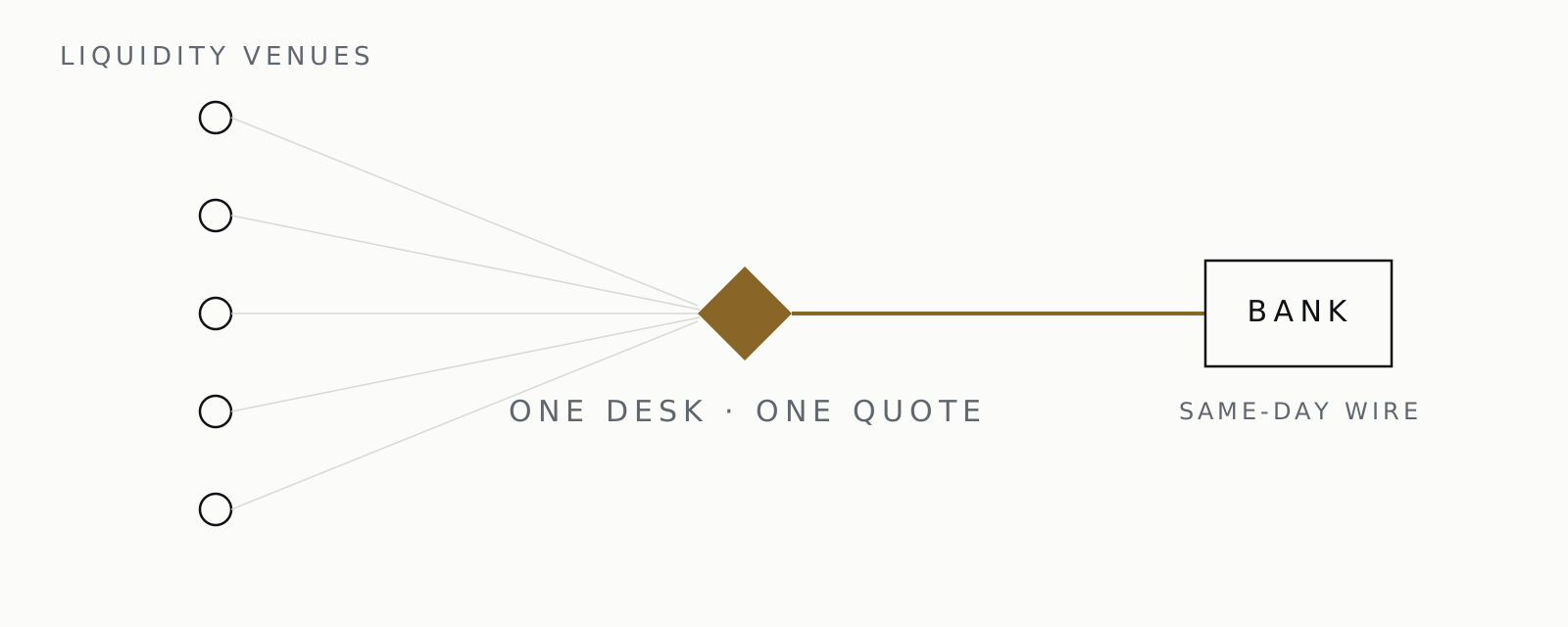
A crypto OTC desk quotes one all-in price for your full size: it sources liquidity from hedge venues or its own inventory, holds the rate for a short written window and settles fiat to your bank account. There is no public order book — you trade with a named dealer, not a matching engine.
KEY FACTS
| Trade model | Principal — the desk is your counterparty |
|---|---|
| Quoting | One all-in price per ticket (request-for-quote) |
| Meridian spread | 0.08%–0.40%, by ticket size |
| Typical minimum flow | From around 100,000 USDT |
| AED settlement | Same business day (UAEFTS) |
| USD settlement | 2–5 business days (SWIFT) |
| Payout rule | Own-name bank accounts only |
Source: Meridian OTC published pricing bands, as of September 2026.
What does a crypto OTC desk actually do?
A crypto OTC desk is a principal counterparty for large trades: it quotes you one price for your full ticket and fills you from its own balance sheet. Your order is never matched against other clients, and nothing about it appears in any public feed.
The desk earns the difference between the price it quotes you and what the fill costs it. In Dubai this is a regulated activity, not a grey zone: Meridian OTC operates as a VARA-licensed Broker-Dealer, and any desk's status can be checked in the regulator's public register in a minute.
Why is there no order book at an OTC desk?
An OTC desk has no order book because it is not matching buyers and sellers — it is the counterparty. A public book works well for small anonymous orders; at 1,000,000 USDT the visible depth is rarely enough, and walking the book moves the price against you before the fill completes.
The desk prices your whole ticket as one trade instead, and holds that price for a defined window stated in writing. From the moment you accept, the market risk of completing the trade belongs to the desk — slippage becomes its problem, not yours.
Where does the desk's quote come from?
A desk's quote starts from an index price aggregated across major trading venues, then adds the cost of hedging your specific size plus the desk's spread. The result is one number — at Meridian a dealer returns it within the hour during dealing time, Sunday to Thursday, 09:00–18:00 GST.
The hedge venues are the same large exchanges and market makers an institution would use; the desk simply has accounts, credit lines and size there that a private seller does not. Our spread — 0.08% to 0.40% by ticket size — is published in the pricing bands on the main page, so you can check the arithmetic before you call.
A worked example: on 1,000,000 USDT, a 0.25% spread costs AED 9,175. The rest of the quote barely moves, because USDT tracks the dollar and the dirham is pegged to it — why the USDT/AED rate sits at 3.67 is a separate explainer.
What is desk inventory, and when is it used?
Desk inventory is the stock of USDT and fiat the desk already holds on its own balance sheet. When your trade fits inside that stock, the desk fills you from inventory immediately and re-balances later; when it does not, the desk hedges on external venues first.
Either route is invisible to you, because the price is fixed at acceptance. The risk the desk carries between your acceptance and its hedge is real, and it is one of the things the spread pays for.
How does an OTC trade settle, step by step?
An OTC trade settles as an exchange of two legs: you send USDT on the agreed network, and the desk sends fiat to a bank account in your own name. AED goes out by UAEFTS the same business day you trade; USD goes by SWIFT and takes 2 to 5 business days.
| Stage | What happens | Typical time |
|---|---|---|
| Quote request | You state the amount; a dealer prices the full ticket | Within the hour, dealing time |
| Acceptance | Written all-in price, held for a stated window | Seconds to minutes |
| USDT transfer | You send on TRC20 or ERC20 to the desk's address | Once the network confirms |
| AED payout | UAEFTS to your own-name account | Same business day |
| USD payout | SWIFT to your own-name account | 2–5 business days |
The slowest leg is the banking rail, not the desk: AED clients see funds the same day because UAEFTS settles locally.
The own-name rule is not a preference, it is how a licensed desk keeps your settlement bankable: a wire arriving from a regulated counterparty, to an account in your name, is the version your bank does not question. The full legal frame sits in our guide to cashing out crypto in Dubai legally.
Why does the named dealer matter?
At a licensed desk every quote comes from an identifiable dealer who is accountable for the trade, not from an anonymous engine. That accountability is structural: VARA's Broker-Dealer regime puts record-keeping and market-conduct obligations on the firm behind every fill, as of September 2026.
Practically, you get one contact who knows your file from the account approval onward and can re-quote when the market moves mid-conversation. If something goes wrong, there is a person, a firm and a regulator — which is precisely what a Telegram counterparty cannot offer.
When is an OTC desk the wrong tool?
An OTC desk is the wrong tool below its minimum ticket: most licensed desks in Dubai start around 100,000 USDT, and smaller amounts are usually cheaper on a regulated exchange. It is also the wrong tool for anyone seeking anonymous flow — licensed dealing means identity checks at any size.
The mechanics of the exchange route, and when it beats the desk on cost, are covered in how to sell USDT in Dubai. The short version: below the desk minimum, take the exchange; at size, take the desk.
The bottom line on how OTC desks work
A crypto OTC desk replaces the order book with a firm, all-in quote and a named dealer who stands behind it. The mechanics are simple once seen from inside: price from the venues, fill from inventory or a hedge, settle by bank wire to your own account — and a licence number you can check before any of it.
FAQ
Is an OTC desk the same as an exchange?
No. An exchange runs a public order book and matches strangers; an OTC desk is a principal that quotes you a price and trades from its own balance sheet. Nothing you do at a desk is visible to other market participants.
How does a crypto OTC desk make money?
The desk earns the spread between the all-in price it quotes you and the cost of filling or hedging that trade. At Meridian OTC the spread is 0.08% to 0.40% by ticket size, built into the quote — there is no commission on top.
Is OTC crypto trading regulated in Dubai?
Yes. In Dubai, outside the DIFC, OTC dealing in virtual assets is a regulated activity under VARA's Broker-Dealer regime. Meridian OTC holds licence VL/24/03/017, verifiable in VARA's public register.
Can I negotiate the price at an OTC desk?
The spread band is set by ticket size, so the realistic negotiation is about size and timing, not haggling over a single trade. Larger tickets price at tighter bands, and a quote is always confirmed in writing before you send anything.
Get one firm price for your full ticket
Meridian OTC is a VARA-licensed Broker-Dealer in Dubai. All-in spread 0.08–0.40% by size, a named dealer on every quote, AED by UAEFTS the same business day once your account is approved.
SOURCES
- VARA public register — licence status check, accessed 10 September 2026.
- VARA rulebooks — Broker-Dealer regime, accessed 10 September 2026.
- Central Bank of the UAE — payment systems (UAEFTS), accessed 10 September 2026.
- Meridian OTC published pricing bands and dealing practice — this site, September 2026.
This guide is informational and is not legal, tax or investment advice, nor an invitation to buy or sell any virtual asset. Rules and figures are as of September 2026 — re-check the sources before acting. Virtual assets may lose their value in full or in part and are subject to extreme volatility.