
Source of funds for crypto in the UAE: what banks ask
Source of funds (SOF) is the evidence that the money behind your crypto is legitimate. UAE banks and licensed desks typically accept exchange statements, on-chain transaction history, sale agreements and income records. Prepare the file before you trade — most delays come from missing documents, not the trade itself.
KEY FACTS
| Who asks for SOF | UAE banks and VARA-licensed desks |
|---|---|
| Statement window usually requested | 6–12 months |
| Core evidence | Exchange statements, on-chain history, sale agreements |
| Settlement account | Own name only — no third parties |
| Meridian SOF review time | 1–2 business days for a complete file |
Source: Meridian OTC onboarding practice, as of September 2026.
What is source of funds for crypto?
Source of funds is the documented explanation of where the money behind a crypto position came from. In the UAE, banks and VARA-licensed desks ask for it before approving a large conversion or crediting a large incoming wire. The evidence is mundane — statements, contracts, transaction records — not opinions or assurances.
Source of funds covers one specific pot of money; source of wealth is the broader picture of how you built your net worth. Banks often ask for both on seven-figure flows. The identity documents sit in our onboarding checklist; this guide covers the money trail.
The question arrives twice. A licensed desk reviews the origin of client funds under VARA's compliance rulebook before it trades with you, and the receiving bank applies its own anti-money-laundering checks when the dirhams land. Of the two checks, the desk's comes first — and it is the one you can prepare for.
What do UAE banks actually ask for?
UAE banks ask for four kinds of source-of-funds evidence for crypto: exchange account statements, on-chain transaction history, sale or purchase agreements for one-off events, and income or business records. The exact list depends on the bank and on how the money was made.
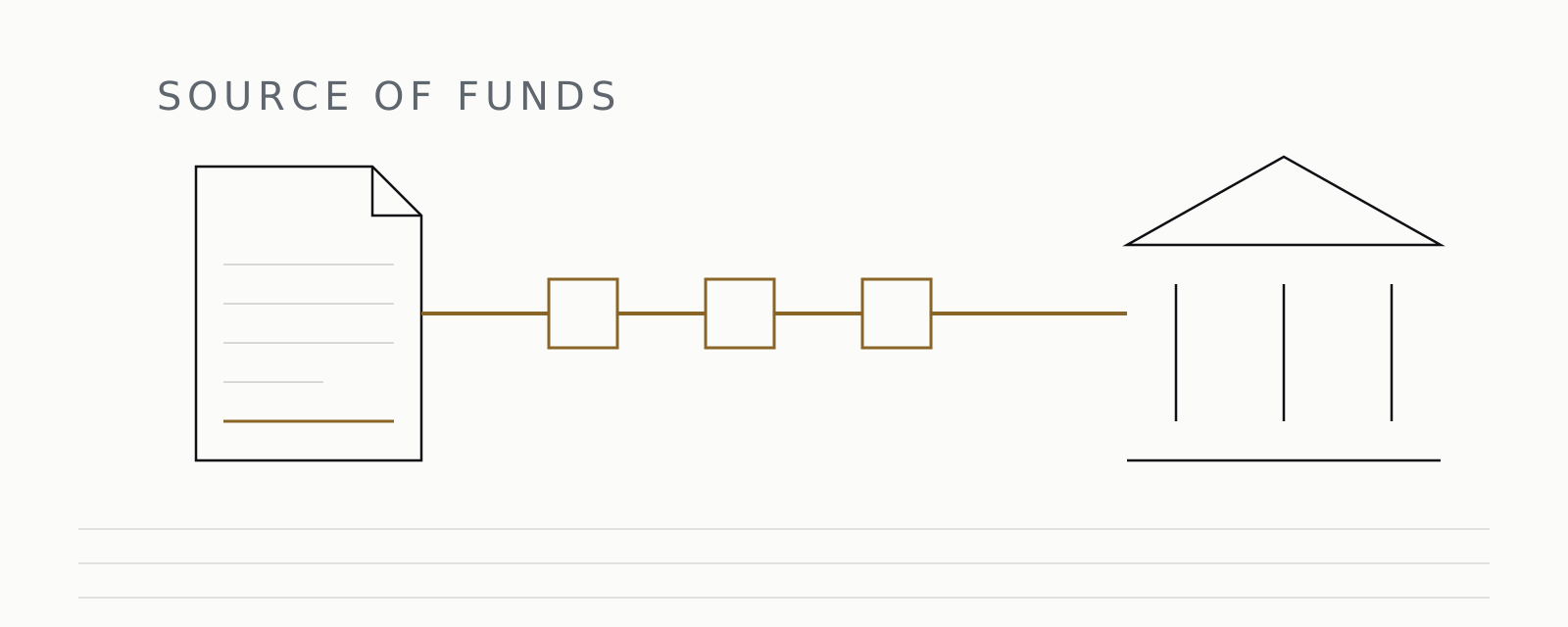
The common thread is provenance, not value. A reviewer wants to trace the dirhams arriving in your account back to a lawful origin, hop by hop: bank deposit to exchange, exchange to wallet, wallet to desk, desk back to bank. Every hop needs a record; gaps are where files fail.
Settlement route matters here. When you cash out through a licensed desk, the incoming wire arrives from a regulated company to your own-name account — the last hop answers itself. That is one reason the legal route to cash out crypto in Dubai runs through bank settlement rather than cash handovers.
Which documents fit each scenario?
The right source-of-funds document depends on how the crypto was acquired. A trader shows exchange statements, a long-term holder shows the original purchase, a contractor paid in crypto shows invoices. The table maps the five scenarios we see most at the desk, as of September 2026.
| Scenario | Primary document | Supporting evidence | Common gap |
|---|---|---|---|
| Trading profits on an exchange | Exchange statements, 6–12 months | Bank statement showing the original fiat deposit | Statements that hide the deposit history |
| Long-term holding (early purchase) | Original purchase records | On-chain history from the purchase wallet to today | A closed exchange that no longer issues statements |
| Income paid in crypto | Contracts and invoices | Wallet records matching invoice amounts | Payments from shared or anonymous wallets |
| Sale of property or business | Sale and purchase agreement | Bank proof of proceeds, then the crypto purchase records | A cash leg with no bank trail |
| Mining or staking rewards | Pool or staking payout records | On-chain reward history, equipment or pool contracts | Rewards mixed with later trading |
The pattern holds across scenarios: one primary document that proves the event, plus the records that connect it to the coins you sell today.
How do you document on-chain history?
On-chain history is documented with block-explorer exports for every wallet you control, from the acquisition transaction to the address you will send from. For USDT that usually means TronScan or Etherscan — one CSV per wallet, plus the transaction hashes of the original purchases.
A usable on-chain pack contains:
- A list of your wallet addresses, with one line on what each is for.
- Transaction hashes for the acquisitions, each tied to a document — a statement, an invoice, an agreement.
- Exchange deposit and withdrawal records, which bridge the on-chain and bank worlds.
Two habits weaken otherwise good files: moving coins through a brand-new wallet right before selling, and mixing unrelated coins in one address. A fresh wallet with no history raises exactly the question your old wallet answered.
Self-custody is not a problem by itself. A clean chain from a known purchase to your own wallet is stronger evidence than a screenshot of an app balance.
How do you prepare the file in advance?
Preparing a source-of-funds file takes a few hours spread over a week, and almost all of it can be done before you need to trade. At Meridian the review itself takes one to two business days once the file is complete; the waiting is usually for documents, not decisions.
-
STEP 1
Download statements now
Export exchange statements and bank statements for the past twelve months today. The same exports are the records UAE crypto tax rules expect you to keep even when no tax is due. Some exchanges throttle history exports or take days to issue stamped PDFs, and closed platforms may not respond at all.
-
STEP 2
Write a one-page money story
Half a page: where the money came from, when, and through which platforms it moved. A reviewer reads this first, and every number in it must match a document behind it.
-
STEP 3
Assemble the on-chain pack
One CSV per wallet, the address list and the acquisition hashes from the previous section. Label files so a stranger can follow them without you on the phone.
-
STEP 4
Match the settlement account
The receiving bank account must be in your own name — corporate funds to a corporate account. A licensed desk will not settle to third parties, so if you plan to sell USDT in Dubai, open the desk account a day before you need it.
Costs sit outside the SOF file but are worth knowing up front: our published spread bands run 0.08%–0.40% by ticket size, with AED settled the same business day by UAEFTS.
What gets source-of-funds evidence rejected?
Source-of-funds evidence fails for a short list of recurring reasons. None of them is about the amount; all of them are about the trail.
- Balance screenshots instead of official statements — a number without provenance.
- Statement windows that stop early: twelve months requested, three provided.
- Third-party accounts anywhere in the chain — a friend's exchange account, a relative's bank.
- Coins from mixers, gambling sites or unidentified P2P counterparties.
- A story that shifts between calls; inconsistency reads as a red flag, not a typo.
When a file fails, a desk declines or asks for more documents, and a bank can hold the incoming wire pending review. Answer queries fast, in writing, and with documents — verbal explanations do not enter the file.
What is the bottom line on crypto source of funds?
Crypto source of funds in the UAE comes down to one discipline: keep the records that connect your money to your coins, and assemble them before you trade. The paperwork is ordinary; the timing is what people get wrong.
Work only with counterparties whose status you can verify — our licence details are public, and any serious desk will show you the same. Prepare the file once, and every later trade is an execution question, not a compliance one.
FAQ
How far back should source-of-funds evidence go?
Most banks and desks ask for statements covering six to twelve months, plus the records for the event that created the money — a purchase, a sale, income — however old that event is. Early purchases need acquisition records, not twelve months of history.
Is a screenshot of my exchange balance enough proof?
No. Banks and licensed desks want official account statements — PDF or CSV exports with your name, the account identifier and transaction history. A screenshot shows a number, not a provenance, and is routinely rejected.
Does a licensed OTC desk replace the bank's checks?
No. The desk runs its own source-of-funds review under VARA rules before trading, and your bank may still review the incoming wire. Passing the desk's review first means the bank receives a clean own-name transfer with documentation behind it.
What if my crypto came from a source I cannot fully document?
Say so early. A desk can sometimes work with partial history — a closed exchange, for example — if the remaining chain is clean and consistent. Undocumented funds from mixers or anonymous P2P deals are usually declined outright.
Trade with your paperwork ready
Meridian OTC is a VARA-licensed Broker-Dealer in Dubai (VL/24/03/017). Send your source-of-funds file during onboarding — review runs one to two business days, then AED settles by UAEFTS the same business day you trade.
SOURCES
- VARA public register — licence status check, accessed 10 September 2026.
- FATF — Updated Guidance for a Risk-Based Approach to Virtual Assets and VASPs (October 2021), accessed 10 September 2026.
- Meridian OTC onboarding and source-of-funds review practice — this site, September 2026.
This guide is informational and is not legal, tax or investment advice, nor an invitation to buy or sell any virtual asset. Rules and figures are as of September 2026 — re-check the sources before acting. Virtual assets may lose their value in full or in part and are subject to extreme volatility.