
OTC desk vs exchange vs P2P in the UAE: the full comparison
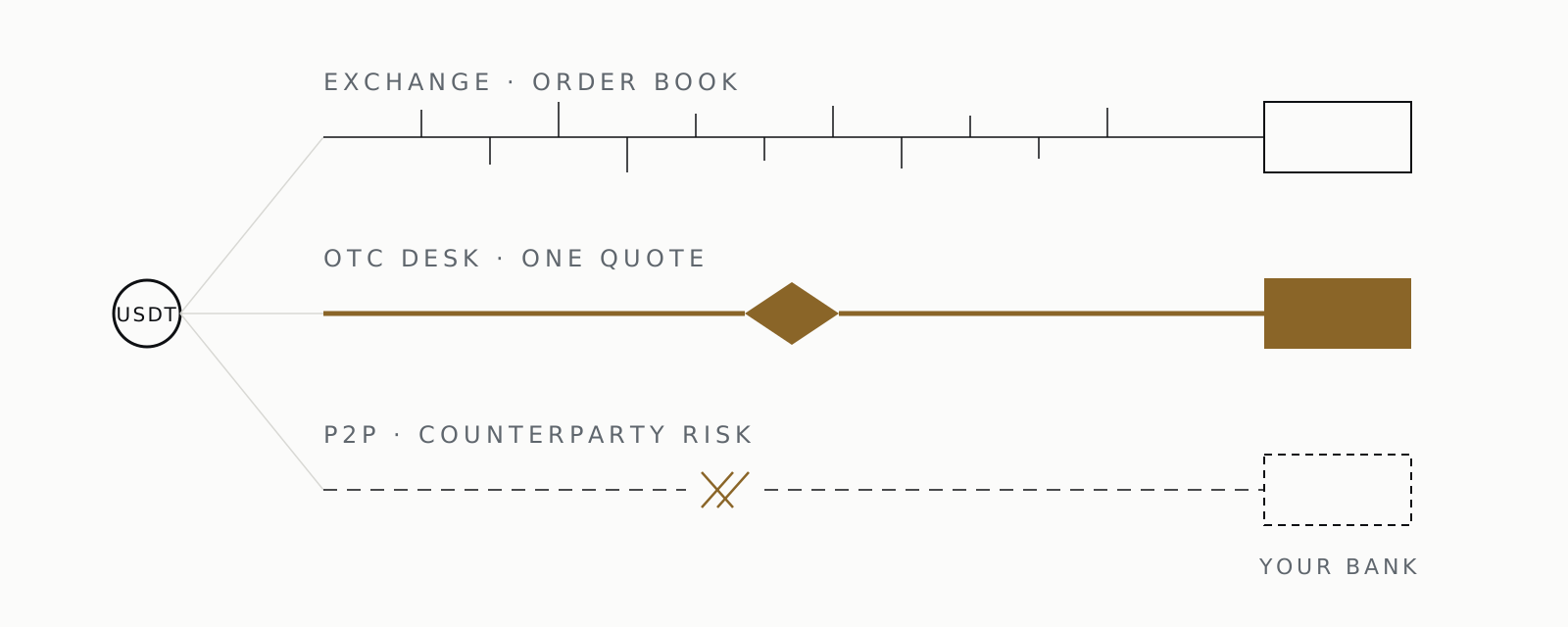
You can sell USDT in the UAE three ways: a licensed OTC desk, a regulated exchange, or a P2P platform. Above roughly 100,000 USDT the desk is cheaper, faster and leaves a clean paper trail; below that the exchange usually wins; P2P trades safety for speed.
KEY FACTS
| Routes compared | Licensed OTC desk, regulated exchange, P2P platform |
|---|---|
| Desk cost (market range) | 0.08%–0.50% all-in spread |
| Desk minimum ticket | From around 100,000 USDT |
| Desk AED settlement | Same business day (UAEFTS) |
| Exchange cost | 0.10%–1% plus withdrawal fees |
Source: Meridian OTC published pricing bands and exchange fee schedules, as of September 2026.
What are the three routes for selling USDT in the UAE?
The three routes for selling USDT in the UAE are a VARA-licensed OTC desk, a regulated crypto exchange with a bank withdrawal, and a P2P platform that matches you with a private buyer. All three are used in Dubai every day; they differ on cost, speed, limits and what your bank sees afterwards. An OTC desk quotes one all-in price for the whole ticket and pays from its own licensed entity to your account — our published spread bands run from 0.08% to 0.40% by size.
An exchange makes you work an order book and then withdraw dirhams to the bank. A P2P counterparty quotes their own spread and pays you directly — usually the widest cost and the weakest paper trail of the three.
How do the three routes compare on cost, speed and risk?
The comparison below is the short version of this whole guide. Ranges are indicative market figures, as of September 2026 — not quotes.
| Route | Realistic cost | Time to money | Limits in practice | Paper trail |
|---|---|---|---|---|
| Licensed OTC desk | 0.08% – 0.50% | Same business day (AED) | From ~100,000 USDT per trade | Bank wire from a licensed entity, own-name only |
| Regulated exchange | 0.10% – 1% + withdrawal fees | 1–3 business days | Daily withdrawal caps by verification tier | Exchange statement; large withdrawals can be reviewed |
| P2P platform | 0.5% – 2% | Minutes to hours | Whatever one counterparty accepts | Transfer from a stranger; reversible and freeze-prone |
On size the desk wins cost and speed together; below the desk minimum the exchange is cheaper; P2P is the expensive, risky outlier at any size.
How does each route set your price?
An OTC desk gives you one written quote for the full amount, held for a defined window — what you accept is what settles, with no partial fills. An exchange fills your order against the book, so a large market order walks the book down and the average fill lands below the top price. A P2P counterparty quotes their own spread, usually the widest of the three.
The baseline for all three is the same: the dirham has been pegged at 3.6725 per US dollar since 1997, and USDT tracks the dollar, so the USDT/AED rate barely moves. Everything you pay above the peg is the route's cost, not the market.
For orientation: on 1,000,000 USDT, a 0.25% desk spread costs AED 9,175 all-in. Selling the same size on an exchange at a 0.10% taker fee looks cheaper until slippage on a thin AED pair and the bank withdrawal fee are added — the gap typically closes or flips above a few hundred thousand USDT.
What limits apply on each route?
Licensed OTC desks in Dubai set a minimum ticket, usually around 100,000 USDT, because fixed costs — compliance review, bank wiring, dealer time — do not shrink with size. Exchanges cap daily withdrawals by verification tier, so a seven-figure exit can take several days of staged withdrawals. P2P has no formal limits, but each trade is capped by what one counterparty will actually fund.
The desk's limit is front-loaded: you clear onboarding once, with a passport and proof of address for an individual or corporate documents for a company, and the full list is in the onboarding section. After that, the per-trade limit is a conversation with your dealer, not a platform rule.
What can go wrong on each route?
Each route fails differently, and the failure modes matter more than the headline fee:
- P2P: counterparty fraud, a reversed or recalled bank transfer after you released the USDT, and a bank freeze when an unexplained third-party credit lands in your account.
- Exchange: withdrawal delays while compliance reviews a large cash-out, and account restrictions if your source-of-funds file is thin.
- OTC desk: the risk sits in choosing an unlicensed desk — no recourse, no regulated settlement, and the same bank questions as P2P when the wire arrives from an opaque entity.
The desk risk is the only one you can eliminate in one minute: ask for the licence number and check it against the VARA register. The wider fraud patterns are covered in our guide to crypto OTC scams in Dubai.
Which route fits your situation?
The right route is a function of ticket size and how your bank will read the incoming transfer:
- Under ~100,000 USDT, no urgency: a regulated exchange is usually cheapest, and the smaller withdrawal rarely triggers review.
- 100,000 USDT and above, or any deadline: a licensed desk — one quote, same-day AED by UAEFTS, and a wire your bank can match to a licensed counterparty. The mechanics of the trade itself are in our guide to selling USDT in Dubai step by step.
- Everyday amounts you could afford to wait on: P2P works, but price in the odds of a frozen transfer and a source-of-funds request before you call it the fast option.
If the amount is large and recurring — a business treasury, a property purchase, a relocation — the legal framing matters as much as the fee; the overview is in our guide to cashing out crypto in Dubai legally.
The bottom line on OTC vs exchange vs P2P
In the UAE the three routes are not rivals so much as tools for different sizes: exchange below the desk minimum, desk at and above it, P2P only where you accept counterparty risk as the price of speed. Whatever the route, the test that protects you is the same — a licensed counterparty and a settlement your bank can trace.
FAQ
Is an OTC desk cheaper than an exchange for a large USDT sale?
Above roughly 100,000 USDT, usually yes: a desk charges one all-in spread of 0.08%–0.50%, while an exchange adds taker fees, order-book slippage and withdrawal costs on size. Below that threshold the exchange is normally the cheaper route.
Is P2P crypto trading legal in the UAE?
P2P platforms operate in the UAE, but the person sending you dirhams is a private counterparty, not a licensed entity. Selling virtual assets as a business requires a VARA licence in Dubai; a one-off sale to a stranger carries bank-review risk rather than clear illegality.
Why do UAE banks question P2P transfers?
An inbound transfer from an unrelated third party with no invoice or contract behind it looks like unexplained money flow. UAE banks can freeze the credit and request source-of-funds documents, which a private P2P counterparty cannot provide.
How fast is each route, end to end?
A licensed desk pays AED by UAEFTS the same business day once your account is approved. An exchange takes 1–3 business days including the bank withdrawal. P2P settles in minutes to hours, unless a bank review adds days afterwards.
Price the desk route on your actual size
Meridian OTC is a VARA-licensed Broker-Dealer in Dubai. All-in spread 0.08–0.40% by ticket size, AED by UAEFTS the same business day once your account is approved. One written quote tells you exactly where the desk lands against your exchange or P2P alternative.
SOURCES
- VARA public register — licence status check for any desk, accessed 10 September 2026.
- Central Bank of the UAE — payment systems (UAEFTS), accessed 10 September 2026.
- Binance spot trading fee schedule — reference for exchange taker fees, accessed 10 September 2026.
- Meridian OTC published pricing bands and onboarding requirements — this site, September 2026.
This guide is informational and is not legal, tax or investment advice, nor an invitation to buy or sell any virtual asset. Rules and figures are as of September 2026 — re-check the sources before acting. Virtual assets may lose their value in full or in part and are subject to extreme volatility.