
What is a seed phrase? The master key to your crypto wallet
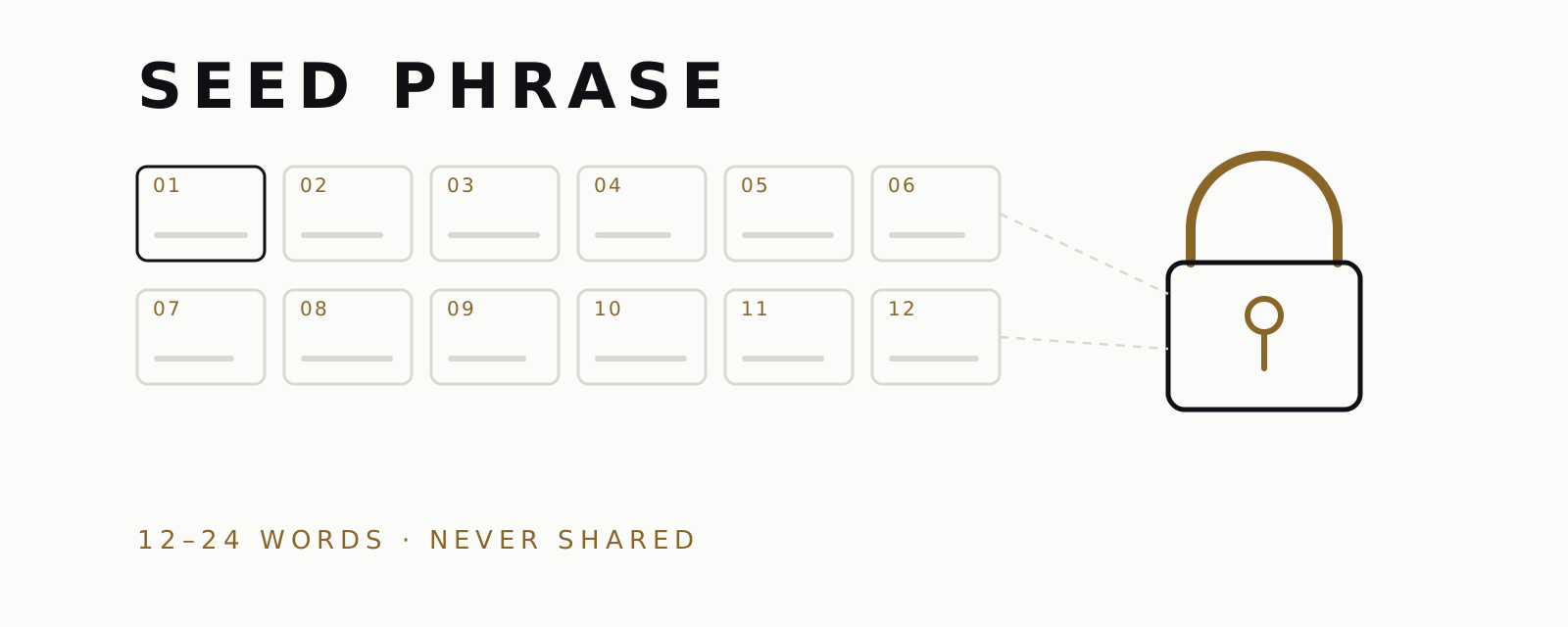
A seed phrase is a list of 12 to 24 words, generated by your crypto wallet, from which every private key in that wallet can be derived. Anyone who knows the phrase controls the funds — which is why no legitimate desk, bank or regulator will ever ask you for it.
KEY FACTS
| What it is | A 12–24 word master key that derives every private key in a wallet |
|---|---|
| Standard | BIP-39, from a fixed list of 2,048 English words |
| Whoever holds it | Controls 100% of the funds, from anywhere in the world |
| Correct storage | Offline — paper or steel, never photographed or cloud-synced |
| Desk rule | A licensed desk never asks for it — only for a public address and your documents |
Source: BIP-39 specification and Meridian OTC dealing practice, as of September 2026.
How does a seed phrase work?
A seed phrase works as the single root from which a wallet derives all of its private keys. The standard behind it, BIP-39, picks 12 or 24 words from a fixed list of 2,048 English words, and the same phrase restores the same wallet on any compatible device or app.
The words are not the password to an account; they are the account. This reality shapes every step of moving from a hardware wallet to a UAE bank account: there is no company holding a backup and no reset procedure.
The standard is global, so nothing changes when you relocate to the UAE: the same phrase imports the same wallet onto a new device in Dubai. Portability that is convenient for you is equally convenient for anyone who obtains the words.
What are the safety rules for a seed phrase?
The safety rules for a seed phrase come down to one principle: the phrase exists only offline and only with you. Write it on paper or stamp it into steel, keep copies in two separate secure locations, and never type it into a website, photograph it or store it in cloud notes.
- Write the 12 or 24 words on paper or steel; two copies, two separate locations.
- Never photograph, email, cloud-sync or type the phrase into any website or "verification" form.
- Never say it to anyone: not support, not a desk, not a regulator. No legitimate party needs it.
- Test the backup by restoring a small amount before trusting it with size.
- Store the phrase separately from the device it restores — a fire that takes one should not take both.
- Decide who can reach it after you: sealed instructions belong in any plan for crypto inheritance in the UAE.
The most common failure is convenience, not a cracked device: a photo in a phone gallery or a note in a synced app silently copies the phrase to every device and backup you own. One leaked image is full control of the wallet.
Why does a seed phrase matter when you sell USDT?
A seed phrase matters when you sell USDT because phishing aimed at large sellers almost always ends with a request for the phrase. A licensed OTC desk needs only your documents and a public receiving address to settle the trade — it never needs your seed phrase, your private keys or a "wallet verification" signature.
The desk's checks are identity checks, not wallet checks: passport, proof of address and, at size, source-of-funds evidence — the full list sits in our onboarding section. A "dealer" on a messenger who asks you to sync, validate or verify your wallet by entering the phrase is running the oldest script in the OTC scam patterns seen in Dubai.
A real desk gives you a VARA licence number you can check in the public register and settles to an account in your own name — ours is linked from the licence section of the main page. A counterparty that asks for your phrase instead has told you everything you need to know.
What does one leaked phrase cost? A worked example
Take a wallet holding 400,000 USDT — about AED 1,469,000 at the 3.6725 peg, as of September 2026. Selling it through a licensed desk at a 0.25% spread costs AED 3,672.50; typing the seed phrase into a fake "verification" page costs the full AED 1,469,000, with no chargeback and no recourse.
The asymmetry is the point: the spread is the entire cost of the legitimate route, while the fraudulent route takes everything.
For calibration: as of September 2026, Meridian OTC's published spread of 0.08% to 0.40% by ticket size is the full fee on a trade, and the desk asks for your documents and your public address — never for your seed phrase.
FAQ
Is a seed phrase the same as a private key?
Not exactly. A private key controls one address; the seed phrase is the root from which the wallet derives every private key it contains. Whoever holds the phrase can recreate all the keys, so it needs the stronger protection.
Will an OTC desk or a bank ever ask for my seed phrase?
Never. A licensed desk needs your identity documents and a public wallet address to settle a trade — nothing more. Any request for the phrase, the private keys or a "wallet sync" is a fraud attempt, whoever appears to be asking.
What happens if I lose my seed phrase?
The wallet becomes unrecoverable the moment the device holding it fails, and no company can reset it. This is why the backup is made before the wallet holds meaningful value and stored in two separate physical locations.
Can I change my seed phrase?
No — the phrase is bound to the wallet's keys and cannot be edited. The way to change it is to generate a new wallet with a new phrase and move the funds, which is also the correct response if you suspect yours was exposed.
Sell USDT without ever sharing your seed phrase
Meridian OTC is a VARA-licensed Broker-Dealer in Dubai. We settle to a bank account in your own name and need your documents and a public address — never your phrase. All-in spread 0.08–0.40% by size, published openly.
SOURCES
- BIP-39 — Mnemonic code for generating deterministic keys — the 12/24-word standard and the 2,048-word list, accessed 11 September 2026.
- VARA public register — licence status check, accessed 11 September 2026.
- Meridian OTC onboarding requirements and published pricing bands, September 2026.
This guide is informational and is not legal, tax or investment advice, nor an invitation to buy or sell any virtual asset. Rules and figures are as of September 2026 — re-check the sources before acting. Virtual assets may lose their value in full or in part and are subject to extreme volatility.