
What is an OTC desk?
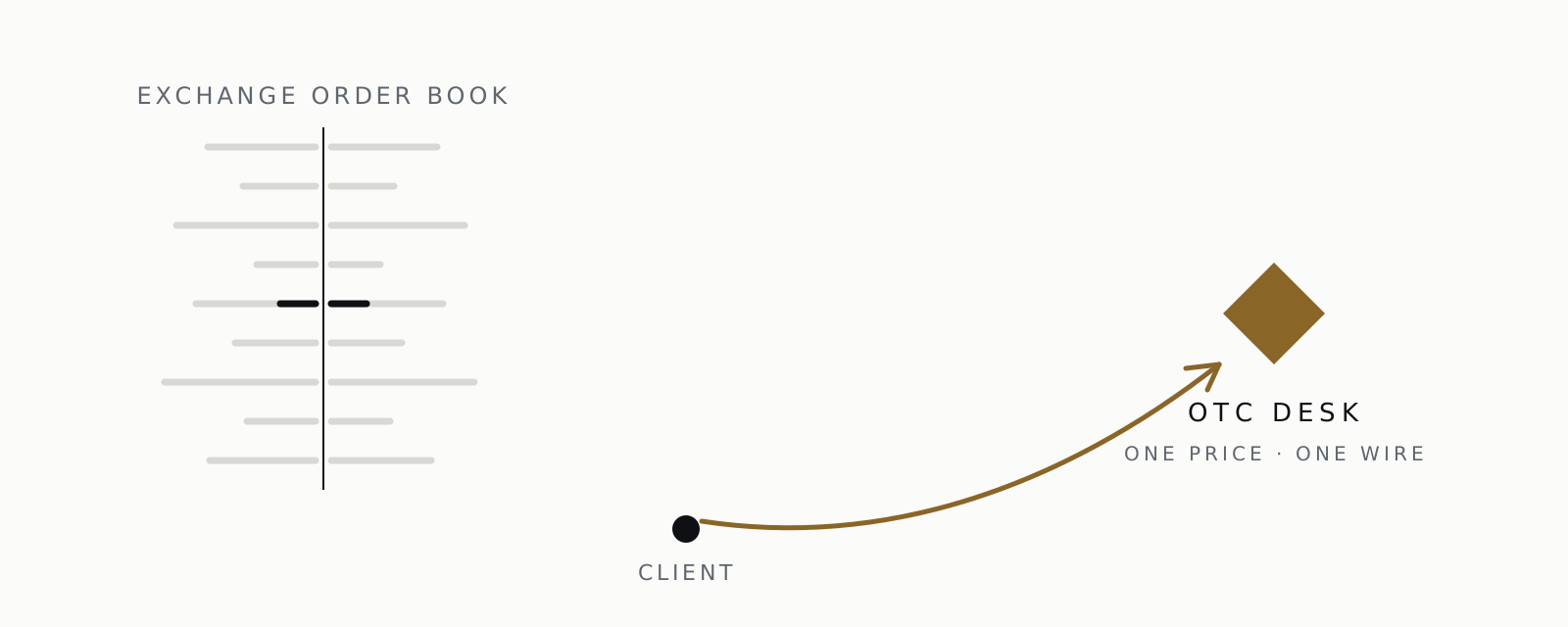
An OTC desk is a trading service that buys and sells large amounts of cryptocurrency directly with a client, off the public exchange order book. You agree one fixed price with a dealer, then settle by bank transfer. In Dubai, OTC desks dealing in virtual assets are licensed by VARA.
KEY FACTS
| Full name | Over-the-counter (OTC) desk |
|---|---|
| Regulator in Dubai | VARA (outside the DIFC) |
| Typical minimum ticket | From around 100,000 USDT |
| Meridian spread | 0.08%–0.40%, by ticket size |
| AED settlement | Same business day (UAEFTS) |
| USD settlement | 2–5 business days (SWIFT) |
Source: Meridian OTC published pricing bands, as of September 2026.
How is an OTC desk different from an exchange?
An exchange matches thousands of small public orders on an order book; an OTC desk quotes one price for your whole amount, directly to you. On an exchange a large market order walks the book and moves the price against you. At a desk the quoted price is the fill price.
The difference shows up on size. When selling USDT in Dubai in six figures, one market order eats through the visible bids and each fill is worse than the last. A desk prices the whole ticket once, so you know the exact AED amount before you send anything.
| Attribute | Regulated exchange | Licensed OTC desk |
|---|---|---|
| Price discovery | Public order book | One written quote |
| Price on a large order | Slippage as the order walks the book | Fixed for the full amount |
| Practical minimum | None | Around 100,000 USDT |
| Settlement to a UAE bank | Withdrawal, 1–3 business days | AED same business day (UAEFTS) |
On small amounts the exchange is cheaper and simpler; on six-figure tickets the desk removes slippage and the withdrawal queue. For a three-way view including P2P, see the OTC vs exchange vs P2P comparison.
How does an OTC desk work in the UAE?
An OTC desk in the UAE works as a licensed principal trader. You open an account, request a quote for your amount, accept it in writing, send the crypto and receive a bank wire to an account in your own name. In Dubai the desk must hold a VARA licence to do this legally.
The licence is the first thing to check. Ask the desk for its licence number and look it up in VARA's public register; ours is linked from the licence section of the main page. A desk that will not name its regulator is not a desk, it is a stranger with a rate.
The trade itself has four steps:
-
STEP 1
Open the account
Passport and proof of address for an individual, licence and ownership documents for a company; approval usually takes one business day. The full document list is in the onboarding section.
-
STEP 2
Request a quote
You state the amount and receive one all-in price, held for a defined window in writing. No partial fills, no drift between quote and fill.
-
STEP 3
Send the crypto
You send only after accepting the written quote, on the agreed network (TRC20 is the common USDT rail in the UAE). If you send from an exchange account, the exchange and the desk pass travel-rule identity data between themselves behind the scenes.
-
STEP 4
Receive the wire
AED goes out by UAEFTS the same business day you trade; USD goes by SWIFT in 2 to 5 business days. A licensed desk pays only to an account in your own name.
Who is an OTC desk for in the UAE?
An OTC desk suits anyone converting from around 100,000 USDT per trade: investors exiting a large position, companies moving treasury in or out of crypto, and property buyers funding a deposit from digital assets. Below that size the desk minimum makes a regulated exchange the cheaper route.
The common thread is size plus a need for a paper trail. A six-figure conversion has to land in a bank account with documentation the bank will accept, and a licensed desk provides exactly that.
Why does an OTC desk matter when selling USDT?
USDT tracks the US dollar and the dirham is pegged at 3.6725, so the USDT to AED rate barely moves; what you actually control is the cost of converting. That cost is the spread. We publish ours — 0.08% to 0.40% by ticket size — in the pricing section, as of September 2026.
The second reason is settlement quality. Selling through a licensed desk ends with a wire from a regulated entity to your own account, which is the version of events your bank wants to see.
Example: selling 250,000 USDT through an OTC desk
A client sells 250,000 USDT in September 2026. The desk quotes the peg minus a 0.20% spread: gross 250,000 × 3.6725 = AED 918,125, cost AED 1,836, net AED 916,289 wired by UAEFTS the same business day.
The same ticket sold as one market order on an exchange could plausibly lose 0.30%–0.50% to slippage — AED 2,754 to AED 4,591 — before withdrawal fees and a 1–3 day wait. The slippage range is illustrative, not measured; the desk quote, by contrast, is a fixed number in writing before you commit.
FAQ
Is an OTC desk legal in Dubai?
Yes — dealing virtual assets over the counter is a regulated activity in Dubai when the provider holds a VARA licence. Check the licence number in VARA's public register; Meridian OTC's is VL/24/03/017.
What is the minimum amount an OTC desk takes?
Most licensed desks in Dubai start at around 100,000 USDT per trade. Below that size a regulated exchange is usually the cheaper route.
How quickly does an OTC desk pay out?
Once your account is approved, AED goes out by UAEFTS the same business day you trade. USD goes by SWIFT and takes 2 to 5 business days. Payment goes only to an account in your own name.
Is an OTC desk the same as a broker?
In practice, yes: a licensed OTC desk is a broker-dealer that trades with you as principal. The OTC part simply means the trade happens off the public exchange order book.
Trade through a licensed OTC desk
Meridian OTC is a VARA-licensed Broker-Dealer in Dubai (VL/24/03/017). All-in spread 0.08–0.40% by size, published openly. AED by UAEFTS the same business day once your account is approved.
SOURCES
- VARA public register — licence status check, accessed 10 September 2026.
- Central Bank of the UAE — payment systems (UAEFTS), accessed 10 September 2026.
- Meridian OTC published pricing bands and onboarding requirements, September 2026.
This guide is informational and is not legal, tax or investment advice, nor an invitation to buy or sell any virtual asset. Rules and figures are as of September 2026 — re-check the sources before acting. Virtual assets may lose their value in full or in part and are subject to extreme volatility.