
Moving crypto wealth to the UAE: from residency to bank settlement
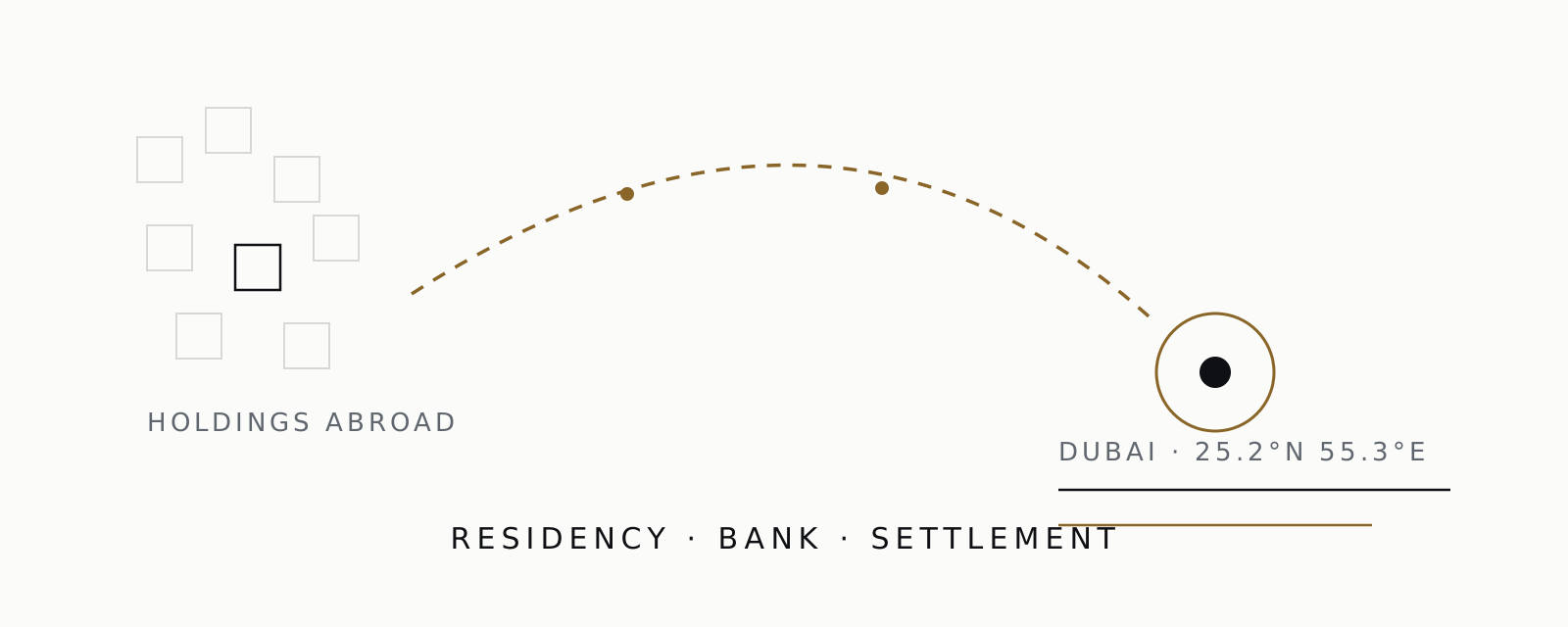
Moving crypto wealth to the UAE works in a fixed order: secure residency and an Emirates ID, open a bank account, document where the money came from, and only then convert. The coins cross no border — the scrutiny happens at the bank and the dealing desk.
KEY FACTS
| Personal income tax on crypto gains | 0% — the UAE has no personal income tax |
|---|---|
| Residency anchor for banking | Residence visa + Emirates ID |
| Golden Visa, investor route | 10 years; real estate from AED 2,000,000 |
| Typical desk minimum | From around 100,000 USDT |
| Conversion cost at Meridian | 0.08%–0.40% spread, by ticket size |
| AED settlement | Same business day (UAEFTS), own-name account only |
Source: UAE Government portal; Meridian OTC published pricing bands, as of September 2026.
Do you need UAE residency before moving crypto wealth?
You do not need UAE residency to hold crypto, but you effectively need it to bank crypto proceeds in the UAE. Banks open full resident accounts against an Emirates ID, and a licensed desk settles only to an account in your own name — so residency is the first domino, not an optional extra.
The three common residency routes are employment, company formation and the Golden Visa. For investors the usual door is the 10-year Golden Visa against real estate from AED 2,000,000, as of September 2026 — the current thresholds are on the UAE Government portal and move, so re-check before you plan around them.
Selling while still a non-resident is lawful — the legal route to cashing out crypto in Dubai does not require citizenship. But without a UAE account the proceeds settle abroad, which recreates the cross-border problem you relocated to solve.
How do you open a UAE bank account as a crypto holder?
A UAE resident account is opened in person with a passport, residence visa and Emirates ID; for crypto-derived wealth the bank adds a documented source of funds. Approval runs from a few working days to several weeks for crypto profiles, depending on the bank and the quality of the file.
Appetite differs by institution. The large local banks — FAB, Emirates NBD, ADCB, Mashreq — all onboard crypto-adjacent clients case by case, and digital banks such as Wio serve residents with smaller balances. A salary or a local business helps, but a documented asset file is what the decision turns on.
The bank is not judging crypto as an asset class; it is judging documentation quality. A chronological file showing where the coins came from moves you forward; a wallet address and a shrug moves you to the exit.
How do you prove source of funds earned abroad?
Source of funds is proven with documents from the country where the wealth was created: exchange account statements, on-chain history, purchase records and the paper trail of the original money that bought the crypto. UAE banks accept foreign documents; what they do not accept is an undocumented gap.
The file varies with the origin of the wealth. The common cases:
| Source of wealth | Core documents | Common gap |
|---|---|---|
| Exchange trading profits | Account statements, trade-history export | Unlabelled fiat deposits into the exchange |
| Early coins held long-term | Original bank transfer to the exchange, wallet history | Peer-to-peer purchases years ago with no record |
| Business or property sale | Sale agreement, proof of proceeds, conversion record | Conversion run through an unlicensed broker |
| Salary and savings | Employment contract, payslips, bank statements | Savings already mixed with trading proceeds |
The pattern is the same in every row: the bank wants the story on paper, from the first dollar or euro to the wallet you will settle from.
Documents outside English or Arabic may need certified translation, and home-country tax returns strengthen the file even where no tax was due. Build the file before you fly — assembling it from Dubai, across time zones and closed foreign accounts, is the slow version.
Does crypto cross a border when you move to the UAE?
Crypto crosses no border when you move to the UAE: the coins sit on the network, not in a country, so relocation moves you and your keys. There is no customs declaration for a wallet and no UAE capital control on inbound crypto, as of September 2026.
The border you actually cross is the first conversion onshore. The moment USDT becomes AED in a UAE bank account, the desk's KYC and the bank's source-of-funds review apply — that is the checkpoint, and it is a document checkpoint, not a luggage one.
Keep the move quiet and simple: update your address at the exchanges you use, carry your hardware wallet as personal effects and leave the coins where they are until the account exists. There is no prize for moving coins early.
What does the first conversion in the UAE look like?
The first conversion in the UAE is a standard OTC trade with the homework already done: the desk onboards you on the same file the bank saw, quotes one all-in price, takes your USDT and wires AED to your own account the same business day. Bitcoin follows the same steps, with a fixed written quote absorbing the price move.
-
STEP 1
Onboard at the desk in parallel with the bank
The document list — passport, visa, proof of address, source of funds — is the one in our onboarding section, and it overlaps almost fully with the bank's file. Desk approval takes one business day in most cases, so run both processes at once.
-
STEP 2
Agree the size and take a written quote
State the amount; the desk returns one all-in price held for a defined window. For a relocation conversion, say the full size upfront — the spread band improves with the ticket, and a dealer prices 2,000,000 USDT better than the same amount in eight pieces.
-
STEP 3
Send USDT on the agreed network
TRC20 is the common rail in the UAE; ERC20 works too. Send only after accepting the written quote, and expect a small test transfer first if the wallet is new to the desk.
-
STEP 4
Receive AED in your own account
AED goes out by UAEFTS the same business day you trade; USD goes by SWIFT and takes 2 to 5 business days. Settlement is own-name only — the full sell-side mechanics are in our guide to selling USDT in Dubai.
Note the order dependency: the desk pays only to an account in your own name, so conversion comes after the bank account exists. That is why the whole relocation sequences as residency → bank → conversion, and not the other way round.
How much does the relocation conversion cost?
The relocation conversion costs the desk's spread on top of the 3.6725 dollar peg — the dirham has been fixed to the US dollar since 1997, which is why the USDT/AED rate barely moves. Meridian publishes the band — 0.08% to 0.40% by ticket size — in the pricing section, with a calculator that turns the band into money at your size.
A worked example: on a 2,000,000 USDT conversion priced at 0.15%, the spread is 3,000 USDT — about AED 11,018 — as the full cost of turning the holding into dirhams the same business day. A retail exchange at that size costs more in slippage and withdrawal friction, and the money lands days later.
If you want to test the rails first, run one ticket near the desk minimum of around 100,000 USDT and let your bank see the documented flow once. The main amount moves more easily behind a clean precedent.
What are the common mistakes when moving crypto wealth to the UAE?
The mistakes we see from the dealing side, in order of how often they cost the client a quarter:
- Converting before the bank account exists. Proceeds have no own-name account to land in, and a licensed desk will simply refuse the trade.
- Arriving with undocumented early coins. If the 2017 purchase left no record, say so and build the file around what exists — never invent invoices, for a bank or for a desk.
- Trying to settle into a relative's or a company's account. Desks refuse third-party settlement; banks flag it. A company can sell, but only through its own corporate account.
- Choosing a desk by rate alone. Check the licence number in the VARA public register first — ours is linked from the licence section of the main page.
- Assuming UAE residency erases home-country tax. Tax residence is a separate question with its own tests; take advice on the exit side before you convert, not after.
The bottom line on moving crypto wealth to the UAE
Moving crypto wealth to the UAE is a sequencing problem, not a trading problem: residency first, bank second, conversion third. The coins need no visa and cross no border — what crosses a review is the money at the end. Build the source-of-funds file before you fly, and the first conversion becomes a same-day wire instead of a three-month correspondence.
FAQ
Can I open a UAE bank account before becoming a resident?
Some banks offer non-resident accounts with higher minimum balances and fewer features, as of September 2026. For crypto-derived wealth the resident route — visa, Emirates ID, then account — is materially easier and is the order this guide assumes.
Do I pay tax on crypto gains in the UAE?
The UAE levies no personal income tax, so an individual's crypto gains are not taxed federally, as of September 2026. Your previous country of residence may still tax you until your tax residence changes — take advice on the exit side before converting.
Will a UAE bank ask where my crypto came from?
Yes. Banks are required to understand source of funds and source of wealth, and crypto profiles get the fullest version of that review. Arrive with exchange statements, on-chain history and the record of the original money that bought the coins.
Can I convert crypto before my UAE bank account is open?
A licensed desk settles only to an account in your own name, so a conversion before the account exists would have to settle abroad. Practically, open the account first; the desk onboarding can run in parallel and takes about one business day.
Convert with same-day AED settlement
Meridian OTC is a VARA-licensed Broker-Dealer in Dubai. All-in spread 0.08–0.40% by size, published openly. AED by UAEFTS to your own account the same business day once you are approved.
SOURCES
- UAE Government portal — residence visas, accessed 10 September 2026.
- VARA public register — licence status check, accessed 10 September 2026.
- Central Bank of the UAE — payment systems (UAEFTS), accessed 10 September 2026.
- Meridian OTC published pricing bands and onboarding requirements — Meridian OTC published pricing bands, September 2026.
This guide is informational and is not legal, tax or investment advice, nor an invitation to buy or sell any virtual asset. Rules and figures are as of September 2026 — re-check the sources before acting. Virtual assets may lose their value in full or in part and are subject to extreme volatility.