
What is a blockchain confirmation?
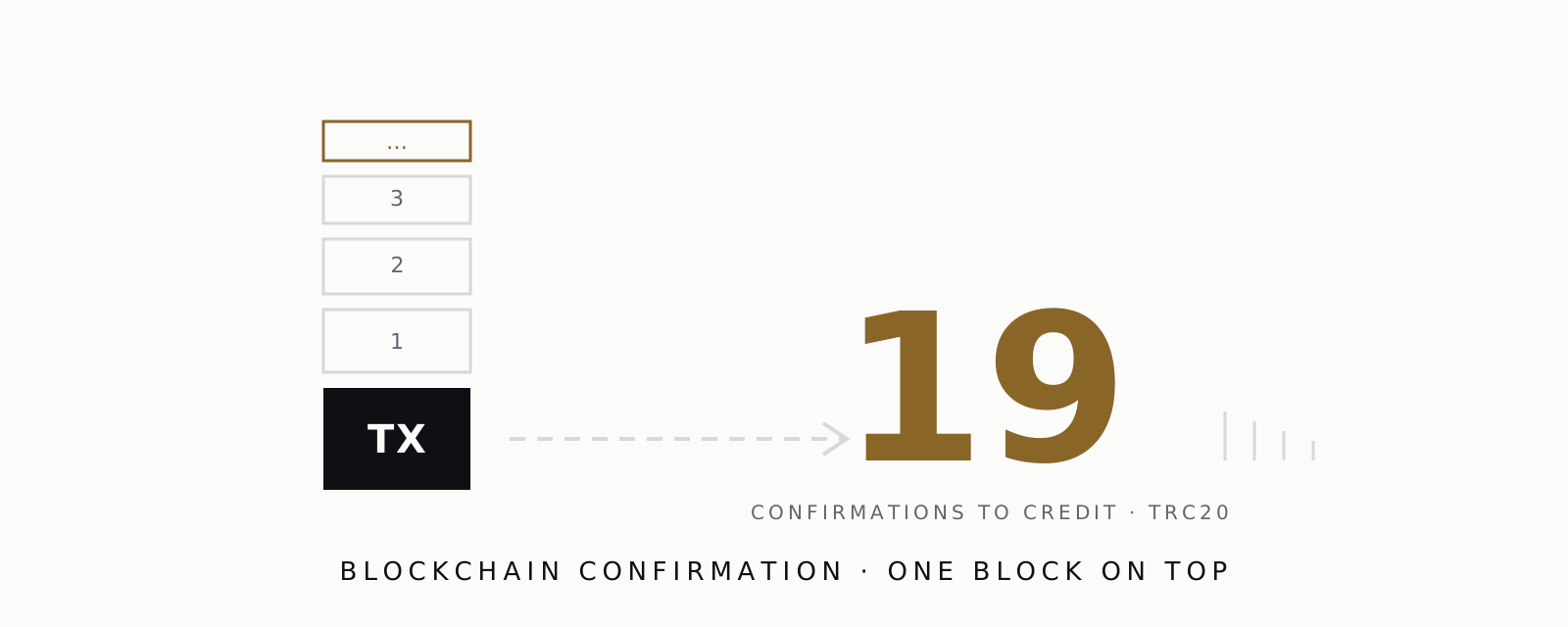
A blockchain confirmation is one block added to the chain after the block that contains your transaction. Each new block is another confirmation and makes a reversal less likely. A desk credits your transfer only after a set count (about 19 on Tron, 12 on Ethereum), and only then does the payout clock start.
KEY FACTS
| Term | Blockchain confirmation — one block added after your transaction's block |
|---|---|
| Zero confirmations | Broadcast to the network, not yet in a block |
| TRC20 (Tron) | 19–20 confirmations, about 1 minute (3-second blocks) |
| ERC20 (Ethereum) | 12 confirmations (~3 minutes); protocol finality ~13 minutes |
| Payout trigger | The desk's threshold — not your wallet's "sent" status |
| AED after threshold | Same business day (UAEFTS); USD 2–5 days (SWIFT) |
Source: TRON and Ethereum documentation and Meridian OTC published terms, as of September 2026.
What counts as a confirmation?
A blockchain confirmation counts from the moment your transaction lands in a block — that is confirmation one, and every block on top adds another. Enough blocks, and reversal stops being practical: the point desks call settlement finality.
The count matters because each additional block makes a chain reorganisation — the network dropping and replacing recent blocks — exponentially less likely. Before the first block, the transfer sits in the network's waiting room at zero confirmations: visible to explorers, but not yet part of the chain.
You can watch the count live. Paste the transaction hash into Tronscan for TRC20 or Etherscan for ERC20 transfers and the confirmation number ticks upwards in real time.
How many confirmations does a desk wait for?
There is no universal number of confirmations a desk waits for: each provider sets its own threshold per network, based on how easily that chain reorganises. The market convention for USDT is 19–20 confirmations on Tron — about one minute — and 12 on Ethereum, about three minutes, as of September 2026.
| Network | Desk threshold | Block time | Time to credit |
|---|---|---|---|
| TRC20 (Tron) | 19–20 confirmations | ~3 seconds | ~1 minute |
| ERC20 (Ethereum) | 12 confirmations | ~12 seconds | ~3 minutes |
The thresholds differ because the chains differ; the wait lands at one to three minutes either way.
Ethereum's protocol-level finality comes later — about 13 minutes, after two epochs — so some desks add a buffer on very large ERC20 tickets. The per-network numbers and what drives them are in our guide to USDT settlement times by network.
How confirmations work in the UAE
In the UAE, a blockchain confirmation threshold is the trigger a VARA-licensed desk waits for before releasing your dirhams. Once your transfer reaches that count, the desk credits it and sends AED to your own-name bank account by UAEFTS the same business day.
The threshold protects both sides: the desk does not pay out against a transfer a reorganisation could still erase, and you face no chargeback-style dispute after the wire has gone. Own-name settlement keeps the chain clean — one sender, one beneficiary, one paper trail from transaction hash to bank credit.
None of this adds days. On an approved account the whole sequence from quote to wire fits inside one trading day; the full flow is in our guide to selling USDT in Dubai step by step.
Why confirmations matter when you sell USDT
Confirmations matter when you sell USDT because the desk's payout clock starts at its threshold, not when your wallet shows "sent". A transfer visible in your wallet can still be sitting at zero confirmations.
This is why a congested network or a low gas fee can stall a same-day settlement: the desk is not being slow, the count is. If your transfer is stuck in the waiting room, no desk can credit it — the chain has to include it in a block first.
The part you control is preparation, not chain speed: an approved account and a written quote before you send. Finishing the onboarding document list a day early removes the delay that most often costs sellers a full banking day.
Worked example: 500,000 USDT on TRC20
Take a sale of 500,000 USDT on TRC20 at a 0.12% spread. You accept a written quote at 11:02, send at 11:15, and the transfer reaches 19 confirmations around 11:16 — Tron adds a block roughly every three seconds. The desk releases the AED wire by UAEFTS the same business day.
The arithmetic: 500,000 × 3.6725 = AED 1,836,250 gross. The 0.12% spread costs AED 2,203.50, so about AED 1,834,046 credits your own account — check your ticket size against the published spread bands.
Of the whole trade, confirmations consumed about one minute. The same sale on ERC20 would wait roughly three minutes at the desk threshold — still the smallest leg, with the bank rail deciding the rest.
FAQ
How many confirmations does a USDT transfer need?
Each desk sets its own threshold per network. The market convention is 19–20 confirmations on Tron (about one minute) and 12 on Ethereum (about three minutes), as of September 2026.
Is one confirmation enough for a large USDT transfer?
One confirmation means your transaction sits in a block, but a short reorganisation can still replace that block. For six-figure transfers, desks wait for their full threshold before crediting, which is why one confirmation is not enough.
Why does the desk wait when my wallet already shows the transfer?
A wallet can show a broadcast transaction that still has zero confirmations. The desk credits only after its threshold is met on-chain, because only then is a reversal impractical and the payout safe to release.
Do more confirmations get AED to my bank faster?
No. Once the threshold is met, extra confirmations change nothing: the AED wire goes out by UAEFTS the same business day. The bank rail, not the confirmation count, sets the total time.
Sell USDT with a payout you can time
Meridian OTC is a VARA-licensed Broker-Dealer in Dubai. All-in spread 0.08–0.40% by ticket size, published openly. AED goes out by UAEFTS the same business day once your transfer reaches the confirmation threshold.
SOURCES
- TRON developer documentation — block production and the TRC20 standard, accessed 11 September 2026.
- Ethereum developer documentation — proof-of-stake finality, accessed 11 September 2026.
- Central Bank of the UAE — payment systems (UAEFTS), accessed 11 September 2026.
- Meridian OTC published pricing bands and settlement terms — Meridian OTC published pricing bands, September 2026.
This guide is informational and is not legal, tax or investment advice, nor an invitation to buy or sell any virtual asset. Rules and figures are as of September 2026 — re-check the sources before acting. Virtual assets may lose their value in full or in part and are subject to extreme volatility.