
Why OTC quotes have a validity window
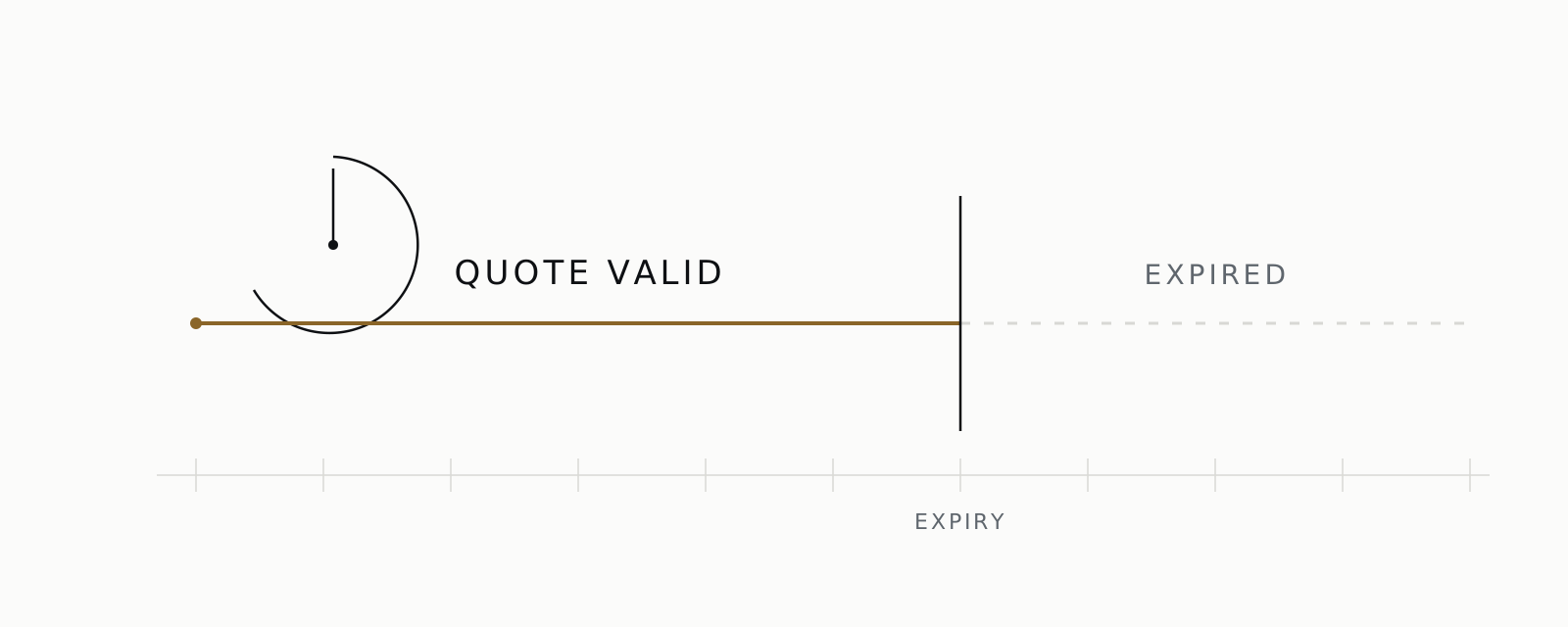
An OTC quote is held for a short window — usually seconds to a few minutes — because the desk prices it against a live hedge. Once the window lapses the price is recalculated, not honoured. A desk offering an open-ended quote is either padding the spread or not hedging at all.
KEY FACTS
| Typical quote window | Seconds to a few minutes, stated on the quote |
|---|---|
| Why it exists | The desk hedges your trade in a moving market |
| At expiry | Price is recalculated; a new quote is free |
| Meridian spread | 0.08%–0.40%, by ticket size |
| Minimum ticket | From around 100,000 USDT |
| Settlement | AED same business day (UAEFTS); USD 2–5 days (SWIFT) |
Source: Meridian OTC published pricing bands and dealing practice, as of September 2026.
Why does an OTC quote expire at all?
An OTC quote expires because it is priced against a live market. The rate a desk gives you is the rate at which it can hedge your trade right now, plus its spread. When the market moves, that rate stops being real, so the quote is built to lapse before the gap opens.
On an exchange you take whatever the order book shows at the instant you click. A desk does the opposite: it freezes a number for you, and freezing a number in a moving market costs money. The validity window is the price of the freeze — the period in which the desk can still lay off your risk at roughly the level it quoted.
The spread itself is separate from the window. Ours is published as bands by ticket size in the pricing section of the main page, and the window is printed on each written quote you receive.
What is the desk doing while the clock runs?
While an OTC quote is live, the desk is either hedging your trade or consciously holding the risk. For a sale of 2,000,000 USDT it checks where that volume can be placed, at what price, and what the network and funding legs cost — the quote is that calculation plus the spread.
The hedge has its own costs stacked inside the quote: the taker fee or spread where the volume is placed, the network fee for moving the asset, and the funding cost of holding the position until your leg settles. Each of these is live data. A quote struck at 14:00 is priced on the liquidity, fees and funding available at 14:00 — at 14:05 all three may have shifted.
Liquidity at a given price exists for moments, not hours. If you accept after the window, the desk would be filling you at a price struck against liquidity that no longer exists. Re-quoting is not a negotiation tactic; it is the arithmetic being re-done.
This is also why a quote is tied to an exact size. "Sell 1,500,000 USDT for AED" gets a firm price with an expiry; "what's your rate?" gets an indication. The full sequence from account approval to the bank wire is in our step-by-step guide to selling USDT in Dubai.
How much can the market move inside one minute?
Enough to erase a desk's entire margin. USDT/AED itself is nearly constant — the dirham has been pegged at 3.6725 to the dollar since 1997, and USDT tracks the dollar — but the desk's hedge leg is not the peg. It is the price at which real volume actually changes hands, and that moves every second; our guide to why the USDT/AED rate sits at 3.67 covers the difference in detail.
| Ticket (USDT) | Spread income at 0.20% (AED) | Cost of a 0.3% adverse move (AED) |
|---|---|---|
| 250,000 | 1,836 | 2,754 |
| 1,000,000 | 7,345 | 11,018 |
| 5,000,000 | 36,725 | 55,088 |
On every ticket a 0.3% adverse move costs more than a 0.20% spread earns — that asymmetry, not bureaucracy, is why windows are measured in seconds.
For BTC or ETH quotes the arithmetic is harsher: moves of a few tenths of a percent within a minute are common, and the same table would show the margin gone several times over. A desk that quotes you firm size in a volatile asset and never expires the quote is not absorbing that risk out of generosity.
What happens when a quote expires?
Nothing punitive: an expired quote is simply withdrawn. The desk re-prices from the current market and, if you still want to trade, issues a new quote with a new window. A quote is not an order — letting it lapse costs you nothing and commits you to nothing.
-
STEP 1
Request a quote for an exact size and side
"Sell 1,500,000 USDT for AED" gets a firm price; a vague "rate check" gets an indication. Have your wallet and bank details ready before you ask — the window will not wait for you to find them.
-
STEP 2
Read the written quote
It states the price, the size, the side and an explicit expiry time. If any of these is missing, what you are holding is not a quote but a conversation.
-
STEP 3
Accept inside the window
The price is now firm and the trade moves to settlement. With an approved account, AED leaves by UAEFTS the same business day; USD goes by SWIFT in 2 to 5 business days.
-
STEP 4
Or let it lapse
The desk re-prices from the current market if you come back — in either direction. If the market moved in your favour while you were deciding, the next quote reflects that too.
One habit makes the window painless: ask for the quote only when you are ready to act. Desks do not punish lapsed quotes — a fresh request is free and takes a message — so there is no reason to hold a quote open "just in case". Clients who treat the window as the deal mechanics it is, rather than as pressure, get tighter pricing over time because the desk can quote what it can actually hedge.
Why is a quote with no expiry a red flag?
A quote described as "valid anytime" is not a quote; it is marketing. Either the spread is padded wide enough to absorb any plausible move, or the desk is not hedging and your trade is its own bet — or the binding rate will be set later, at settlement, when your coins are already sent and you have no room to negotiate.
The red flags around quote windows, in descending order of importance:
- No expiry in writing. The number you were shown is indicative, and the binding rate appears after you have already transferred.
- A rate noticeably better than the market mid. The peg is arithmetic; better-than-arithmetic is recovered in the settlement leg, not gifted.
- "We'll hold it for you all day" at no cost. Holding risk costs real money; a desk that charges nothing for it is on the other side of your trade.
- Pressure to decide instantly without a written quote. A real window is stated in writing, not shouted in a chat.
- No licence number, or one that does not resolve in the VARA public register. It takes a minute to check — ours is linked from the licence section of the main page.
The bottom line on quote validity windows
A short quote window is not a sales tactic; it is the cost of freezing a live market, made visible. Judge a desk by whether the window is written down, the spread is published and the licence resolves — and treat "valid anytime" as the warning it is.
FAQ
How long is a typical OTC quote valid?
There is no market standard: the window is set per quote and stated in writing, usually from tens of seconds to a few minutes. It runs shorter in fast markets and on larger tickets. At Meridian OTC the expiry is printed on every written quote.
Does the clock start when the quote is sent or when I read it?
The window starts when the quote is issued, not when you read it. The desk prices and hedges from the moment the rate is struck, so the timer runs from issue time. If quotes arrive by chat, ask for the issue timestamp.
Can I ask the desk to hold the price for longer?
You can ask, but a longer window costs the desk real hedging risk, so expect a wider spread in exchange. For most tickets it is cheaper to take the short window and be ready to accept.
What if the market moves in my favour after my quote expires?
You get a new quote at the new market — expiry cuts both ways. The window fixes your price for better or worse; once it lapses, the next quote follows the current market, whichever direction it moved.
Get a written quote with a clear expiry
Meridian OTC is a VARA-licensed Broker-Dealer in Dubai. Every quote states the price, the size and the expiry in writing; the all-in spread of 0.08–0.40% by size is published openly. AED by UAEFTS the same business day once your account is approved.
SOURCES
- VARA public register — licence status check, accessed 10 September 2026.
- Central Bank of the UAE — payment systems (UAEFTS), accessed 10 September 2026.
- Meridian OTC published pricing bands and dealing practice — this site, September 2026.
This guide is informational and is not legal, tax or investment advice, nor an invitation to buy or sell any virtual asset. Rules and figures are as of September 2026 — re-check the sources before acting. Virtual assets may lose their value in full or in part and are subject to extreme volatility.