
What is a chargeback?
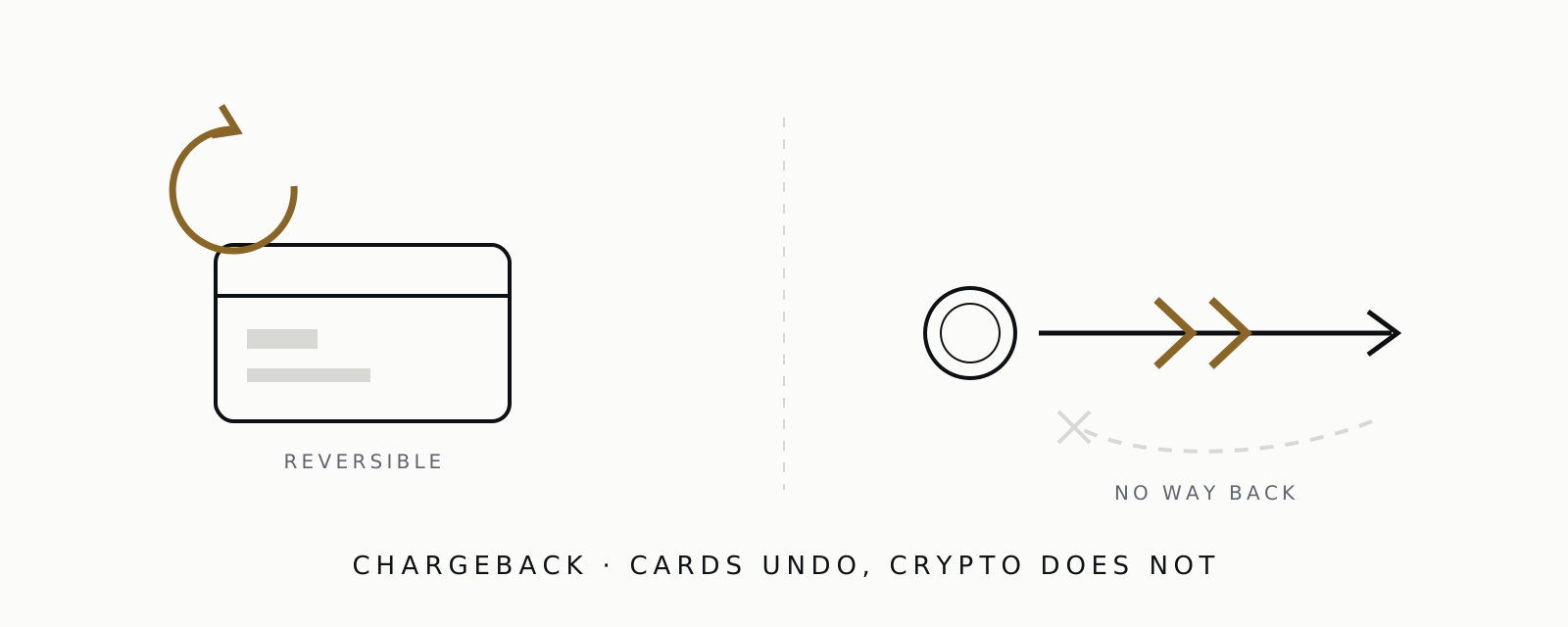
A chargeback is the reversal of a card payment, initiated by the cardholder through their bank and forced on the merchant by the card network. It exists only on card rails: bank transfers and confirmed crypto transactions have no equivalent, which is why settlement finality matters in a USDT sale.
KEY FACTS
| Term | Chargeback — a card payment reversed via the cardholder's bank |
|---|---|
| Who triggers it | The cardholder, through the issuing bank |
| Filing window | Commonly up to 120 days, by network and reason code |
| Card rails (Visa, Mastercard) | Reversible by design |
| USDT transfer after finality | Not reversible by anyone |
| AED payout from a licensed desk | Same business day, final once posted (UAEFTS) |
Source: Visa and Mastercard dispute rules and Meridian OTC published terms, as of September 2026.
How a chargeback works
A chargeback starts when a cardholder disputes a transaction with the bank that issued the card. The issuer pulls the money back through the card network and credits the cardholder provisionally, while the merchant gets a short window to prove the charge was valid. For months after payment, a card transaction lacks settlement finality — the point where a payment can no longer be reversed.
Disputes are filed under reason codes: fraud, goods not received, duplicate charge. Filing windows commonly run up to 120 days from the transaction date, depending on the network and the code. Merchants also pay a chargeback fee per case, win or lose.
The design assumption is that a card payment stays provisional for months. Crypto rails make the opposite assumption: once a transfer is confirmed, there is no intermediary left to appeal to.
How chargebacks work in the UAE
In the UAE, a chargeback follows the same card-network rules as anywhere else. You dispute the transaction with the bank that issued your card — Emirates NBD, FAB, ADCB or any other issuer — and the bank files it with Visa or Mastercard under a reason code. The Central Bank of the UAE licenses and supervises the issuers, but the reversal mechanics belong to the networks.
For a UAE merchant, a chargeback means a provisional debit, a per-case fee and a tight evidence deadline. Card-not-present transactions — everything paid online — are treated as high-risk, and digital-asset purchases sit at the top of that risk category. The same card rails cap push-to-card payouts in the low thousands per transaction.
Card-funded crypto buying is where the two worlds collide. A buyer pays by card, receives crypto that cannot be recalled, then disputes the card charge and keeps both. The P2P version of this pattern appears in our notes on common OTC scam setups in Dubai.
Why crypto settlements have no chargebacks
Crypto networks have no chargeback mechanism because no intermediary is authorised to reverse a confirmed transaction. Once validators confirm a USDT transfer and it reaches finality, no bank, network or desk can undo it. The only refund is a new, separate transfer from the recipient.
This is a design choice, not a missing feature. Reversibility is why card payments carry dispute fees, rolling reserves and months of uncertainty; irreversibility is why on-chain settlement carries none of that overhead — and none of that protection either.
Bank rails sit in between. An AED payout by UAEFTS, the Central Bank's real-time gross settlement system, is final once posted to your account, and no cardholder dispute can reach it because it was never a card payment. The UAEFTS glossary entry explains how the rail settles.
Why this matters when you sell USDT
Irreversibility cuts both ways when you sell USDT. Your outgoing transfer cannot be recalled once sent, so the counterparty must be vetted before you send anything. Their AED wire, once posted, cannot be charged back either — the trade closes for good.
That asymmetry is why a licensed desk settles only to a bank account in your own name, and why P2P buyers offering reversible payment methods are the classic fraud setup. The full trade sequence is in our step-by-step guide to selling USDT in Dubai.
Preparation decides the speed: an approved account and a written quote before you send. The onboarding document list takes one business day in most cases, and the all-in spread runs 0.08%–0.40% by ticket size, as of September 2026.
Worked example: 500,000 USDT on two rails
Compare two ways to sell 500,000 USDT at a 0.20% spread. At a licensed desk the gross is 500,000 × 3.6725 = AED 1,836,250, the spread costs about AED 3,673, and roughly AED 1,832,577 lands in your own account by UAEFTS the same business day — final once posted.
On a P2P platform, suppose the buyer pays AED 1,836,250 from a card-funded or otherwise recallable source. You release 500,000 USDT — irreversible — and six weeks later the buyer's bank pulls the payment back in a dispute. You now hold neither the dirhams nor the USDT, and recovering either is a police matter, not a network function.
Same notional, opposite risk. One rail prices the trade at 0.20% and ends it in a day; the other offers a better headline rate and keeps the door open for 120 days.
FAQ
Can you charge back a USDT transfer?
No. Once a USDT transfer reaches finality on its network, neither the sender, the network nor any bank can reverse it. The only way back is a new, separate transfer from the recipient — which is why desks pay out only after their confirmation threshold is met.
How long does a cardholder have to file a chargeback?
Filing windows commonly run up to 120 days from the transaction date, depending on the card network and the reason code — fraud claims often allow longer than service disputes. The issuing bank's dispute team gives the exact deadline for your case.
Why do P2P crypto scams involve chargebacks?
A scammer pays with a reversible rail — a card or a recallable transfer — receives your crypto, then disputes the payment with their bank. You lose both the coins and the money. Irreversible-for-irreversible settlement removes the asymmetry.
Is an AED bank wire from an OTC desk reversible?
No. An AED payout by UAEFTS is final once posted to your account, and a licensed desk pays only to an account in your own name. No cardholder dispute can reach it, because the wire was never a card payment.
Sell USDT with settlement that cannot be clawed back
Meridian OTC is a VARA-licensed Broker-Dealer in Dubai. All-in spread 0.08–0.40% by ticket size, published openly. AED goes out by UAEFTS the same business day, to an account in your own name — final once posted.
SOURCES
- Visa — Visa Rules (public) — dispute and chargeback framework, accessed 11 September 2026.
- Central Bank of the UAE — payment systems (UAEFTS), accessed 11 September 2026.
- Meridian OTC published pricing bands and settlement terms — Meridian OTC published pricing bands, September 2026.
This guide is informational and is not legal, tax or investment advice, nor an invitation to buy or sell any virtual asset. Rules and figures are as of September 2026 — re-check the sources before acting. Virtual assets may lose their value in full or in part and are subject to extreme volatility.