
USDT settlement times by network: TRC20, ERC20 and beyond
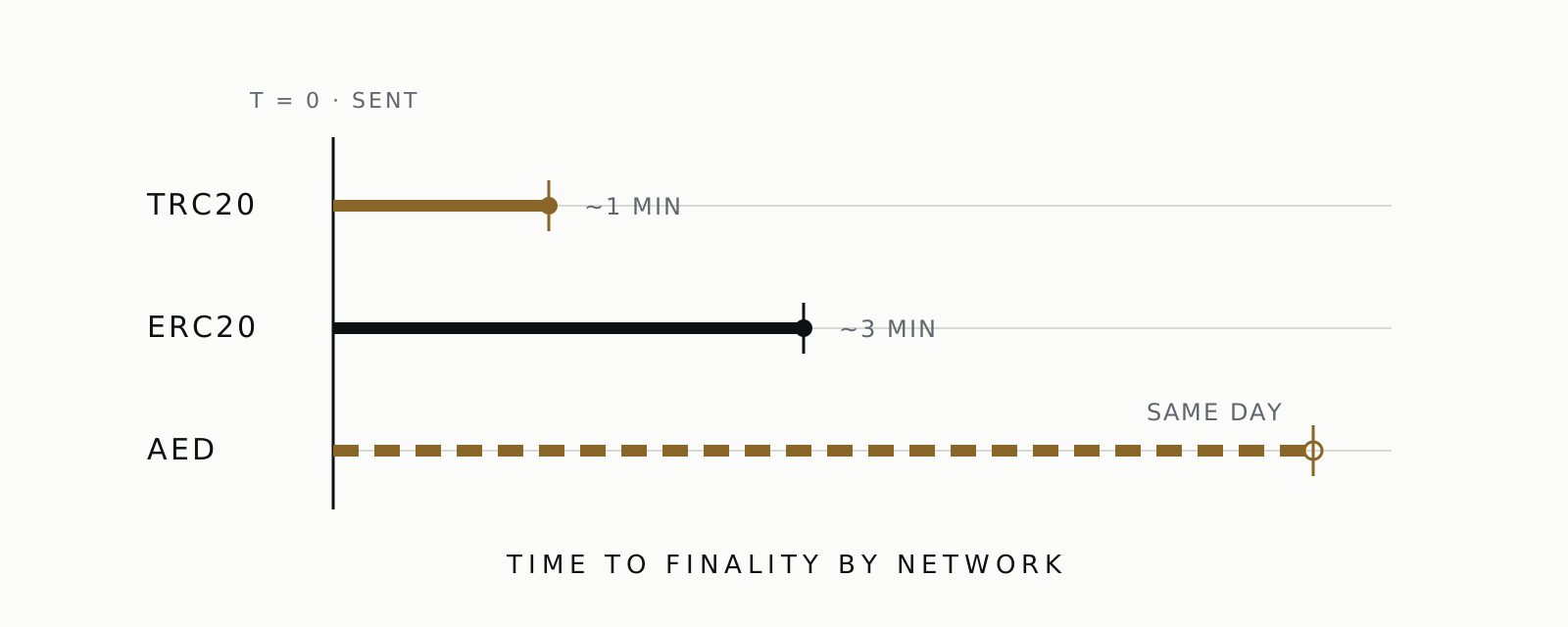
USDT settles at different speeds on each network: TRC20 on Tron credits in about one minute, ERC20 on Ethereum in about three, and Solana in seconds. A licensed desk starts your AED payout once its confirmation threshold is met — Meridian settles AED the same business day.
KEY FACTS
| TRC20 (Tron) time to credit | About 1 minute (19–20 confirmations) |
|---|---|
| ERC20 (Ethereum) time to credit | About 3 minutes (12 confirmations); protocol finality ~13 minutes |
| USDT on Solana / TON | Seconds to credit |
| AED payout after credit | Same business day (UAEFTS) |
| USD payout after credit | 2–5 business days (SWIFT) |
| Meridian spread | 0.08%–0.40%, by ticket size |
Source: network documentation and Meridian OTC published terms, as of September 2026.
How fast does USDT settle on each network?
USDT settlement time depends on the network carrying the transfer, not on Tether itself. As of September 2026, TRC20 transfers on Tron typically credit in about one minute, ERC20 transfers on Ethereum in about three minutes, and USDT on Solana or TON in seconds. The table below shows what desks and large exchanges actually wait for before crediting.
Network speed is only the first leg of the trade; the rest is the desk and the bank. The full sequence is laid out in our guide to the step-by-step bank-settled sale in Dubai.
| Network | Block time | Confirmations awaited | Typical time to credit | Transfer fee (indicative) |
|---|---|---|---|---|
| TRC20 (Tron) | ~3 s | 19–20 | ~1 minute | USD 1–4 in TRX |
| ERC20 (Ethereum) | ~12 s | 12 | ~3 minutes | USD 0.10–5 in ETH, gas-dependent |
| Solana | ~0.4 s | 1 confirmed block | Seconds | Under USD 0.01 |
| TON | ~5 s | 1 | Seconds | Under USD 0.05 |
| BNB Smart Chain (BEP20) | ~3 s | 15 | ~1 minute | Under USD 0.10 |
For a same-day AED payout, TRC20 leaves the widest margin before the banking cut-off; ERC20 is workable but tighter, and its fee moves with gas.
When is a USDT transaction final?
A USDT transaction is final when reversing it is no longer economically possible. On Tron, blocks become effectively irreversible after 19–20 confirmations. On Ethereum, the protocol itself marks transactions as final after two epochs — roughly 13 minutes — although most desks credit far earlier, after 12 confirmations.
Twelve confirmations on Ethereum is a market convention, not a protocol rule: each new block makes a chain reorganisation exponentially less likely. For a dealing desk, "final" is a policy decision — the point where the residual reversal risk is smaller than the cost of making a client wait.
You do not need to compute any of this yourself. Tronscan for TRC20 and Etherscan for ERC20 both show the live confirmation count on any transaction hash.
When does an OTC desk treat your transfer as done?
An OTC desk treats your USDT transfer as done when its own confirmation threshold is met — not when your wallet shows "sent". From that moment the fiat clock starts: at Meridian, AED goes out by UAEFTS the same business day, and USD goes by SWIFT in two to five business days.
The sequence is: send, network confirmations, desk credit, then the bank wire. The network minutes are usually the smallest part of that timeline, which is why chasing a faster chain matters less than having an approved account and a written quote before you send. A licensed desk also pays only to an account in your own name, so the wire itself never waits on third-party details.
Once credited, the AED side is arithmetic — the dirham has been pegged to the US dollar at 3.6725 since 1997. Why the USDT to AED rate barely moves is its own short story.
Which network should you use to send USDT in Dubai?
TRC20 is the default rail for USDT in the UAE: the fastest and cheapest of the widely supported networks, and the one most local desks quote against. Use ERC20 when the funds already sit on Ethereum and moving them would cost more than the fee difference.
- Check the address format in the written quote: TRC20 addresses start with "T", ERC20 addresses with "0x".
- Never send ERC20 USDT to a TRC20 address or the reverse — recovery is rarely possible.
- A small test transfer adds a second wait; on size, most desks consider it optional rather than required.
- The network fee is trivial next to the spread on the ticket — compare it against the published spread bands before optimising the wrong number.
USDT also circulates on Solana, TON, BNB Smart Chain, Polygon and several other chains. Support varies by desk, so confirm the network in the written quote before assuming it is accepted.
What slows a USDT settlement down?
The common causes of a slow USDT settlement are a congested network, a withdrawal queue at the sending exchange, a wrong network or address, and a first-trade compliance review at the desk. Three of the four are avoidable with preparation.
- Withdrawing from an exchange: the exchange's internal queue can add hours before the transaction even reaches the network — the chain is not the bottleneck.
- Gas spikes on Ethereum: a low-fee ERC20 transaction can turn three minutes into thirty. Use the wallet's normal or fast setting, not the cheapest one.
- Sending to an address from a chat message instead of the written quote, or after the quote window has expired.
- First trade with a desk: compliance reviews the source of funds. Completing the onboarding document list a day early removes this delay entirely.
One delay cannot be bought away: the banking leg. AED wires move during UAE banking hours, so a transfer credited after the cut-off settles the next business day. Dealing at Meridian runs Sunday to Thursday, 09:00–18:00 GST.
The bottom line on USDT settlement times
Default to TRC20 in the UAE, pick ERC20 only when the funds already live on Ethereum, and treat the desk's confirmation threshold as the real start of the payout clock. On an approved account the whole chain — send, confirmations, credit, UAEFTS wire — fits inside one business day on any major network.
FAQ
How many confirmations does a TRC20 USDT transfer need?
Tron produces a block roughly every 3 seconds, and most desks and exchanges credit TRC20 after 19 to 20 confirmations — about one minute in total. As of September 2026 that makes TRC20 the fastest widely used USDT rail into the UAE.
How long does ERC20 USDT take to confirm?
Twelve confirmations at 12-second blocks take about 3 minutes, which is the threshold most desks wait for. Full protocol-level finality on Ethereum takes roughly 13 minutes, so some desks add a buffer on very large tickets.
Is TRC20 or ERC20 better for settling with a Dubai OTC desk?
TRC20 is faster and cheaper and is the dominant USDT rail in the UAE. ERC20 makes sense when the funds already sit on Ethereum. Either way, the payout clock starts when the desk credits the trade, not when you press send.
Can a confirmed USDT transfer be reversed?
No. Once a USDT transfer is confirmed on Tron or Ethereum it cannot be clawed back by the sender. That is why a licensed desk releases fiat only after its confirmation threshold is met, and why you send only to the address in your written quote.
Know exactly when your AED lands
Meridian OTC is a VARA-licensed Broker-Dealer in Dubai. We credit TRC20 and ERC20 at a stated confirmation threshold and pay AED by UAEFTS the same business day, spread 0.08–0.40% by size.
SOURCES
- Ethereum.org — proof-of-stake and finality — epoch timing and finality definition, accessed 10 September 2026.
- TRON protocol documentation — block production and confirmation mechanics, accessed 10 September 2026.
- Tether — supported protocols — networks carrying official USDT, accessed 10 September 2026.
- Central Bank of the UAE — payment systems (UAEFTS), accessed 10 September 2026.
- Meridian OTC published pricing bands and settlement terms — Meridian OTC published pricing bands, September 2026.
- Eco — USDT network fee comparison 2026 — indicative per-network transfer costs, accessed 14 September 2026.
- Tronscan — TRON Proposal #104 — energy unit price reduced from 210 to 100 sun, 29 August 2025, accessed 14 September 2026.
This guide is informational and is not legal, tax or investment advice, nor an invitation to buy or sell any virtual asset. Rules and figures are as of September 2026 — re-check the sources before acting. Virtual assets may lose their value in full or in part and are subject to extreme volatility.