
UAE banks and crypto inflows: what compliance teams look for
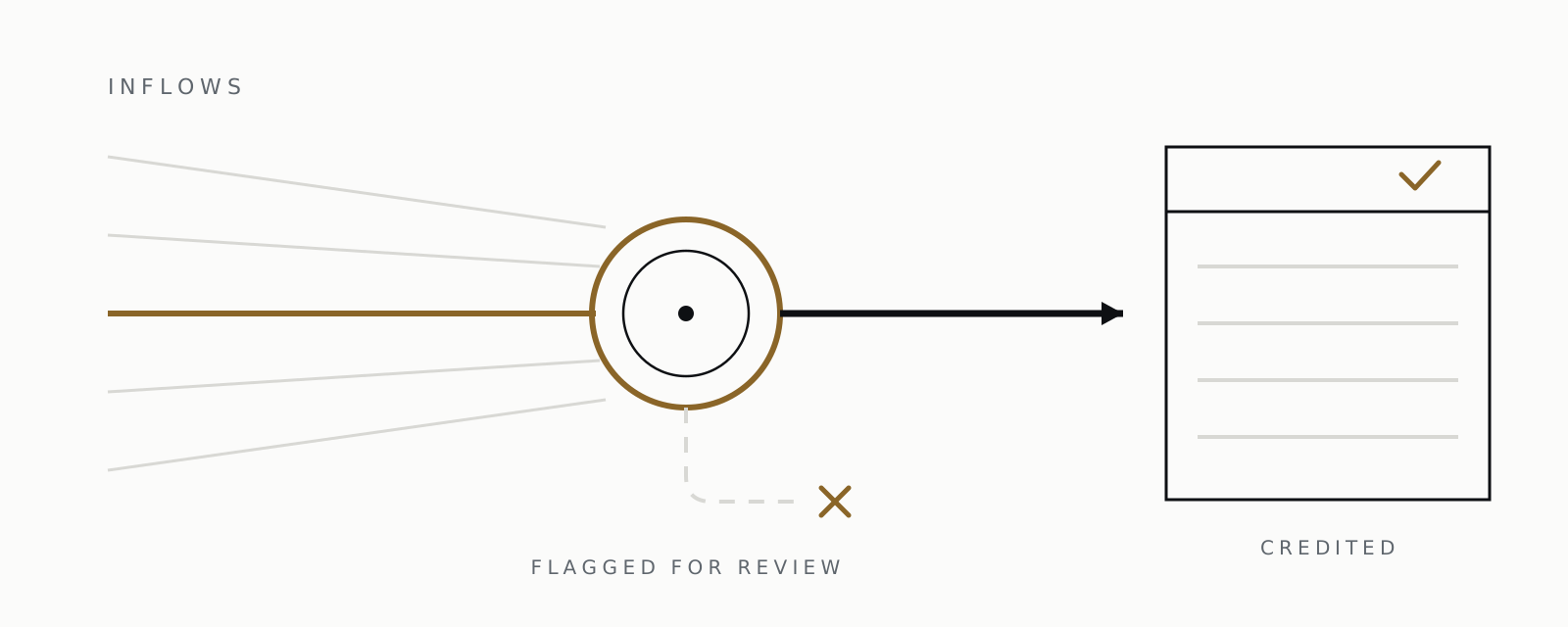
UAE banks accept crypto-derived inflows when the source is documented: a licensed sender, an account in your own name and a paper trail for the funds. Wires from regulated desks pass in most cases; unexplained third-party transfers are what trigger reviews, holds and freezes.
KEY FACTS
| Bank supervisor | Central Bank of the UAE (CBUAE) |
|---|---|
| Desk licensing | VARA (Dubai, outside the DIFC) |
| Clean inflow profile | Licensed sender, own-name account, documents on file |
| Top freeze trigger | Third-party sender name |
| Published review thresholds | None — practice varies by bank |
Source: CBUAE and VARA public materials, plus Meridian OTC desk observation, as of September 2026.
Do UAE banks accept money from crypto sales?
Yes — UAE banks accept crypto-derived inflows when the origin is documented. No UAE law bans a bank from crediting the proceeds of a virtual-asset sale; what Federal Decree-Law No. 20 of 2018 and Central Bank of the UAE rules require is that the bank knows where the money came from.
The test is the licence behind your counterparty and the paper trail, not the asset itself. In practice the trail has three parts: a regulated counterparty, an account in your own name, and documents that connect the two. When all three parts are present, the inflow reads to a bank like any other investment liquidation.
The counterparty check takes one minute — look the desk up in VARA's public register and match the legal entity name, not the brand.
What does a bank compliance team check on a crypto inflow?
A UAE bank compliance team checks four things on a crypto-derived inflow: who sent the money, whether the sender is regulated, how the funds were earned, and whether the amount fits your known profile. Each check maps to a document you can prepare before the money moves.
- Sender identity. The originator name on the wire is matched against your account name and history.
- Counterparty status. The sending institution is screened: licensed virtual-asset provider, known exchange, or unknown entity.
- Source of funds and wealth. Trade confirmations, wallet statements and sale agreements showing where the USDT came from — the full list is in our guide to source-of-funds documents for crypto.
- Profile consistency. An AED 3,700,000 credit lands differently on an account that declared trading income than on a dormant salary account.
None of this is exotic: it is the same scrutiny applied to any large, non-salary credit. Crypto adds one step — the bank wants to see the conversion itself, from a licensed venue, in writing.
Which crypto inflows pass smoothly, and which get flagged?
The inflows that pass smoothly share one shape: a licensed sender, a matching name and an amount the bank was told to expect. The patterns below reflect what our desk sees on the receiving end of client settlements, as of September 2026.
| Inflow profile | What the bank sees | Typical outcome |
|---|---|---|
| Licensed-desk wire to your own account, documents on file | Regulated sender, matching name | Credited without questions in most cases |
| First large inflow from a licensed desk, no prior notice | New pattern, large amount | Possible document request; usually credited after a short review |
| Own-name transfer from a regulated exchange | Named exchange as originator | Varies by bank; documents commonly requested |
| Third-party sender, P2P proceeds or cash deposit | Name mismatch or unclear origin | High chance of a hold, deeper review or rejection |
The profile that clears fastest is the boring one: one regulated sender, your own name, documents already on file.
No UAE bank publishes a fixed dirham threshold above which a review is automatic. Practice varies by bank, by relationship and over time — which is why lists of "crypto-friendly banks" age badly, and why we do not publish one.
What triggers a deeper review or a freeze?
A deeper review is triggered when the inflow breaks the expected pattern: a sender name that is not yours, amounts split into pieces, wallet history that touches sanctioned or anonymous services, or activity that does not match the profile you declared when the account was opened. Large conversions can move from standard screening into enhanced due diligence on large crypto conversions — a process that adds days and documents, but a process, not a verdict.
The triggers we see most often on the receiving end, as of September 2026:
- Third-party sender name — the most common trigger by a wide margin.
- Structured amounts: several wires just under round numbers instead of one transparent transfer.
- Wallet history passing through mixers or sanctioned addresses before reaching the desk.
- A sudden large credit on a new or low-activity account.
- Documents that contradict each other — a trade confirmation that does not match the wire amount.
When a bank cannot close a file, it reports to the UAE Financial Intelligence Unit through the goAML platform, and it is not allowed to tell you it did — "tipping off" is an offence under the AML law. Silence from a bank mid-review is normal, not a signal to move the money elsewhere.
How do you prepare a large inflow before it arrives?
Preparing a large crypto inflow is four steps, all done before the trade: open the desk account, brief your bank, assemble the settlement pack and receive one own-name wire. Each step removes a question the compliance team would otherwise ask later.
-
STEP 1
Open the desk account early
Passport and proof of address for an individual; licence and ownership documents for a company — the full list is in the onboarding section. Approval takes one business day in most cases, and it removes the rush on the day you trade.
-
STEP 2
Tell your bank before the money moves
A two-line message to your relationship manager — amount, sender, date — turns a surprise credit into an expected one. Expected inflows are reviewed faster than surprises; the same logic applies to a recurring selling programme, where every payout follows a pattern the bank already knows.
-
STEP 3
Assemble the settlement pack
Trade confirmation with the desk's licence number, a wallet statement showing the origin of the USDT, and a short source-of-funds letter. Send it the moment the bank asks, not after three follow-ups.
-
STEP 4
Receive one wire to your own account
Own-name settlement only — a desk offering to pay "any account you name" is creating the exact mismatch banks flag. One wire for the full amount reads cleaner than five smaller ones.
What happens after the money lands?
After a clean inflow, nothing happens: the funds are available the day the wire arrives. AED settlements from our desk go out by UAEFTS the same business day you trade, and USD by SWIFT in two to five business days — how long each settlement rail takes is mapped rail by rail in a separate guide.
If the bank does call, it is almost always a document request with a deadline. Answer in writing, in full, within the deadline, and the file closes.
The bottom line on UAE banks and crypto inflows
UAE banks are not the obstacle to crypto inflows; undocumented inflows are. Use a licensed counterparty, settle to your own name, brief the bank before a large credit, and the compliance check becomes a formality you prepared for rather than a freeze you discover.
FAQ
Can a UAE bank reject a crypto-related transfer?
Yes. Banks set their own risk appetite and can return or refuse any inflow. A licensed sender, own-name settlement and complete documents make acceptance the norm, but no desk can guarantee a bank's decision.
Will money from a crypto sale freeze my bank account?
A freeze typically follows an unexplained or third-party inflow. A wire from a licensed desk to an account in your own name, with documents ready, is a profile banks see routinely and usually clear without a hold.
Do I have to tell my bank before a large crypto inflow?
There is no legal duty to pre-notify, but a short heads-up to your relationship manager with the trade confirmation turns a surprise credit into an expected one. Expected inflows are reviewed faster.
Does the sender's name on the wire matter?
Yes — the sender name is the strongest single signal. Own-name settlement from a licensed desk is the clean profile; a sender whose name does not match yours is the most common trigger for a hold.
Settle to your bank with the paper trail included
Meridian OTC is a VARA-licensed Broker-Dealer in Dubai (VL/24/03/017). All-in spread 0.08–0.40% by size, a written trade confirmation on every deal, AED by UAEFTS the same business day to your own account.
SOURCES
- Central Bank of the UAE — payment systems (UAEFTS), accessed 10 September 2026.
- VARA public register — licence status check, accessed 10 September 2026.
- UAE Government portal — combatting money laundering (Federal Decree-Law No. 20 of 2018), accessed 10 September 2026.
- UAE Financial Intelligence Unit — goAML reporting platform, accessed 10 September 2026.
- Meridian OTC desk observations on client settlement handling, September 2026.
This guide is informational and is not legal, tax or investment advice, nor an invitation to buy or sell any virtual asset. Rules and figures are as of September 2026 — re-check the sources before acting. Virtual assets may lose their value in full or in part and are subject to extreme volatility.