
Bank wire vs card payout for crypto settlements: cost and limits
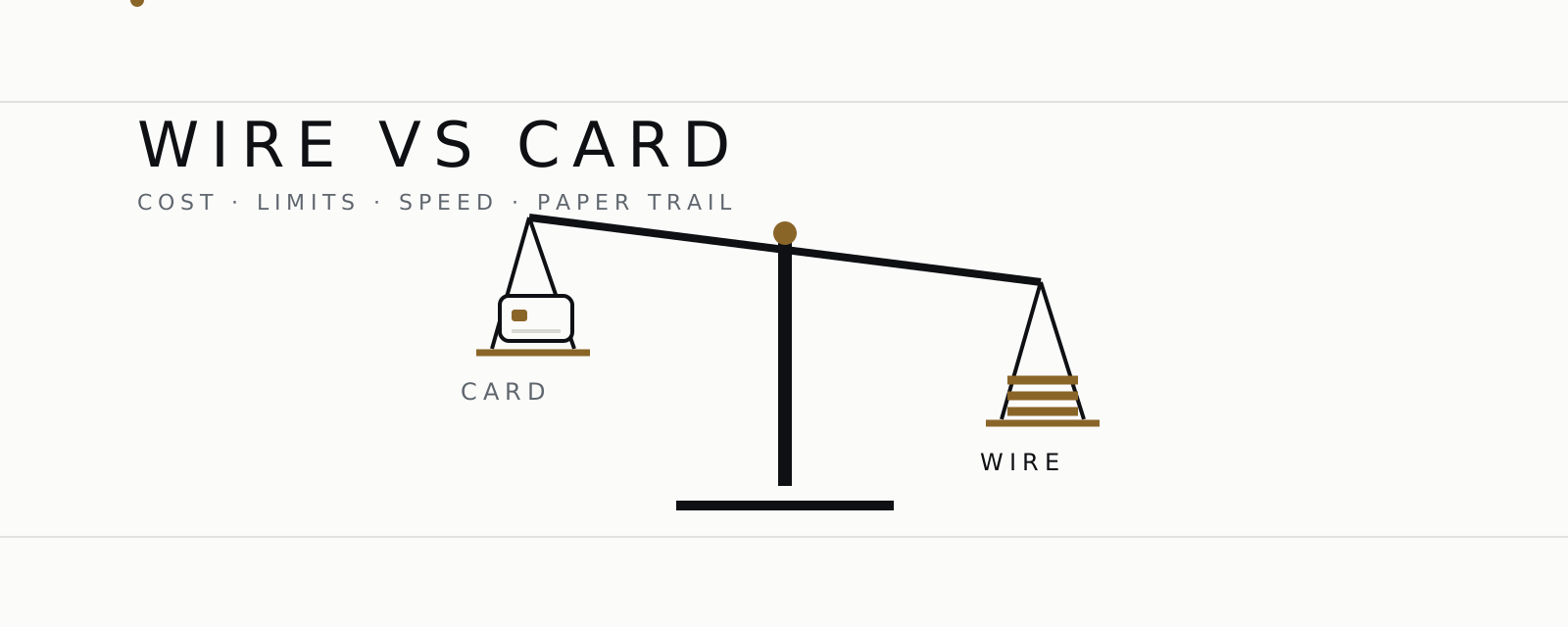
For crypto settlements of any size, a bank wire beats a card payout on cost, capacity and paper trail: wires carry a flat bank charge and no practical cap, while push-to-card costs 1–3% and stops in the low thousands. Cards suit small, urgent amounts only.
KEY FACTS
| Push-to-card cost | Typically 1%–3% all-in, plus FX margin |
|---|---|
| Push-to-card cap | Low thousands of dollars per transaction |
| Bank wire fee | Flat bank charge, no percentage, no practical cap |
| AED wire | Same business day (UAEFTS) |
| USD wire | 2–5 business days (SWIFT) |
| Meridian OTC spread | 0.08%–0.40%, by ticket size, payout included |
Source: Meridian OTC published pricing bands and card-scheme documentation, as of September 2026.
What is the difference between a bank wire and a card payout?
A bank wire moves money account-to-account through the banking system — UAEFTS for AED inside the UAE, SWIFT for USD abroad. A card payout, also called push-to-card, sends money through Visa Direct or Mastercard Send to your card number. The wire is a bank rail; the card payout is a card-scheme rail.
The difference matters more as size grows. A card payout rides consumer card infrastructure built for refunds and small credits; a wire rides the same rails your salary and rent move on. We covered the card ceilings in detail in our guide to push-to-card limits for crypto payouts.
Which rail costs less?
A bank wire costs less for anything beyond a few thousand dollars. Wires carry a flat bank charge with no percentage, while push-to-card pricing is typically 1–3% all-in plus any FX margin, as of September 2026. On size, the card fee alone can exceed the entire desk spread.
| Attribute | Bank wire | Push-to-card |
|---|---|---|
| Cost structure | Flat bank charge, no percentage | 1% – 3% + FX margin |
| Practical ceiling | No rail cap; bank compliance applies | Low thousands of dollars per transaction |
| AED speed | Same business day (UAEFTS) | Minutes to hours |
| USD speed | 2–5 business days (SWIFT) | Minutes to hours, where offered |
| Reversibility | Final once settled | Chargeback rights apply |
| Paper trail | Full bank record with named sender | Card-statement credit, weaker origin trail |
Past a few thousand dollars the wire wins on cost by an order of magnitude; the card's only real edge is minutes-level speed at small size.
Desk costs sit on top of either rail. Our own spread runs 0.08% to 0.40% by ticket size and is published on the main-page pricing bands, with the bank payout included in one all-in quote.
Why are card payouts capped and wires are not?
Card payouts are capped because the card schemes treat them as consumer credits: programme rules set per-transaction ceilings that differ by use case and country — low thousands of dollars for default person-to-person programmes, higher for approved disbursement programmes — and both the schemes and issuers apply value and velocity controls on top. A bank wire has no scheme ceiling — the practical limit is your own account and the bank's compliance review, not the rail.
For a seven-figure settlement, a cap means splitting the money across dozens of card transactions, each paying its own percentage fee. Worse, a stream of many small credits is itself a fraud pattern that card issuers screen for, so the workaround invites the freeze you were trying to avoid.
Which rail settles faster?
Push-to-card is faster at small size: funds typically arrive in minutes to hours. A bank wire settles AED the same business day through UAEFTS and takes 2 to 5 business days for USD over SWIFT, as of September 2026. Above the card caps, the wire is both faster in practice and the only workable option.
The same-day AED leg works because the UAE's real-time gross settlement system settles each transfer individually in central-bank money while it is open. Our explainer on how UAEFTS settles AED the same day covers the mechanics and cut-off times.
USD is slower because it crosses correspondent banks, each of which can deduct a fee and add a day. Our note on what a USD SWIFT wire from the UAE involves covers fee options and the usual causes of delay.
How do banks treat card payouts versus wires?
UAE banks read the two rails differently. A wire from a licensed desk arrives with a named, regulated sender, a payment reference and a full paper trail — the profile banks expect for a large credit. A stream of push-to-card credits from an offshore processor can resemble anonymous third-party money, which is what triggers reviews.
A licensed desk pays only to an account in your own name, so the wire lands as own-name settlement with documents you can show your banker if asked. For the bank's side of that check, read what UAE banks accept in crypto-derived inflows.
Bank wire vs card payout: which should you choose?
Choose the rail by size, not by habit. Under roughly USD 10,000, when minutes matter more than basis points, push-to-card is a reasonable choice. From about 100,000 USDT — where licensed desks start — the bank wire wins on cost, capacity and auditability at the same time.
A worked example at 500,000 USDT: at the 3.6725 peg that is AED 1,836,250. A card payout at a typical 2% all-in costs about AED 36,725 and splits into dozens of capped transactions. The same trade settled by wire at our 0.25% tier costs about AED 4,591 in one same-day transfer — roughly eight times cheaper.
Our spread steps down with size: 0.40% around 100,000 USDT, 0.25% at 500,000, 0.15% at 2 million and 0.08% from 10 million, as of September 2026. If the amount you are moving has a comma in it, the answer is the wire.
The bottom line on bank wire vs card payouts
Card payouts are a convenience rail: instant, small and expensive. Bank wires are the settlement rail: flat-cost, uncapped and documented. Use the card for what cards are for, and settle size by wire to your own account, from a counterparty whose licence you can check in the VARA register.
FAQ
Can I receive a large crypto sale on my card?
In practice, no. Push-to-card programmes cap credits in the low thousands of dollars per transaction, so a six-figure sale would need dozens of separate credits, each paying a percentage fee. Above card size, a bank wire is the workable rail.
Is a bank wire reversible like a card payment?
No. A settled wire is final, which is why desks prefer it and why you should check the quote and account details before sending USDT. Card payments carry chargeback rights — one reason card payouts cost more.
What is the maximum push-to-card amount?
It depends on the card scheme, the sending programme and your issuer. Per-transaction ceilings typically sit in the low thousands of dollars, with additional daily and monthly caps set by issuers, as of September 2026.
Do I pay the wire fee on top of the desk spread?
At Meridian OTC, no: the quote is all-in and the bank payout is included in the spread. Other providers price differently — always ask whether the quoted figure includes the payout leg and any correspondent-bank deductions.
Settle size by wire, same day
Meridian OTC is a VARA-licensed Broker-Dealer in Dubai. Spread 0.08–0.40% by size, all-in, published openly. AED reaches your own account the same business day by UAEFTS once your account is approved.
SOURCES
- Visa Direct — product documentation, accessed 11 September 2026.
- Mastercard Send — product documentation, accessed 11 September 2026.
- Central Bank of the UAE — payment systems (UAEFTS), accessed 11 September 2026.
- SWIFT — cross-border payments for banks, accessed 11 September 2026.
- Visa Direct — Risk and Compliance FAQ (transaction limits and velocity controls), accessed 14 September 2026.
- Meridian OTC published pricing bands — Meridian OTC published pricing bands, September 2026.
This guide is informational and is not legal, tax or investment advice, nor an invitation to buy or sell any virtual asset. Rules and figures are as of September 2026 — re-check the sources before acting. Virtual assets may lose their value in full or in part and are subject to extreme volatility.