
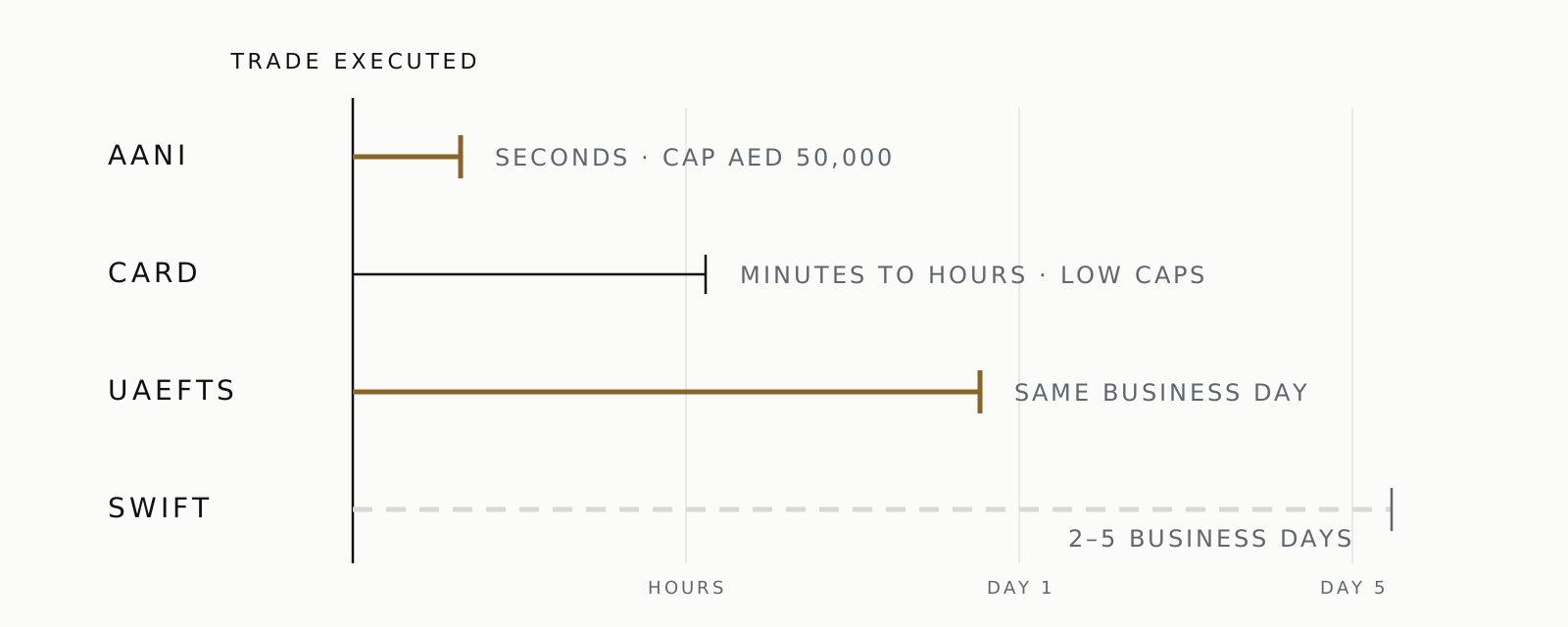
How long a crypto-to-bank transfer takes in the UAE, by rail
A crypto-to-bank transfer in the UAE takes from seconds to five business days, depending on the rail that carries the payout. AED by UAEFTS lands the same business day, Aani moves smaller amounts in seconds, card payouts take minutes to hours, and USD by SWIFT takes two to five business days.
KEY FACTS
| Fastest rail | Aani — seconds, capped at AED 50,000 per transfer |
|---|---|
| Large AED payouts | UAEFTS — same business day, before the bank cut-off |
| USD payouts | SWIFT — 2–5 business days |
| Card payout | Minutes to hours, caps set per card programme |
| Cut-off rule | Miss the cut-off, add one business day |
| Meridian OTC practice | AED same business day, own-name accounts only |
Source: Central Bank of the UAE, Al Etihad Payments and Meridian OTC settlement practice, as of September 2026.
How long does each crypto-to-bank rail take?
A crypto-to-bank transfer in the UAE has two legs: the crypto leg, where you sell a coin such as USDT to a counterparty, and the bank leg, where that counterparty pays fiat into your account. When you sell through a licensed desk in Dubai, the crypto leg is measured in minutes. The clock that decides when money arrives is the bank leg, and it runs on four rails.
Each rail trades speed against ceiling. The faster rails carry less money per transfer, so the size of your trade picks the rail before you do.
| Rail | Currency | Time to credit | Ceiling per transfer | Runs |
|---|---|---|---|---|
| Aani (instant payments) | AED | Seconds | AED 50,000 platform cap; bank limits often lower | 24/7 |
| Card payout (push-to-card) | AED, USD | Minutes to hours | Set per card programme, far below OTC size | 24/7 |
| UAEFTS | AED | Same business day | No rail ceiling; bank policy applies | UAE business days, bank hours |
| SWIFT | USD, other | 2–5 business days | No rail ceiling | Business days in every country on the route |
For a six-figure ticket only UAEFTS inside the UAE and SWIFT across borders have the ceiling to carry it; the instant rails cap out far below a typical OTC trade.
Aani is the instant-payment platform run by Al Etihad Payments, a Central Bank of the UAE subsidiary, and settles between participating banks around the clock. Card payouts ride Visa Direct or Mastercard Send and land fast, but the caps set by each card programme keep them for everyday amounts.
Why is UAEFTS the default rail for large AED payouts?
UAEFTS — the UAE Funds Transfer System operated by the Central Bank of the UAE — is the default rail for large AED payouts because it settles high-value transfers between UAE banks during business days and sets no per-transaction ceiling of its own. Whatever limit applies sits with the sending and receiving bank, not with the rail.
A transfer released before the sending bank's cut-off is credited the same business day under normal conditions. Banks set their own cut-offs, typically in the early-to-mid afternoon, and anything instructed after the cut-off is queued for the next business day.
This is the rail Meridian OTC uses for AED settlement: on an approved account, a trade agreed before the cut-off pays out the same business day. The conversion itself is priced off the 3.6725 dirham peg, so the rate barely moves and the spread is the real cost.
How do the day of the week and the cut-off change the timing?
The day of the week changes crypto-to-bank timing because UAEFTS and SWIFT settle on business days only. The UAE weekend is Saturday and Sunday, so a bank payout instructed on a Friday afternoon, after the cut-off, waits until Monday. Aani and card payouts run 24/7, but their caps put them out of reach for a large trade.
Worked examples, all as of September 2026:
- Trade agreed Monday 11:00 GST, AED by UAEFTS: money in the account Monday afternoon.
- Trade agreed Friday 15:00 GST, after the bank's cut-off: money Monday, not Friday.
- Trade agreed Tuesday, USD by SWIFT with a US public holiday mid-week: three to five business days instead of two.
- UAE public holidays stop the AED leg the same way; Eid and National Day weeks are the classic trap.
Public holidays count twice on SWIFT. A UAE holiday holds the sending side and a US holiday holds the receiving side, and both push the credit date out.
What has to happen before the bank leg even starts?
The bank leg starts only after three things have happened on the crypto side: your account is approved, you have accepted a written quote, and your USDT transfer is confirmed on-chain. Each step is fast on its own, but starting from zero on the day you need the money is how same-day turns into next-day.
-
STEP 1
Approve the account before the day you trade
Passport and proof of address for an individual, licence and ownership documents for a company; approval takes one business day in most cases. The full list is in our onboarding section. An approved account is the single biggest speed-up available.
-
STEP 2
Accept a written quote early in the day
State the amount, get one all-in price held for a defined window. Our spread bands — 0.08% to 0.40% by ticket size — are published on the pricing section of the main page.
-
STEP 3
Send USDT on a fast network
TRC20 typically confirms within a minute or two and is the common USDT rail in the UAE. ERC20 works but costs more and confirms more slowly, and the desk waits for confirmation before it releases the payout.
-
STEP 4
The desk releases the payout before the cut-off
With the trade confirmed before the bank cut-off, AED goes out by UAEFTS the same business day. A licensed desk pays only to an account in your own name — no third-party payouts, no exceptions.
What slows a crypto-to-bank transfer down?
A crypto-to-bank transfer in the UAE slows down for five recurring reasons, and four of them are avoidable with a day of preparation. The unlucky one — a correspondent bank on a SWIFT route — is outside anyone's control, which is why USD quotes carry a range rather than a promise. If speed and a clean paper trail both matter, the route described in our guide to cashing out crypto in Dubai legally is the one built for it.
- A first large inbound transfer triggers a review at the receiving bank — keep the trade confirmation and the desk's invoice.
- A name mismatch stops the payment outright: a licensed desk pays only to your own account, so a payout "to my cousin's IBAN" never leaves.
- A missed cut-off or a public holiday on either end adds a full business day.
- SWIFT correspondent banks each add their own business day and their own compliance checks to a USD wire.
- A slow network choice on the crypto leg delays the confirmation the desk waits for before paying out.
How do you get AED into your account the same day?
Same-day AED settlement needs three things to line up: an already-approved account, a trade agreed before the sending bank's cut-off on a business day, and AED rather than USD as the payout currency. That combination puts the transfer on UAEFTS inside bank hours — the only rail that carries a six-figure sum and still settles the same day.
On size below roughly 100,000 USDT the calculus changes: a regulated exchange plus an Aani top-up can be faster overall, and an honest desk will say so. Above that size, the desk route wins on speed and cost together.
The bottom line on crypto-to-bank timing in the UAE
Crypto-to-bank timing in the UAE is decided by the rail, the cut-off and the day of the week — not by the coin. Pick AED over USD when you can, trade before the early-afternoon cut-off on a business day, and open the account the day before you need it; done that way, the money lands the same day you sell.
FAQ
How long does a UAEFTS transfer take in the UAE?
A UAEFTS transfer released before the sending bank's cut-off on a UAE business day is normally credited the same business day. Anything sent after the cut-off, or on a Saturday, Sunday or public holiday, is processed on the next business day.
What is the maximum you can send with Aani?
The Aani platform cap is AED 50,000 per transaction as of September 2026, and many banks set lower limits inside their own apps. That makes Aani useful for small, urgent payouts, not for six-figure OTC settlements.
Can I receive crypto sale proceeds on a weekend?
Only on the rails that run around the clock: Aani within its cap, or a card payout. UAEFTS and SWIFT do not settle on Saturdays, Sundays or public holidays, so a large payout instructed on a Friday afternoon lands the next business day.
Why does a USD wire from a crypto sale take days?
USD moves by SWIFT through one or more correspondent banks, and each intermediary works its own business days and cut-offs. Two to five business days is the normal range as of September 2026.
Trade before the cut-off, settle the same day
Meridian OTC is a VARA-licensed Broker-Dealer in Dubai. All-in spread 0.08–0.40% by size, published openly. AED goes out by UAEFTS the same business day once your account is approved — own-name settlement only.
SOURCES
- Central Bank of the UAE — payment systems (UAEFTS), accessed 10 September 2026.
- Aani — instant payments by Al Etihad Payments (CBUAE subsidiary), accessed 10 September 2026.
- SWIFT gpi — cross-border payment tracking and timing, accessed 10 September 2026.
- Meridian OTC settlement practice and published pricing bands — Meridian OTC published pricing bands, September 2026.
This guide is informational and is not legal, tax or investment advice, nor an invitation to buy or sell any virtual asset. Rules and figures are as of September 2026 — re-check the sources before acting. Virtual assets may lose their value in full or in part and are subject to extreme volatility.