
Getting a salary in crypto in the UAE: from payout to dirhams
Getting paid in crypto in the UAE is possible: a 2024 Dubai court ruling upheld wages paid in tokens under an employment contract, though WPS payroll still runs in dirhams. Converting regular payouts through a VARA-licensed desk costs 0.08–0.40% by size, with AED the same business day.
KEY FACTS
| Legal position | Not prohibited; token wages enforced by a Dubai court in 2024 |
|---|---|
| WPS payroll | Dirhams, via MOHRE-approved banks and agents |
| Personal income tax | None, as of September 2026 |
| Conversion regulator | VARA (Dubai), licence VL/24/03/017 |
| Meridian spread | 0.08%–0.40%, by ticket size |
| AED settlement | Same business day (UAEFTS) |
Source: UAE Government portal, VARA public register and Meridian OTC published pricing bands, as of September 2026.
Is it legal to get paid in crypto in the UAE?
Getting paid in crypto in the UAE is not prohibited, and the courts now treat it as a contract question. In August 2024 the Dubai Court of First Instance ordered an employer to pay part of an employee's wages in EcoWatt tokens exactly as the employment contract stated (Labour Case No. 1739 of 2024, as reported by the law firms that reviewed the judgment).
The ruling reversed a 2023 position in which a similar claim failed because the token's value could not be shown. What the law regulates directly is the service side: exchanging virtual assets in Dubai requires a VARA licence, so the regulated step is converting the payout — selling USDT in Dubai through a licensed desk — not receiving it.
A contract that names a token component should fix the token, the valuation source and the valuation date. A vague clause is precisely what sank the 2023 claim.
Where does WPS leave a crypto salary?
The Wage Protection System (WPS) pays UAE private-sector wages in dirhams through banks and agents approved by MOHRE and the Central Bank, so a crypto salary cannot run through it. For a MOHRE-registered employer the WPS salary in AED stays the auditable payroll line; the token component sits outside it as a contractual supplement.
In practice, as of September 2026, three structures cover most crypto-paid staff in the UAE:
- An AED base salary through WPS, plus a token bonus or top-up under the contract — the most common mainland pattern.
- Employment in the DIFC or ADGM, which have their own employment regimes outside MOHRE's WPS.
- Contractor or consultant terms with an overseas entity, where no UAE payroll exists at all — you invoice, and the invoice is paid in USDT.
The structure decides what counts as your official income on paper, which matters later for a bank application or a visa file. Agree it with HR before negotiating the split, not after.
Is a crypto salary taxed in the UAE?
A crypto salary is not taxed in the UAE: the country levies no personal income tax, as of September 2026, and that covers wages received in crypto and an individual's later sale of it. According to the UAE Government portal's taxation page, the UAE taxes corporate profit, VAT and excise — not individual income.
Your home country may see it differently. A US citizen, or an expat still within another country's reporting rules, can owe tax there on crypto wages regardless of the UAE's zero, so the UAE position does not end the question for everyone.
How do you convert a regular crypto salary to dirhams?
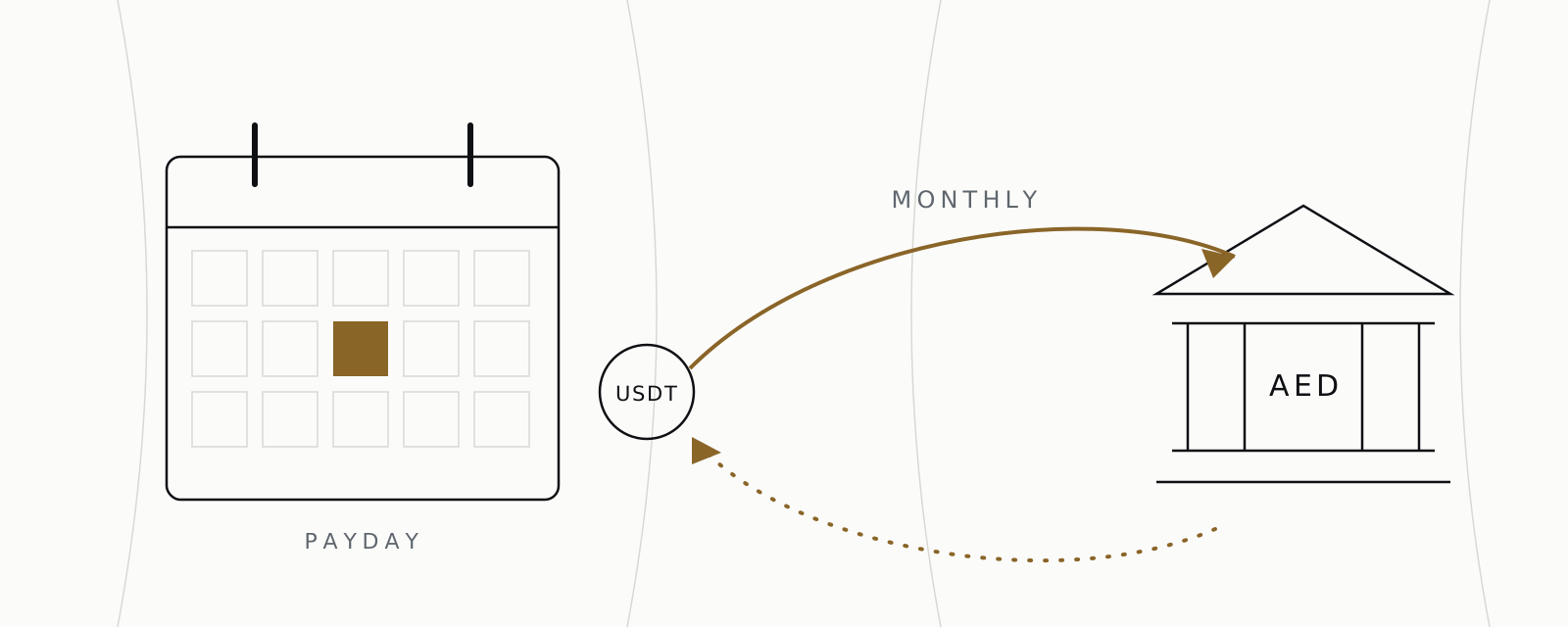
Converting a crypto salary to dirhams works like any OTC sale: you accept a written all-in quote, send the USDT, and receive AED by UAEFTS the same business day. The one wrinkle is size — licensed desks start around 100,000 USDT, so the conversion rhythm depends on how large each payout is.
| Conversion pattern | Typical size | Route | Cost | Time to AED |
|---|---|---|---|---|
| Each payout, as it lands | ≥100,000 USDT | Licensed OTC desk | 0.40%–0.08% spread | Same business day |
| Accumulate, convert quarterly | ≥500,000 USDT per trade | Licensed OTC desk | 0.25% tier or better | Same business day |
| Small monthly payout | <100,000 USDT | Regulated exchange, bank withdrawal | 0.10%–1% + withdrawal fees | 1–3 business days |
Once each payout clears the desk minimum, the desk route is cheapest and fastest together; below it, an exchange withdrawal costs less than forcing the size.
A worked example from our published pricing bands: a salary of 180,000 USDT a month, converted monthly at the 0.40% tier, costs 720 USDT each time — 2,160 USDT a quarter. Held and converted as one 540,000 USDT trade at the 0.25% tier, the same three payouts cost 1,350 USDT, saving 810 USDT (about AED 2,975 at the 3.6725 peg) a quarter.
Holding three months of salary in USDT to reach a tier is a market decision, not free money — a stablecoin carries depeg and counterparty risk for as long as you hold it. A standing monthly schedule through a regular selling programme removes the timing decision without the accumulation risk.
Will your bank question regular crypto inflows?
A UAE bank treats a recurring wire from a licensed desk like any recurring inflow once it can see what it is: salary. What triggers reviews is unexplained inflows, so the paper trail matters more than the amount — the pattern we describe in our guide to how UAE banks treat crypto inflows.
Five documents close almost every bank question before it is asked:
- The employment contract naming the token component and its valuation rule.
- Payslips or an employer letter showing the split between AED and tokens.
- The desk's written trade confirmation for each conversion.
- Wallet records linking the incoming salary transfers to the employer.
- Settlement into an account in your own name — a licensed desk pays nowhere else.
The bottom line on a crypto salary in the UAE
A crypto salary in the UAE is legal as a contract term, untaxed for the individual and routine to convert — as long as the WPS side stays in dirhams and the conversion goes through a licensed desk to your own account. Fix the valuation rule in the contract, keep every trade confirmation, and the arrangement stops being exotic on the second payslip.
FAQ
Can my employer pay my entire salary in USDT in the UAE?
A contract can provide for it, and a 2024 Dubai court ruling enforced such a clause. But a MOHRE-registered employer must still run wages through WPS in dirhams, so for mainland employees crypto is in practice a supplement.
Is there a minimum amount to convert a crypto salary at an OTC desk?
Most licensed desks in Dubai start around 100,000 USDT. Below that size a regulated exchange withdrawal is usually cheaper, or you can accumulate payouts and convert quarterly at a better tier.
Do I pay tax on a crypto salary in the UAE?
The UAE levies no personal income tax, as of September 2026, on wages received in crypto or on personal sales of it. If you remain tax-resident in another country, that country's rules may still apply to you.
How often can I convert salary payouts to AED?
As often as each payout meets the desk minimum. A standing monthly or quarterly schedule can be agreed with the desk in advance, with each conversion still priced by a written quote at the time.
Convert salary payouts with same-day AED settlement
Meridian OTC is a VARA-licensed Broker-Dealer in Dubai, licence VL/24/03/017. All-in spread 0.08–0.40% by size, AED by UAEFTS the same business day, into an account in your own name.
SOURCES
- UAE Government portal — payment of salaries and wages (WPS), accessed 11 September 2026.
- UAE Government portal — taxation (no income tax on individuals), accessed 11 September 2026.
- Dubai Court of First Instance, Labour Case No. 1739 of 2024 — wages in digital assets under an employment contract, ruling of 15 August 2024 as reported by Wasel & Wasel, accessed 14 September 2026.
- VARA public register — licence status check, accessed 11 September 2026.
- Meridian OTC published pricing bands and onboarding requirements — this site, September 2026.
This guide is informational and is not legal, tax or investment advice, nor an invitation to buy or sell any virtual asset. Rules and figures are as of September 2026 — re-check the sources before acting. Virtual assets may lose their value in full or in part and are subject to extreme volatility.