
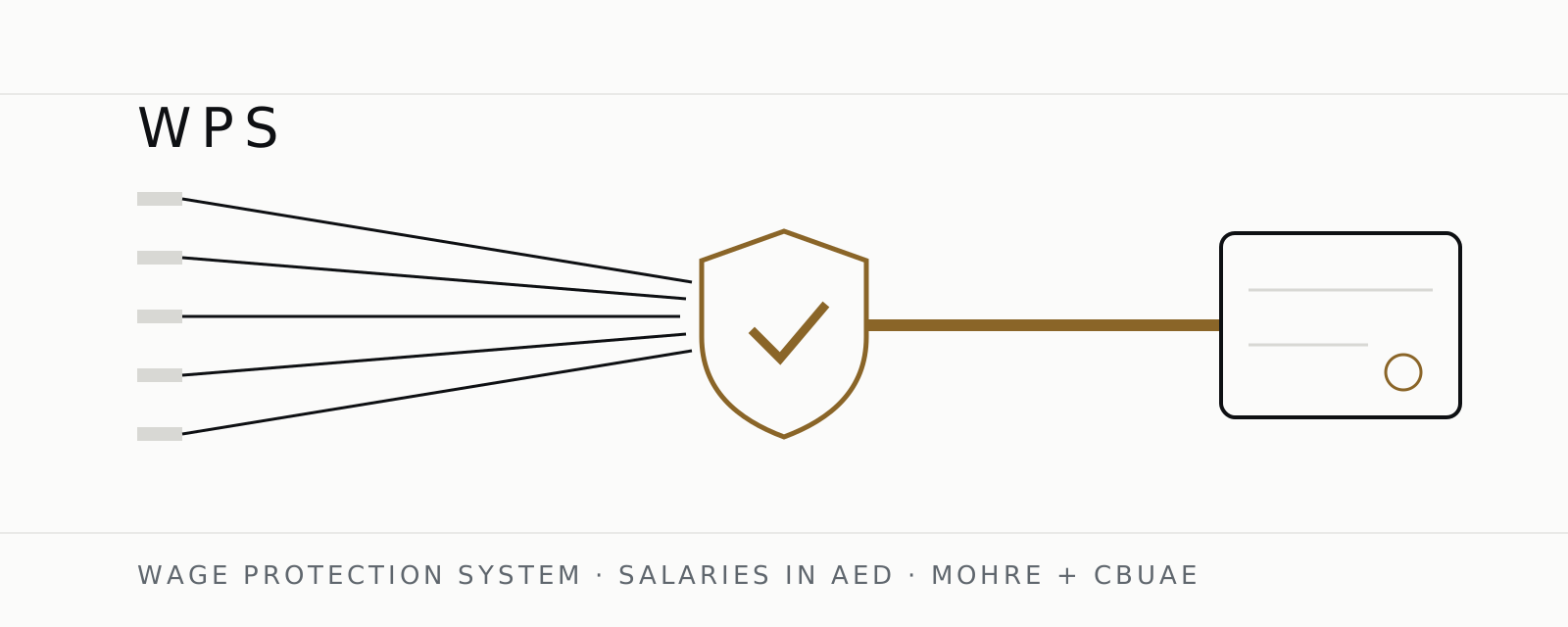
What is WPS in the UAE?
WPS is the Wage Protection System — the UAE's mandatory electronic salary-transfer framework, run by the Ministry of Human Resources and Emiratisation (MOHRE) with the Central Bank of the UAE. Employers registered with MOHRE must pay wages in dirhams through WPS-approved banks and exchange houses, creating a salary record your bank can read.
KEY FACTS
| Full name | Wage Protection System (WPS) |
|---|---|
| Run by | MOHRE, with the Central Bank of the UAE |
| Introduced | 2009, for private-sector employers |
| Applies to | Employers registered with MOHRE; free zones and DIFC have their own rules |
| Salary due date | 1st of each month, for the previous month's wages (since 1 June 2026) |
| Compliance floor | At least 85% of total wages through WPS each month |
| Currency | AED only, through approved banks and exchange houses |
Source: UAE Government portal (u.ae) and MOHRE, as of September 2026.
How does WPS work in the UAE?
The Wage Protection System works as a monitored payroll channel: each pay cycle the employer submits a Salary Information File (SIF) through a WPS-approved bank or exchange house, and salaries are credited to employees' accounts in dirhams. MOHRE and the Central Bank match every payment against the registered employment contract.
The SIF is the heart of it — and the same record trail is what your bank reads years later, long before you think about selling USDT in Dubai. The file lists each employee, the contracted wage and the amount actually paid, so a mismatch — a salary cut that was never registered, a payment short of the contract — is visible to the ministry at once.
The approved agents are the UAE's banks and licensed exchange houses. Cash payrolls, transfers from the owner's personal account and crypto payments do not count — money that never passed the SIF checkpoint leaves the wages officially unpaid. A company paying staff from a crypto treasury converts first — the route is in our guide to selling crypto from a company account — and runs the dirhams through WPS.
When must salaries be paid under WPS?
Under Ministerial Resolution No. 0340 of 2026, wages for a given month are due on the first day of the following Gregorian month, and at least 85 per cent of the total payroll must clear through WPS by that date. The resolution took effect on 1 June 2026.
The rule replaced the older 15-day grace period from Ministerial Resolution No. 598 of 2022, so a large share of the WPS guidance still online describes a deadline that no longer exists. Late payment now triggers enforcement quickly: MOHRE can suspend new work permits for the company from the fifth day after the due date, with fines and referral for repeated cases.
For the employee the practical point is simpler. If your September salary has not arrived by the first days of October, the delay is already visible to MOHRE — you do not need to file anything for the system to notice.
Who is covered by WPS, and who is not?
WPS covers employees of private-sector establishments registered with MOHRE — the mainland private sector, plus free zones whose payroll runs through MOHRE. It is not universal: several free zones keep their own payroll rules, and DIFC and ADGM apply their own employment laws outside MOHRE's system.
Domestic workers are covered only in part: MOHRE makes WPS mandatory for a small set of specialised domestic-worker occupations and optional for the rest. Government payrolls sit outside it, and so does anyone without a MOHRE employment contract.
That last group matters here. Freelancers on their own permits, investors living off capital and founders who pay themselves informally have no WPS record at all — nothing is wrong, but the standard income story a bank expects is simply absent. It has to be rebuilt from contracts, invoices and account statements.
Why does WPS matter when you sell USDT?
WPS matters to a USDT seller because it is the income history your bank and your desk already trust. A salary that arrived through WPS for years is a documented, ministry-matched record, and when a large conversion lands on top of it, the inflow reads as wealth built from visible earnings.
The connection starts at the bank counter. When you open an account, the bank asks where your income comes from, and years of WPS credits are the cleanest possible answer. The same file works when a desk approves your trading account — the document list is in our onboarding section — because salary history is the backbone of most source-of-funds reviews.
The second point is arrival. When the AED from a sale lands, the bank's monitoring compares it against the profile it already holds, and a profile built on WPS salaries reads far better than an empty one. Our guide to proving source of funds for crypto proceeds sets out the full document set for both cases.
None of this means an account without WPS history cannot receive settlement. It means the paper trail starts earlier than the trade, and banks read the whole trail — our piece on how UAE banks treat inbound crypto money covers the monitoring side.
Example: a salary history behind a 300,000 USDT sale
A worked example shows how the pieces connect. Say you have earned AED 40,000 a month through WPS for three years — AED 1,440,000 of ministry-matched income — and you now sell 300,000 USDT. The dirham has been pegged to the US dollar at 3.6725 since 1997, so the gross value is AED 1,101,750.
At a 0.25% spread the cost is about AED 2,754, leaving AED 1,098,996 to settle. Our published spread bands run 0.08%–0.40% by ticket size, as of September 2026.
The desk's review is quick because the file writes itself: three years of WPS credits, a registered contract, savings consistent with the salary. The bank receiving AED 1,098,996 sees an inflow from a named, VARA-licensed corporate account landing on a profile that already shows documented earnings — a very different read from the same amount arriving on an account with no income history.
Without the WPS years the trade still works, but the questions take longer: invoices, contracts, sale agreements. The rail that pays your salary every month is quietly building the credibility your future settlements will draw on.
FAQ
Is WPS mandatory in UAE free zones?
It depends on the zone. Mainland employers registered with MOHRE must use WPS, while DIFC and ADGM apply their own employment laws and sit outside MOHRE's system. Many other free zones apply their own payroll rules, so check with the zone's authority.
Can my salary be paid in cash or crypto under WPS?
No. WPS wages must be paid in dirhams through an approved bank or exchange house, matched to a Salary Information File. Cash envelopes and crypto transfers do not count — wages paid that way are treated as unpaid.
Does WPS apply to freelancers and investors?
No — without an employment contract with a MOHRE-registered employer there is no WPS record. Banks and desks then read income from contracts, invoices and account statements instead, so keep them organised before a large conversion.
How can I check my own WPS record?
Your salary credits appear on your bank statements, and MOHRE shows your registered contract and wage details through the My Contract service in its app and on its website. A mismatch between the two is worth raising with the employer early.
Sell USDT with same-day AED settlement
Meridian OTC is a VARA-licensed Broker-Dealer in Dubai (VL/24/03/017). All-in spread 0.08–0.40% by ticket size, published openly; AED goes out over UAEFTS the same business day once your account is approved.
SOURCES
- UAE Government portal — payment of salaries/wages (WPS), accessed 11 September 2026.
- Ministry of Human Resources and Emiratisation (MOHRE) — Wage Protection System, accessed 11 September 2026.
- Morgan Lewis — UAE introduces new Wage Protection System resolution effective 1 June 2026 (Ministerial Resolution No. 340 of 2026: due date, Day 5 work-permit suspension), accessed 14 September 2026.
- Gulf News — WPS for domestic workers: mandatory and optional occupations, 30 July 2025, accessed 14 September 2026.
- Khaleej Times — how to check your labour contract details online (MOHRE My Contract service), accessed 14 September 2026.
- Addleshaw Goddard — changes to the DIFC Employment Law (DIFC Law No. 2 of 2019 and the 2020 amendment), accessed 14 September 2026.
- Meridian OTC published pricing bands and onboarding requirements, September 2026.
This guide is informational and is not legal, tax or investment advice, nor an invitation to buy or sell any virtual asset. Rules and figures are as of September 2026 — re-check the sources before acting. Virtual assets may lose their value in full or in part and are subject to extreme volatility.