
Getting paid in crypto as a UAE freelancer: from invoice to dirhams
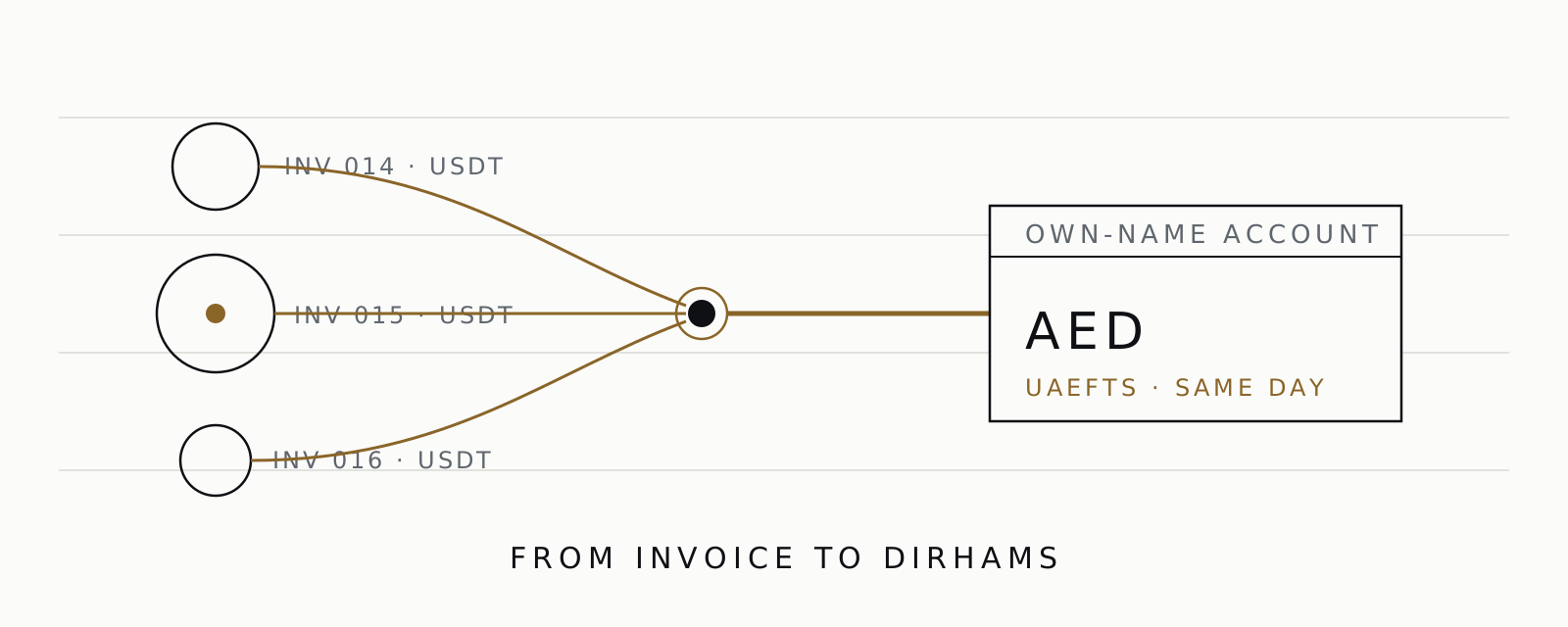
A UAE freelancer can legally accept payment in USDT: receiving crypto for your services is not a regulated activity, and the UAE charges no personal income tax. The practical route is invoice, receive USDT, convert at a licensed desk, and take AED into your own bank account the same business day.
KEY FACTS
| Personal income tax | None — 0% for individuals |
|---|---|
| Corporate Tax (if you bill via a company) | 9% above AED 375,000 taxable income |
| VAT registration threshold | AED 375,000 in taxable supplies over 12 months |
| USDT/AED rate basis | USD peg at 3.6725 |
| Meridian spread | 0.08%–0.40%, by ticket size |
| AED settlement | Same business day (UAEFTS) |
| Typical desk minimum | From around 100,000 USDT |
Source: UAE government portal, Federal Tax Authority and Meridian OTC published pricing bands, as of September 2026.
Is it legal for a UAE freelancer to get paid in crypto?
Yes — a freelancer in the UAE can get paid in crypto legally. Receiving virtual assets as payment for your own services is not a regulated virtual-asset activity, so you need no licence to accept USDT into your own wallet — the licensed route for turning it into dirhams is in our guide to cashing out crypto in Dubai legally. The regulated part of the journey is the conversion, and that is where your choice of counterparty matters.
Converting crypto income through an unlicensed counterparty is where freelancers get hurt: banks in the UAE question inbound transfers that look like unlicensed crypto flow, and the account review lands on you, not on the desk. The licensed status of your counterparty is the difference between a clean wire and a frozen account.
The one-minute test for any desk: ask for the licence number and check it in VARA's public register. Ours, VL/24/03/017, is linked from the licence section of the main page.
Do freelancers pay tax on crypto income in the UAE?
Freelancers in the UAE pay no tax on crypto income when they bill as individuals: the country levies no personal income tax at all, as of September 2026, and being paid in USDT instead of dirhams does not create one. Your income is untaxed at the personal level whatever the settlement currency.
The picture changes if you bill through a company. A free-zone entity you invoice through sits inside the Corporate Tax regime: 9% on taxable income above AED 375,000, according to the Federal Tax Authority. The client's payment currency does not change the computation — profit is profit in dirhams, dollars or USDT.
VAT is the second threshold to watch. Registration becomes mandatory once your taxable supplies pass AED 375,000 over 12 months, and settling an invoice in crypto does not remove the supply from the count. If you are anywhere near the line, speak to a tax adviser before the client pays, not after.
One caveat for recent arrivals: zero UAE tax applies once the UAE is your tax home. If you remain tax resident in another country, that country's rules on crypto income can still follow you.
How should you invoice a client in USDT?
To invoice a client in USDT, write the contract in fiat terms and name crypto as the settlement method: the invoice states the dollar or dirham amount for the work, the USDT network, your wallet address and the moment the exchange rate is fixed. That one document is also the paper trail your bank will ask for later.
Three details decide whether the invoice holds up under a bank review:
- Fiat value first: "AED 50,000 for the October sprint, settled in USDT" — not a bare token amount.
- A fixed rate moment: the USDT amount is set at the time the client sends, not the day you convert.
- The network named in writing: TRC20 is the common USDT rail in the UAE and the cheapest; ERC20 works too.
Convert soon after the payment lands. USDT tracks the US dollar and the dirham is pegged to the dollar at 3.6725, so the USDT/AED rate barely moves — the mechanics are in our note on why the USDT/AED rate sits at 3.67. Stable does not mean riskless: a depeg between invoice and conversion is your loss, not the client's.
What is the practical route from invoice to dirhams?
The route from a crypto invoice to dirhams has four steps: agree the amount and network in writing, open a settlement account before the payment arrives, receive the USDT and accept a written quote, then take AED into your own bank account. For an approved account the whole sequence fits in one trading day.
-
STEP 1
Put the payment terms in the contract
Amount in fiat, settlement in USDT, network named, rate fixed at the time of sending. This costs nothing and is the document every later question — from the desk's compliance team or your bank — gets answered with.
-
STEP 2
Open the settlement account before the invoice lands
An individual opens an account with a passport and proof of address issued within 90 days; approval takes one business day in most cases. The full document list is in our onboarding section. Doing this before the client pays is the single biggest speed-up available.
-
STEP 3
Receive USDT, then take a written quote
The client pays your wallet; you state the amount to the desk and get one all-in price held for a defined window. You send the USDT only after accepting the quote in writing — never against a verbal rate.
-
STEP 4
Take AED into your own account
AED goes out by UAEFTS the same business day you trade; USD goes by SWIFT and takes 2 to 5 business days. A licensed desk pays only to an account in your own name — that restriction is what makes the transfer clean for your bank.
One size note: licensed desks start around 100,000 USDT per trade. If your invoices are smaller, accumulate several payments in your wallet and convert in one ticket, or use a regulated exchange for the small amounts.
What does converting freelance crypto income cost?
Converting freelance crypto income to dirhams costs the desk's spread on the peg — at Meridian OTC 0.08% to 0.40% by ticket size, published in the pricing section of the main page. Because USDT tracks the dollar and the dirham is fixed to the dollar, the spread is effectively the whole cost.
Worked example: a 120,000 USDT invoice converts to AED 440,700 at the 3.6725 peg. At the top of the band (0.40%) the conversion costs AED 1,763 and you receive AED 438,937 the same business day; a consolidated 1,000,000 USDT trade near the bottom of the band pays closer to AED 2,938 per million.
| Invoice (USDT) | Value at peg (AED) | Cost at 0.40% (AED) | Cost at 0.08% (AED) |
|---|---|---|---|
| 100,000 | 367,250 | 1,469 | 294 |
| 250,000 | 918,125 | 3,673 | 735 |
| 1,000,000 | 3,672,500 | 14,690 | 2,938 |
The larger the consolidated ticket, the closer you sit to the 0.08% end — batching small invoices into one quarterly conversion is the cheapest compliant route.
Below the desk minimum the maths flips: a regulated exchange charges more per cent than a desk but has no floor, so a 20,000 USDT invoice is cheaper to convert there. Compare the withdrawal fee and the bank's treatment of the inbound transfer before choosing.
Will your bank question crypto-sourced income?
Your bank can question crypto-sourced income, and the defence is paperwork assembled before anyone asks. A bank that sees a UAEFTS transfer from a VARA-licensed desk sees a regulated counterparty; your contract, invoices and trade confirmations explain the rest. Problems start when the inbound money has no story.
Keep a single source-of-funds file per client:
- The signed contract and every invoice, with the USDT amount and network stated.
- The desk's written quote and trade confirmation for each conversion.
- Settlement only to an account in your own name — a desk offering to pay third parties is one to walk away from.
- Clients pay you directly; never route a payment through a friend's wallet to "save fees".
The full sell-and-settle mechanics are in our guide on how to sell USDT in Dubai — the same rails apply to freelance income.
The bottom line on freelance crypto payments in the UAE
Getting paid in crypto as a UAE freelancer is legal, untaxed at the personal level and fast — provided the invoice paper trail exists and the conversion runs through a licensed counterparty into your own account. Agree the terms in writing, open the settlement account before the money arrives, and keep every confirmation.
FAQ
Can I get paid in crypto on a UAE freelance permit?
A freelance permit licenses the activity you bill for, not the currency you settle in. Payment terms sit in your contract with the client. Keep the permit, contract and invoices together as your source-of-funds file.
Do I pay VAT on freelance income received in crypto?
VAT registration becomes mandatory once your taxable supplies exceed AED 375,000 over 12 months, whatever the payment currency. Below the threshold registration is optional. Settling an invoice in crypto does not remove the supply from the count.
What if a single invoice is below the desk minimum?
Licensed OTC desks start around 100,000 USDT per trade. Accumulate several payments and convert in one ticket, or use a regulated exchange for smaller amounts — below the desk minimum the exchange route is cheaper.
Which network should my client send USDT on?
TRC20 is the common USDT rail in the UAE and the cheapest to move; ERC20 works too. Confirm the network with your desk before the client sends — a transfer on the wrong network can lose the payment.
Turn freelance USDT into same-day dirhams
Meridian OTC is a VARA-licensed Broker-Dealer in Dubai. All-in spread 0.08–0.40% by size, published openly. AED by UAEFTS the same business day once your account is approved.
SOURCES
- UAE government portal — taxation (no personal income tax), accessed 10 September 2026.
- Federal Tax Authority — Corporate Tax (9% above AED 375,000), accessed 10 September 2026.
- Federal Tax Authority — VAT (registration threshold AED 375,000), accessed 10 September 2026.
- VARA public register — licence status check, accessed 10 September 2026.
- Meridian OTC published pricing bands and onboarding requirements — Meridian OTC published pricing bands, September 2026.
This guide is informational and is not legal, tax or investment advice, nor an invitation to buy or sell any virtual asset. Rules and figures are as of September 2026 — re-check the sources before acting. Virtual assets may lose their value in full or in part and are subject to extreme volatility.