
What is a market maker?
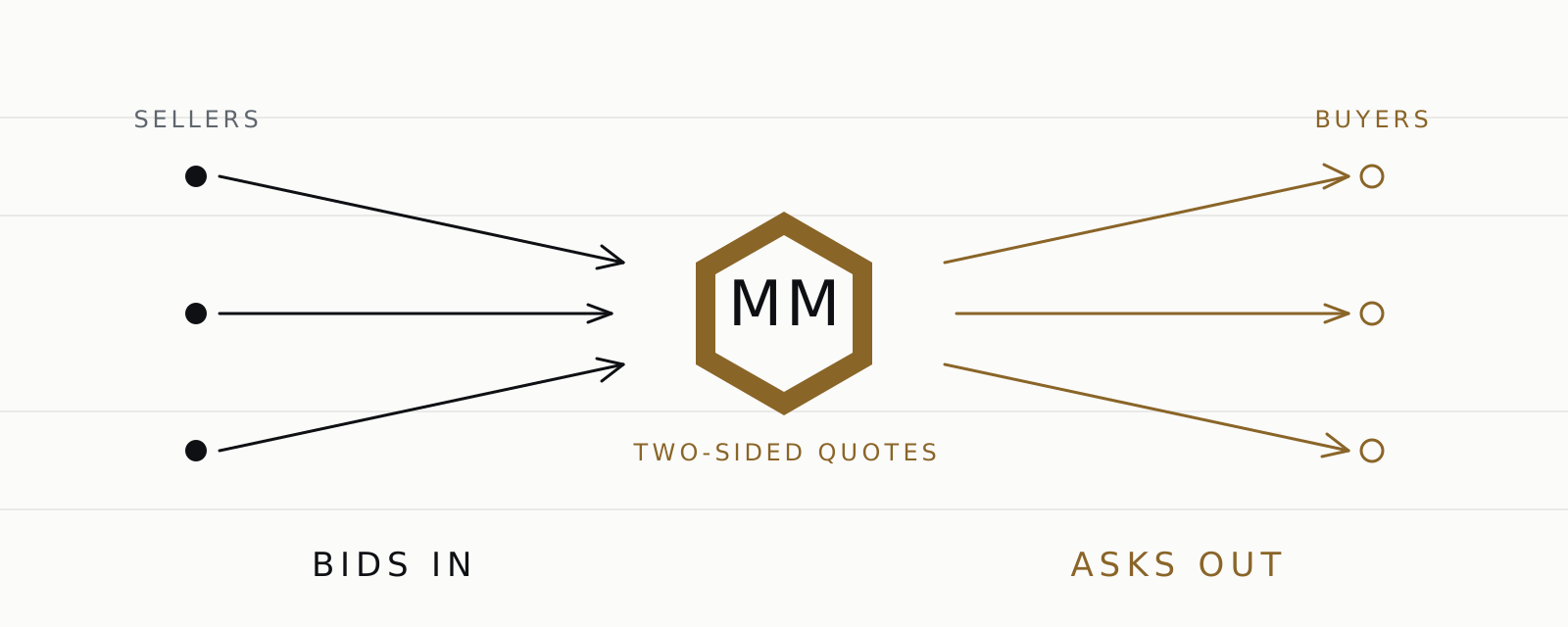
A market maker is a firm that stands ready to buy and sell an asset at quoted prices, earning the gap between the two. In crypto, makers supply the bids and asks you see on an exchange — including the USDT quotes a Dubai desk prices against.
KEY FACTS
| Definition | Firm quoting two-sided prices, earning the spread |
|---|---|
| What it earns | The bid-ask spread, not price direction |
| AED anchor | Dollar peg at 3.6725, held since 1997 |
| Regulator in Dubai | VARA (outside the DIFC) |
| Meridian spread | 0.08%–0.40% all-in, by ticket size |
Source: Central Bank of the UAE and Meridian OTC published pricing bands, as of September 2026.
How does a market maker work in the UAE?
A market maker works by quoting two prices at once: a bid at which it will buy and an ask at which it will sell. It holds an inventory of the asset and earns the spread between those two prices, rather than betting on which way the price moves. In the UAE the same mechanics apply to USDT pairs quoted to local clients.
For USDT against the dirham the quotes cluster around a fixed anchor: the Central Bank of the UAE has held the dirham at 3.6725 per US dollar since 1997, and USDT is designed to track the dollar. So a maker's job on this pair is less about predicting price and more about keeping two-sided quotes available near the peg.
The reference price a Dubai desk shows you starts from these makers. Their quotes on global exchanges form the mid-price — the midpoint between the best bid and the best ask — that any honest quote is measured against.
How does a market maker differ from an OTC desk?
A market maker quotes a continuous two-sided stream to the whole market through an order book, in small clips, to anonymous takers. An OTC desk is a principal counterparty that gives one named client one all-in price for the full ticket, in writing, and settles by bank transfer. The full three-way comparison with exchanges and P2P is in our OTC desk vs exchange vs P2P comparison.
The two are connected: a desk sources liquidity from market makers and exchanges, then internalises the execution risk. When you accept a desk quote, the desk — not you — deals with walking the order book, partial fills and price drift.
That is why a desk can publish a fixed band while a maker cannot. Our all-in spread of 0.08% to 0.40% by ticket size sits in the pricing section of the main page, and the written quote you accept is the number you receive.
Why does the market maker matter when you sell USDT?
When you sell USDT, the price you get is built from market-maker quotes whether you see them or not. On an exchange you sell into the makers' bids directly; at a desk the makers' prices are already inside the single quote you are shown.
This matters most at size. A small sell meets the best bid and is done; a seven-figure sell eats through level after level of the bid stack, and each level is worse than the last. A desk quote removes that cascade: one price, the whole ticket, no partial fills.
The practical steps are the same either way: open your account before you need it, since approval takes one business day in most cases (the document list is in our onboarding section), and check the counterparty's licence number in the VARA public register — ours is linked from the licence section of the main page.
Worked example: the bid stack vs one desk price
Take a ticket of 1,000,000 USDT. On an exchange, suppose the bid side of the book absorbs 200,000 USDT per level at the prices below — an illustrative depth snapshot, as of September 2026. Selling the full amount walks every level.
| Route | Average rate (AED) | After costs (AED) |
|---|---|---|
| Exchange, five bid levels of 200,000 each (3.6720 down to 3.6690) | 3.6707 | 3,667,029 after a 0.10% taker fee |
| OTC desk, all-in quote at 0.08% off the 3.6725 peg | 3.6696 | 3,669,562, settled same day |
On this depth the desk route leaves AED 2,533 more in your account — and the exchange number only gets worse as the ticket grows.
The desk figure is all-in: no separate fee, no settlement charge, no drift between quote and fill. Once your account is approved, AED leaves by UAEFTS the same business day you trade; USD goes by SWIFT and takes 2 to 5 business days.
FAQ
Is a market maker the same as a broker?
No. A market maker trades from its own inventory as principal and earns the spread; a broker passes your order to someone else for a commission. An OTC desk also deals as principal, but quotes you one all-in price for your full size instead of a continuous two-sided stream.
Do market makers set the USDT price in Dubai?
No single maker sets it. The dirham has been pegged to the US dollar at 3.6725 since 1997 and USDT tracks the dollar, so makers compete around that anchor. Their competition is what keeps USDT/AED quotes sitting close to the peg.
Can an individual trade directly with a market maker?
Generally no. Market makers quote to exchanges and institutional counterparties, not to the public. An individual reaches the same liquidity through a broker, an exchange account or an OTC desk that deals as principal.
Is market making regulated in Dubai?
Virtual-asset activity in Dubai outside the DIFC falls under VARA, which licenses activities including Exchange and Broker-Dealer services. A firm quoting and dealing as principal operates inside that perimeter; check any counterparty in the VARA public register, as of September 2026.
Get one price for your full ticket
Meridian OTC is a VARA-licensed Broker-Dealer in Dubai. All-in spread 0.08–0.40% by ticket size, published openly. AED by UAEFTS the same business day once your account is approved.
SOURCES
- VARA public register — licence status check, accessed 11 September 2026.
- Central Bank of the UAE — payment systems (UAEFTS), accessed 11 September 2026.
- Meridian OTC published pricing bands, September 2026.
This guide is informational and is not legal, tax or investment advice, nor an invitation to buy or sell any virtual asset. Rules and figures are as of September 2026 — re-check the sources before acting. Virtual assets may lose their value in full or in part and are subject to extreme volatility.