
How to read an OTC quote: all-in price vs rate plus fees
An OTC quote has four parts: a reference rate (the mid), the desk's spread, your size and a validity window. Compare desks on the all-in price — what actually lands in your bank account — not on a headline rate that excludes fees.
KEY FACTS
| Reference rate (USDT/AED) | 3.6725 mid — the USD peg |
|---|---|
| Meridian spread | 0.08%–0.40% all-in, by ticket size |
| Quote validity | A defined window, stated in writing with each quote |
| AED settlement | Same business day (UAEFTS) |
| Typical desk minimum | From around 100,000 USDT |
Source: Meridian OTC published pricing bands and dealing practice, as of September 2026.
What does an OTC quote contain?
An OTC quote contains four elements: the reference rate it is priced off (the mid), the spread the desk charges, the size it covers and the window for which it is valid. Anything presented without all four is an estimate, not a price you can trade on.
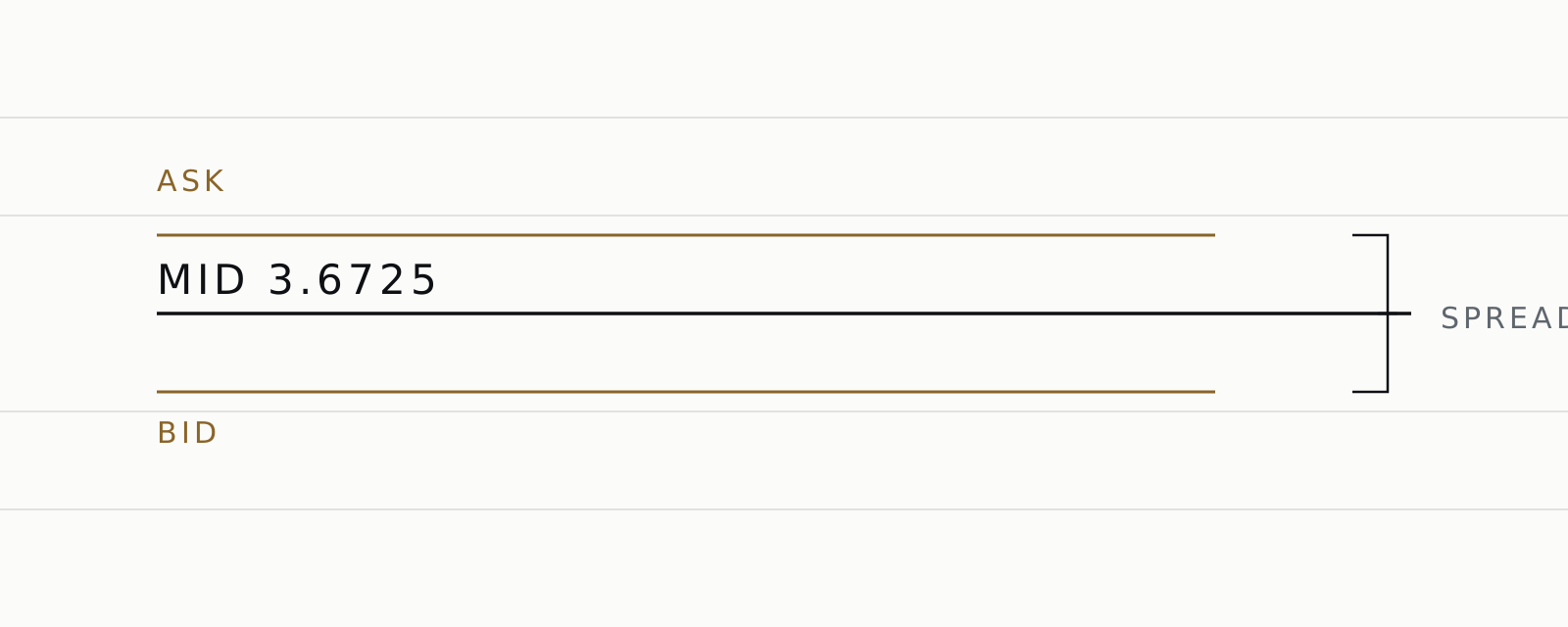
The mid is the market midpoint between buying and selling. For USDT/AED it is effectively the currency peg — 3.6725 — because the dirham has been fixed to the US dollar since 1997 and USDT tracks the dollar.
We publish our spread bands on the main page, so you can check the arithmetic of any quote we send before you speak to a dealer.
What are the mid price and the spread?
The mid price is the midpoint of the market; the spread is the distance between the mid and the price you actually trade at, expressed in per cent or in fils per USDT. A 0.20% spread on the 3.6725 mid is 0.0073 AED per USDT.
For a seller the desk's price sits below mid; for a buyer, above it. In an all-in quote the spread is the entire cost of the trade — there is no second deduction at settlement.
USDT/AED barely moves, because both sides are anchored to the dollar; the mechanics are in our piece on why the USDT/AED rate sits at 3.67. What differs between desks is not the rate, it is the spread.
All-in price vs rate plus fees: what is the difference?
An all-in price is the single rate at which the trade settles, with the spread and all costs inside it. A rate-plus-fees quote shows a headline rate close to mid, then deducts commission, wire fees or "network charges" at settlement. Only the all-in number tells you what lands in your account.
| Aspect | All-in price | Rate plus fees |
|---|---|---|
| What you see | One rate, e.g. 3.6652 | Headline rate near mid, e.g. 3.6700 |
| Where the cost sits | In the spread, stated upfront | In line items deducted at settlement |
| How to compare | Multiply by size — done | Recompute the net yourself, every fee included |
| Typical catch | None, if the window is in writing | Fees "confirmed at settlement", after you commit |
Two quotes are comparable only after both are reduced to one number: dirhams credited to your account per USDT sold.
Worked example: selling 1,000,000 USDT
On a 1,000,000 USDT sale at a 0.20% all-in spread you receive AED 3,665,155 against a mid-market value of AED 3,672,500 — a total cost of AED 7,345. The arithmetic below shows why a better-looking headline rate can pay you less.
-
STEP 1
Start from the mid
Gross value at the reference rate: 1,000,000 × 3.6725 = AED 3,672,500. This is the number every quote is measured against.
-
STEP 2
Apply the all-in spread
At 0.20% the trade price is 3.6725 × 0.998 = 3.665155 per USDT. The cost of the trade is 0.20% × 3,672,500 = AED 7,345.
-
STEP 3
Read the net proceeds
You receive 1,000,000 × 3.665155 = AED 3,665,155, paid to your own account the same business day by UAEFTS. Nothing further is deducted.
-
STEP 4
Now price the "rate plus fees" alternative
A headline rate of 3.6700 looks better, until the deductions: 0.15% commission (AED 5,505) and an AED 2,000 wire fee leave 3,670,000 − 5,505 − 2,000 = AED 3,662,495. That is AED 2,660 less than the all-in quote, from a rate that looked stronger.
This is a hypothetical illustration, not a quote. Before comparing any two desks, ask each to reduce its offer to one net AED figure for your size — the desk that hesitates has told you something.
How long is an OTC quote valid?
An OTC quote is valid for the window stated in it — typically minutes, not hours, because the desk hedges its exposure the moment you accept. As of September 2026, every Meridian quote carries its validity window in writing; industry practice varies widely, and some desks hold prices for seconds only.
A window that is not stated is not a window. If a dealer says the rate is "indicative until you send", the price you saw is advertising, and the real quote arrives after your coins do.
The practical fix is preparation: open your account before the day you trade, so you can accept inside the window instead of watching it expire while compliance checks run.
Which phrases in a quote are red flags?
The red flags in an OTC quote are mostly in the wording, not the numbers:
- "Rate subject to final confirmation" — the number can move after you commit.
- No validity window in writing.
- Fees "calculated at settlement" — costs revealed after the USDT has left your wallet.
- A price better than mid. A negative spread is arithmetic generosity, and desks are not charities; the difference usually comes out of the settlement leg.
- Payment offered to a third-party account, or pressure to send coins before a written quote exists.
Before any of this matters, run the one-minute check: ask for the licence number and confirm it resolves — ours is linked from the licence section of the main page and sits in the VARA public register.
The bottom line on reading an OTC quote
Reading an OTC quote is arithmetic, not judgement: reduce every offer to the net dirhams credited per USDT, inside a written window, from a licensed desk that passes the ten verification checks. The desk that quotes all-in and puts the window in writing is the desk that expects to be compared.
FAQ
What is an all-in price in an OTC quote?
An all-in price is the single rate at which your trade settles, with the spread and every cost already inside it. Multiply it by your size and you get the exact amount credited to your bank account.
How do I compare quotes from two OTC desks?
Ask each desk for the net AED or USD you will receive for the same size, in writing, with the validity window stated. The higher net figure is the better quote — headline rates are not comparable.
Why does an OTC quote expire?
The desk hedges its exposure the moment you accept, so a quote is only good while the market it was priced on still exists. Windows run from seconds to minutes, and a quote without a stated window is an estimate.
Is a rate better than the mid price a good sign?
No. The mid is the break-even point of the market, so a quote above it means the desk loses money on your trade — and the difference will be recovered somewhere you cannot see, usually in the settlement leg.
Get a quote you can actually compare
Meridian OTC quotes one all-in price in writing, with the validity window stated. Spread 0.08–0.40% by size; AED by UAEFTS the same business day once your account is approved.
SOURCES
- VARA public register — licence status check, accessed 10 September 2026.
- Central Bank of the UAE — payment systems (UAEFTS), accessed 10 September 2026.
- Crypto.com Help Center — OTC trading service (portal quotes active for a minimum of 10 seconds), accessed 14 September 2026.
- Meridian OTC published pricing bands and dealing practice — this site, September 2026.
This guide is informational and is not legal, tax or investment advice, nor an invitation to buy or sell any virtual asset. Rules and figures are as of September 2026 — re-check the sources before acting. Virtual assets may lose their value in full or in part and are subject to extreme volatility.