
Partial fills and slippage: why exchanges fail large orders
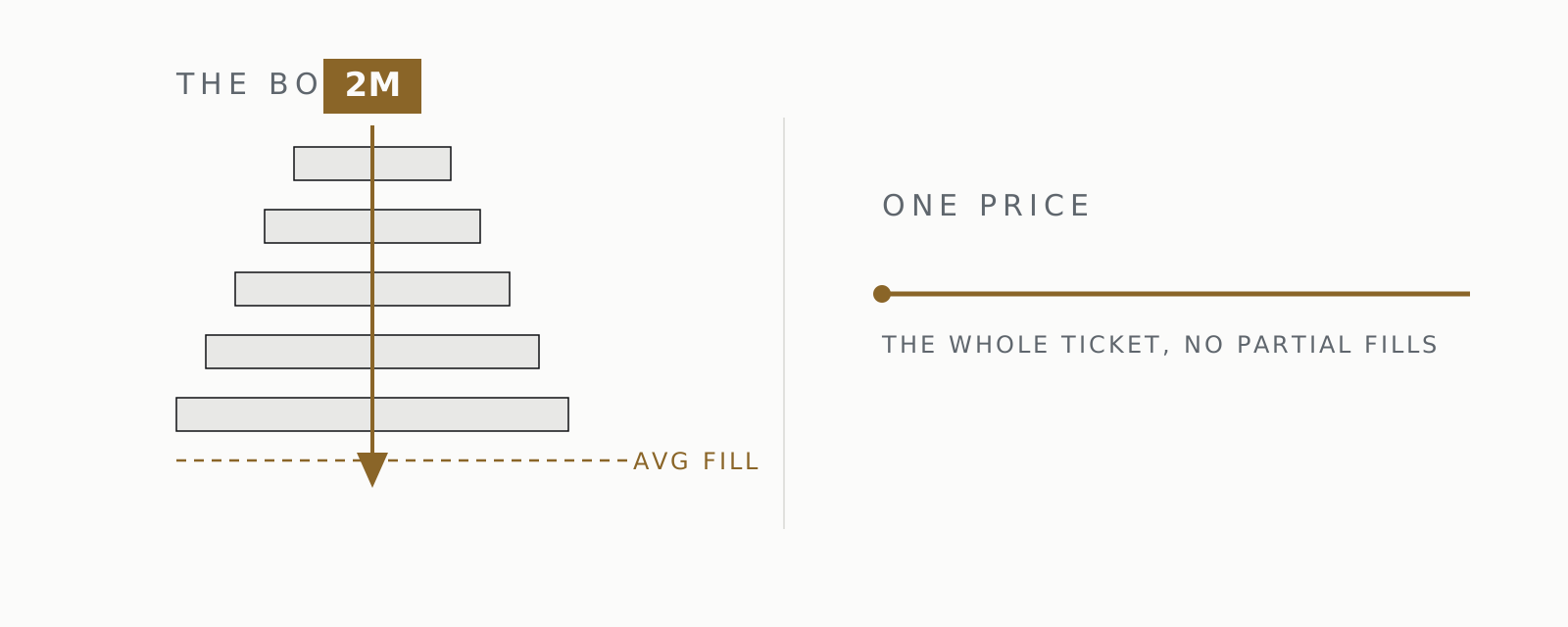
A partial fill happens when the order book cannot absorb your whole order at one price, and slippage is the cost of consuming several price levels to get filled. Below: the arithmetic of a 2,000,000 USDT sale through an illustrative book, against one OTC price for the full ticket.
KEY FACTS
| Mechanic | Order-book depth vs a single quoted price |
|---|---|
| Worked example | Sale of 2,000,000 USDT, illustrative USDT/AED book |
| Slippage in the example | 0.23% — AED 16,750 before fees |
| All-in exchange cost in the example | About 0.33% — AED 24,075 with a 0.10% taker fee |
| Meridian spread | 0.08%–0.40%, by ticket size |
| Typical desk minimum | From around 100,000 USDT |
Source: worked example on stated assumptions; Binance fee schedule and Meridian OTC published pricing bands, as of September 2026.
What is a partial fill?
A partial fill is an execution that covers only part of your order at one price level. An exchange matching engine fills your order against whatever volume sits in the book at each price; anything left over moves to the next, worse price or rests unfilled.
Order books are lists of bids and asks, and every major venue publishes this depth through its API. On regional stablecoin pairs such as USDT/AED, the visible bid side is rarely deep enough to take a seven-figure ticket at one price.
This is the mechanical reason large conversions move to desks that quote one price for the whole amount, priced as a spread over the market. Our published spread bands run 0.08% to 0.40% by ticket size.
What is slippage and how is it measured?
Slippage is the gap between the price you expected and the average price you were actually filled at. For a market sell it equals the cost of walking down the bid side of the book, and it is usually quoted in basis points or as a money amount.
The formula is simple: slippage = (best price − average fill price) ÷ best price. It sits on top of the venue's trading fee, not instead of it — a 0.10% taker fee and 0.20% slippage cost 0.30% together.
On USDT/AED the arithmetic has one quirk: the dirham's peg at 3.6725 anchors the mid-price, so slippage shows up almost entirely as depth cost around the peg. The background is in our piece on why the USDT/AED rate sits near 3.6725.
What does a 2,000,000 USDT order do to an order book?
A 2,000,000 USDT market sell consumes every bid level down the book until the order is filled, and the average price lands below the top bid. In the illustrative book below, the fill averages 3.6626 against a 3.6710 top bid — 0.23% slippage, or AED 16,750, before fees.
The figures are a worked example, not live market data. Assume a USDT/AED book sitting near the 3.6725 peg with the following bids.
| Bid (AED per USDT) | Volume at level (USDT) | Cumulative depth (USDT) |
|---|---|---|
| 3.6710 | 250,000 | 250,000 |
| 3.6680 | 350,000 | 600,000 |
| 3.6640 | 500,000 | 1,100,000 |
| 3.6590 | 700,000 | 1,800,000 |
| 3.6520 | 1,000,000 | 2,800,000 |
The entire visible book absorbs only 2,800,000 USDT before the price falls 1.9 fils below the top bid.
Selling 2,000,000 USDT into this book fills 250,000 at 3.6710, 350,000 at 3.6680, 500,000 at 3.6640, 700,000 at 3.6590 and the final 200,000 at 3.6520. Proceeds come to AED 7,325,250 against AED 7,342,000 at the top bid — a slippage cost of AED 16,750. Add a 0.10% taker fee of about AED 7,325 and the exchange route costs roughly AED 24,075, close to 0.33% all-in.
The same book shows how the cost scales with size: each level consumed pushes the average fill further from the top.
| Order size (USDT) | Levels consumed | Average fill (AED) | Slippage vs top bid | Cost (AED) |
|---|---|---|---|---|
| 250,000 | 1 | 3.6710 | 0.00% | 0 |
| 600,000 | 2 | 3.6693 | 0.05% | 1,050 |
| 1,100,000 | 3 | 3.6669 | 0.11% | 4,550 |
| 1,800,000 | 4 | 3.6638 | 0.20% | 12,950 |
| 2,000,000 | 5 | 3.6626 | 0.23% | 16,750 |
| 2,800,000 | 5 (book exhausted) | 3.6597 | 0.31% | 31,550 |
Cost scales faster than size: doubling the order from 1.1M to 2.0M multiplies the slippage bill almost fourfold.
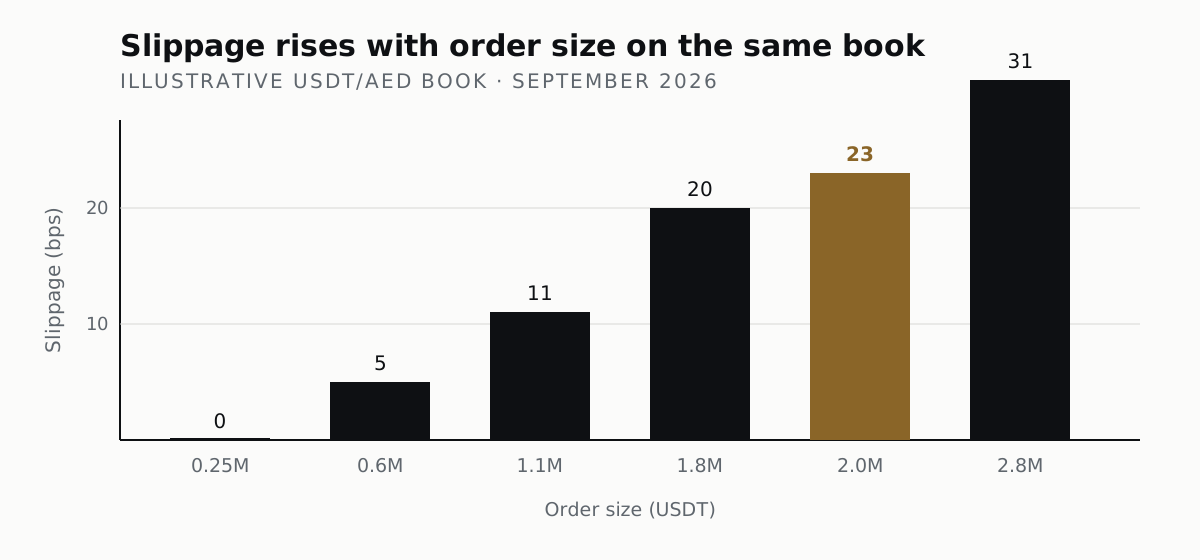
On this book the cost curve bends rather than running straight: the last levels carry far more of the bill than the first ones.
Why doesn't slicing the order fix it?
Splitting one large order into smaller slices reduces the price impact of each slice, but it replaces one cost with three others: time risk, signalling and repeated fees. The slice-by-slice route still buys only the depth the book actually has.
- Time risk: the fills spread over minutes or hours, and on a depeg day USDT/AED can move more than the slippage you saved.
- Signalling: repeated size hitting the bid tells the market a large seller is working; other participants pull or lower their bids, so later slices fill worse. This is the market-impact problem formalised by Almgren and Chriss (2001).
- Repeated fees: every partial fill pays the taker fee again, and someone has to watch the book the whole time.
- Unfilled residue: when the market moves away mid-sequence, the last slices rest unfilled and the conversion is left unfinished.
Iceberg orders and TWAP algorithms hide the size but cannot create depth. They still take whatever the book offers, only slower.
How does an OTC desk remove slippage?
An OTC desk removes slippage by quoting one all-in price for the full ticket before you commit to anything. The desk takes on the market risk of sourcing the volume across venues; you see a single number, held for a defined window, with no partial fills and no drift between quote and fill.
On the same 2,000,000 USDT example, a mid-band spread of 0.25% on AED 7,345,000 costs AED 18,363 — against the illustrative 0.33% all-in exchange cost, and known before you send a single dirham or token. The spread, not the book, is the whole cost.
Account approval takes one business day in most cases, and AED settles by UAEFTS the same business day you trade. USD goes by SWIFT in 2 to 5 business days.
When you are ready to compare routes on real numbers, request a written quote with your size and settlement currency.
When is an exchange still the right route?
An exchange is still the right route when the order is small relative to the book. Below a desk minimum — around 100,000 USDT at most licensed desks in Dubai — the exchange is usually cheaper and simpler, and slippage on a small order against a deep pair is a rounding error.
The desk practice is a quick depth check: if your order is under a tenth of the visible volume within a few levels of the top, slippage is usually negligible. Above that, get both prices — the live book and a desk quote — and compare money, not percentages.
The bottom line on partial fills and slippage
Partial fills and slippage are the same mechanic seen twice: the book has limited depth, and size pays for it. On small orders the cost is trivial; on seven figures it is a five-figure AED line item that a single OTC price removes. Compare both routes in money before you trade.
FAQ
Is slippage the same as the trading fee?
No. The fee is the venue's fixed charge per fill; slippage is the price cost of consuming book depth, and it varies with order size. You pay both: a 0.10% taker fee plus whatever slippage your size creates.
Can a limit order prevent slippage?
A limit order caps your worst price, so it prevents negative slippage — but it does not guarantee a fill. Whatever the book cannot absorb at your price rests unfilled, and you carry the market risk while you wait.
How much slippage should I expect on 1,000,000 USDT?
It depends on live book depth at that moment. On the illustrative book in this article, 1,100,000 USDT slips about 0.11% before fees; a deeper book slips less, a thinner one more. Check the live book or get a firm desk quote.
Can an OTC quote change after I accept it?
No. A written OTC quote locks one price for the full ticket within a defined acceptance window. The desk absorbs any market move after you accept, and the trade settles in full — there are no partial fills.
One price for the whole ticket
Meridian OTC is a VARA-licensed Broker-Dealer in Dubai. All-in spread 0.08–0.40% by size, quoted in writing for the full amount — no partial fills, no slippage. AED by UAEFTS the same business day once your account is approved.
SOURCES
- Binance Spot API — order book (market depth) endpoint — order-book mechanics, accessed 10 September 2026.
- Binance spot trading fee schedule — 0.10% base taker fee, accessed 10 September 2026.
- Almgren, R. & Chriss, N., “Optimal Execution of Portfolio Transactions”, Journal of Risk 3(2), 2001 — market impact of sliced execution, accessed 10 September 2026.
- Meridian OTC published pricing bands and onboarding requirements — this site, September 2026.
This guide is informational and is not legal, tax or investment advice, nor an invitation to buy or sell any virtual asset. Rules and figures are as of September 2026 — re-check the sources before acting. Virtual assets may lose their value in full or in part and are subject to extreme volatility.