
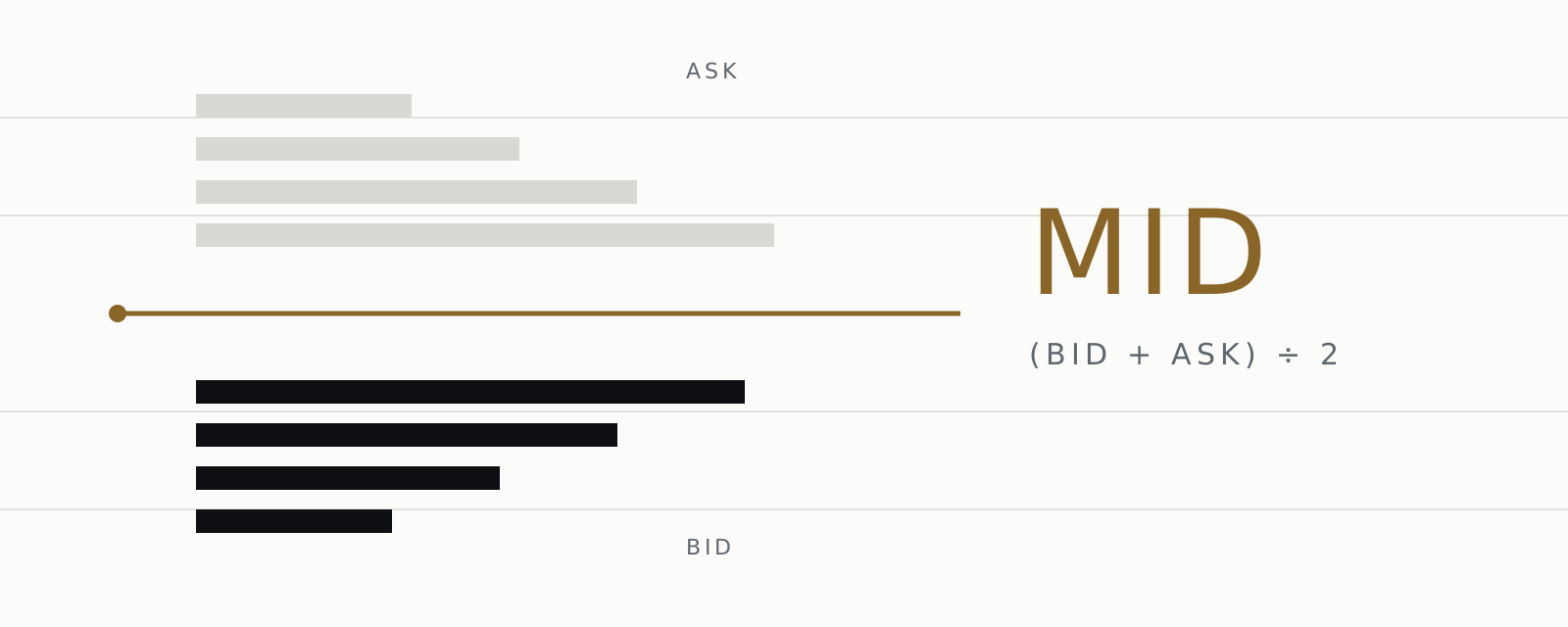
What is the mid price?
The mid price is the midpoint between the highest bid and the lowest ask for an asset at a given moment — for USDT, the average of the best buy and sell orders. OTC desks use it as the neutral reference rate that every quote is measured against.
KEY FACTS
| Definition | Midpoint of the best bid and the best ask |
|---|---|
| Formula | (best bid + best ask) ÷ 2 |
| USDT/USD mid | Sits very close to $1.00 on large venues |
| AED reference | USDT/USD mid × 3.6725 (dirham peg) |
| Meridian quote | Mid − 0.08%–0.40% spread, by ticket size |
Source: Central Bank of the UAE and Meridian OTC published pricing, as of September 2026.
How the mid price works for USDT in the UAE
The mid price changes every time the best bid or best ask in an order book moves, so for a liquid pair like USDT/USD it updates many times per second. Because USDT is designed to track the US dollar, its mid price on large venues sits very close to $1.00, and the dirham's 3.6725 peg turns that into a near-constant USDT/AED reference.
The mid is not a price you can trade at: when you sell USDT, you sell at the bid. Its job is to be a neutral reference both sides can check independently. Because the peg does the heavy lifting, the USDT/AED rate sits near 3.67 and barely moves — so almost everything a quote adds or removes is spread, not market noise.
Why the reference mid matters in an OTC quote
An OTC quote is only checkable if it names its reference. A quote stated as "mid minus 0.25%" can be verified by anyone with a live order book; a bare AED figure cannot. The reference mid turns a take-it-or-leave-it number into arithmetic you can audit before you send anything.
This is how a VARA-licensed desk quotes: the reference mid, the spread by ticket size and the window the quote is held for, all in writing. Our bands, 0.08% to 0.40% by size, are published on the main page pricing section with a calculator that converts the band into money at your ticket.
A desk that will not name its reference — or quotes a rate better than the mid itself — is telling you the cost is hidden elsewhere. Check the licence before the price: ours, VARA VL/24/03/017, is linked from the licence section of the main page.
A worked example: 500,000 USDT against the mid
A quote with every number on the table looks like this. The order book at the moment of the quote shows a best bid of 0.9998 and a best ask of 1.0002 for USDT/USD.
| Line | Value |
|---|---|
| Best bid (USDT/USD) | 0.9998 |
| Best ask (USDT/USD) | 1.0002 |
| Reference mid | 1.0000 |
| Spread at this ticket size | 0.20% |
| Quoted price (mid − spread) | 0.9980 |
| Proceeds for 500,000 USDT | AED 1,832,577.50 |
The whole cost of the trade sits in one line: 0.20% of the mid, which is AED 3,672.50 on 500,000 USDT.
The same arithmetic works in dirhams directly: the mid converts at 3.6725, so the quoted AED rate is 3.665155 per USDT. If a quoted rate implies a different mid from the one you just checked, ask why before you trade. Do the check inside the window the quote is held for, while the number still stands.
How to check the mid price yourself
You can check the mid price in under a minute with any live USDT/USD order book. Kraken lists the pair publicly, and the top of the book shows the best bid and best ask posted by market makers and other liquidity providers — their average is the mid at that second.
-
STEP 1
Open a USDT/USD order book
Kraken or another large venue works; you do not need an account to see the top of the book. Pick a venue with real volume, not a price aggregator.
-
STEP 2
Average the top bid and ask
Take the best bid and best ask, add them and divide by two. That number is the mid price at that second — note the time.
-
STEP 3
Convert to AED if the quote is in dirhams
Multiply by 3.6725, the dirham's peg rate against the dollar. A mid of 1.0000 becomes an AED reference of 3.6725.
-
STEP 4
Compare against the quote
The gap between the mid and the quoted rate should equal the stated spread, and the reference timestamp should match when you looked. When you are ready, request a written quote and hold it against your own check.
The bottom line on the mid price
The mid price is the neutral midpoint that every serious quote is measured against — nothing more exotic than that. Ask for the reference, the spread and the quote window in writing, and check the mid yourself while the window is open. The mechanics of the trade around the quote are in our walkthrough for selling USDT in Dubai.
FAQ
Is the mid price the rate I actually get?
No. When you sell USDT you trade at the bid; an OTC quote is the reference mid minus the desk's spread. For USDT the bid sits within a fraction of a cent of the mid, so the stated spread is almost the whole cost.
Why does the USDT mid price stay near 1.00 USD?
USDT is designed to track the US dollar, and arbitrage traders buy or sell whenever it drifts, which pushes it back. On large venues the mid rarely strays far from $1.00; brief depeg episodes are the exception, not the rule.
Is the mid price the same on every exchange?
Almost. Each venue runs its own order book, so mids differ slightly at any given second, but arbitrage keeps large venues aligned. A quote should state which venue or index its reference mid comes from.
What if a quoted rate is far from the mid I checked?
Ask which reference and timestamp the desk used. If the gap exceeds the stated spread, or the desk cannot name a reference, treat it as a red flag and get a second written quote elsewhere.
Get a quote you can check against the mid
Meridian OTC quotes every trade as a written reference mid minus a published spread of 0.08–0.40% by ticket size. AED goes out by UAEFTS the same business day once your account is approved.
SOURCES
- Kraken — Tether (USDT) price and markets — live order-book reference, accessed 10 September 2026.
- Central Bank of the UAE — exchange rates (USD/AED 3.6725), accessed 10 September 2026.
- Meridian OTC published pricing bands and quote format, September 2026.
This guide is informational and is not legal, tax or investment advice, nor an invitation to buy or sell any virtual asset. Rules and figures are as of September 2026 — re-check the sources before acting. Virtual assets may lose their value in full or in part and are subject to extreme volatility.