
What is KYC? Know Your Customer checks in the UAE
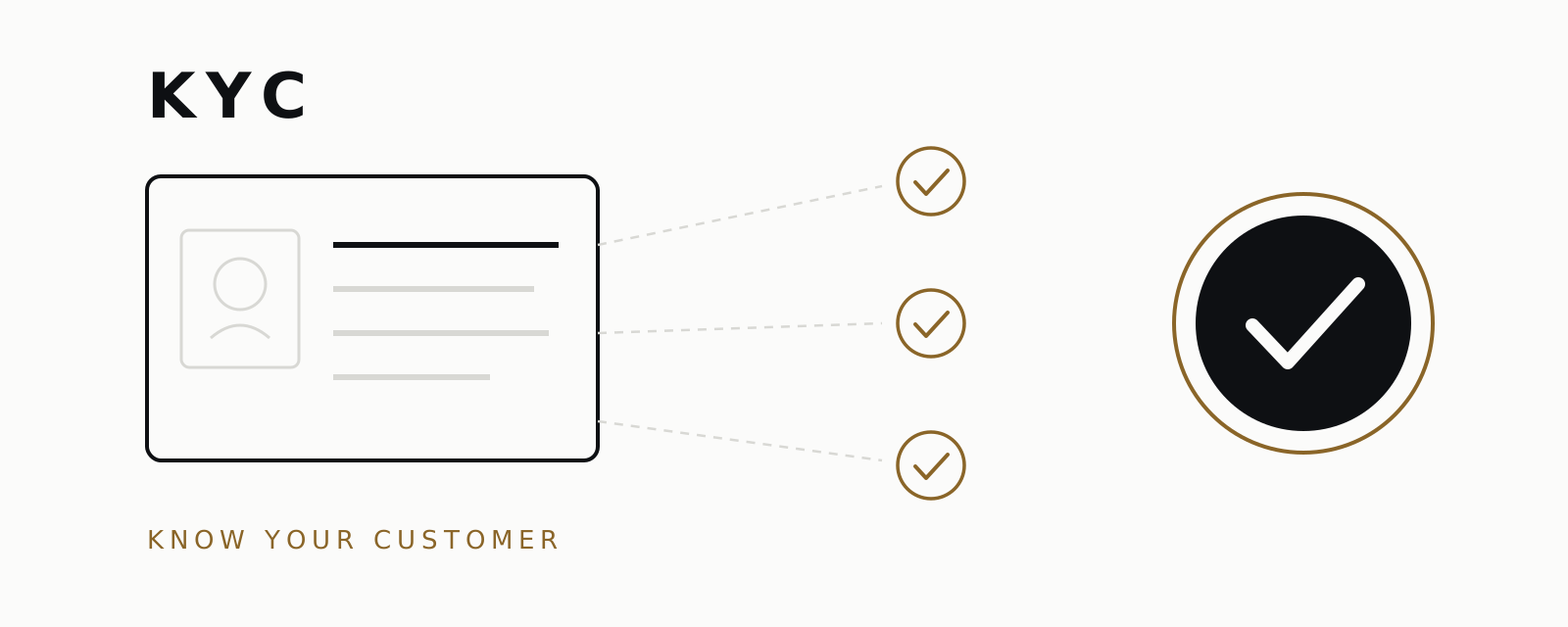
KYC (Know Your Customer) is the identity check a financial institution must complete before it can serve you. In the UAE it is a legal duty of every licensed virtual-asset provider: the desk verifies who you are, where your funds come from, and pays out only to an account in your own name.
KEY FACTS
| What it is | Mandatory identity check before a financial relationship starts |
|---|---|
| Legal basis in the UAE | Federal anti-money laundering law; VARA rulebooks for Dubai desks |
| Documents (individual) | Passport and proof of address issued within 90 days |
| Documents (company) | Trade licence, ownership and ultimate-beneficial-owner documents |
| Approval time | One business day in most cases |
| Payout rule | Bank account in your own name only |
Source: VARA rulebooks and Meridian OTC onboarding requirements, as of September 2026.
How does KYC work in the UAE?
KYC in the UAE works as a one-time onboarding step: you submit identity documents once, the desk verifies them against its legal obligations, and you trade freely afterwards. You meet it the moment you open an account to sell USDT in Dubai through any licensed provider.
The legal basis is Federal Decree-Law No. (20) of 2018 on anti-money laundering, which obliges financial institutions and designated businesses to identify their customers and understand the origin of funds. For virtual assets in Dubai outside the DIFC, VARA writes the detailed customer due diligence rules into its rulebooks, and every licensed desk must follow them as a licence condition.
The check is not a judgement of you personally. It is the desk proving to its regulator and its banks that it knows who stands behind every trade and every wire.
Which documents does KYC require in the UAE?
KYC in the UAE requires a short, fixed set of documents. An individual provides a valid passport and proof of address — a utility bill or bank statement issued within the last 90 days. A company provides its trade licence, ownership structure and documents for each ultimate beneficial owner, plus its LEI code where it holds one.
For large tickets the desk also asks for source-of-funds evidence: a sale agreement, bank statements or wallet history showing where the USDT came from. This is standard at seven-figure size and is not a sign of suspicion. The full checklist sits in our onboarding section.
Send complete, unexpired documents the first time. Most delays at this stage come from a proof of address older than 90 days or a passport scan that cuts off a corner — not from the check itself.
Why does KYC matter when you sell USDT?
KYC matters when you sell USDT because it is what makes the payout clean. A licensed desk settles only to an own-name IBAN, and the wire arrives from a regulated counterparty your bank can recognise. That paper trail is your defence against a frozen account.
UAE banks review inbound transfers for links to unlicensed crypto flow, and "the website said it was fine" does not unfreeze an account. Selling through a VARA-licensed desk — check any licence number in the public register; ours is linked from the licence section of the main page — converts a crypto sale into an ordinary, explainable bank credit.
The same check also protects the trade itself. A counterparty that verifies you is one you can hold accountable: there is a written quote, a licensed entity and a legal route to cash out crypto in Dubai if anything goes wrong.
What does KYC look like in practice: a worked example
A client selling 250,000 USDT starts KYC on Monday at 10:00 GST with a passport and a recent bank statement. The account is approved on Tuesday morning — one business day. On Wednesday the client accepts a written quote at a 0.20% spread, sends the USDT on TRC20, and the desk wires the proceeds by UAEFTS the same business day.
The arithmetic: 250,000 USDT at the 3.6725 peg is AED 918,125; the 0.20% spread costs AED 1,836.25, leaving AED 916,288.75 net in the client's own account. Figures are indicative, as of September 2026 — the spread band of 0.08% to 0.40% depends on ticket size.
Total KYC friction: one business day, once. Every trade after that is quote, transfer, wire — the check does not repeat unless your documents expire or your profile materially changes.
Can you sell crypto without KYC in the UAE?
No — not through a licensed provider at any meaningful size. Identity checks on large conversions are a legal requirement in the UAE, so a desk advertising "no KYC" is telling you it operates outside the regulated perimeter, with everything that implies for your money and your bank account.
P2P platforms and cash desks skip the checks, and the risks move to you: fraud with no recourse (the chargeback scam on P2P sales is the classic case), cash of unclear origin landing in your account, a bank review you cannot answer. KYC done once by a licensed desk is the minimum legal friction — the alternative is not less friction, it is the same friction arriving at the worst possible moment, after the money is gone or frozen.
FAQ
Is KYC mandatory for selling crypto in the UAE?
Yes. Licensed providers must identify every customer under UAE anti-money laundering law, and VARA makes it a licence condition for Dubai desks. Any provider offering to skip the check at size is operating without a licence.
How long does KYC take at an OTC desk?
One business day in most cases, provided the documents are complete and current. The commonest cause of delay is a proof of address older than 90 days.
What documents do I need for KYC in the UAE?
An individual needs a valid passport and proof of address issued within 90 days. A company needs its trade licence, ownership documents and details of each ultimate beneficial owner.
Does KYC get shared with my bank?
Your documents stay with the desk under confidentiality and data-protection rules. What your bank sees is the settlement itself: a wire from a licensed counterparty to your own account, which is exactly what it wants to see.
KYC once, then same-day settlement on every trade
Meridian OTC is a VARA-licensed Broker-Dealer in Dubai. Account approval takes one business day in most cases; after that, AED settles the same business day you trade. All-in spread 0.08–0.40% by size, published openly.
SOURCES
- VARA public register — licence status check, accessed 10 September 2026.
- UAE Federal Decree-Law No. (20) of 2018 on Anti-Money Laundering and Combating the Financing of Terrorism, as amended — the legal basis for customer identification, as of September 2026.
- Meridian OTC onboarding requirements and published pricing bands — Meridian OTC published pricing bands, September 2026.
This guide is informational and is not legal, tax or investment advice, nor an invitation to buy or sell any virtual asset. Rules and figures are as of September 2026 — re-check the sources before acting. Virtual assets may lose their value in full or in part and are subject to extreme volatility.