
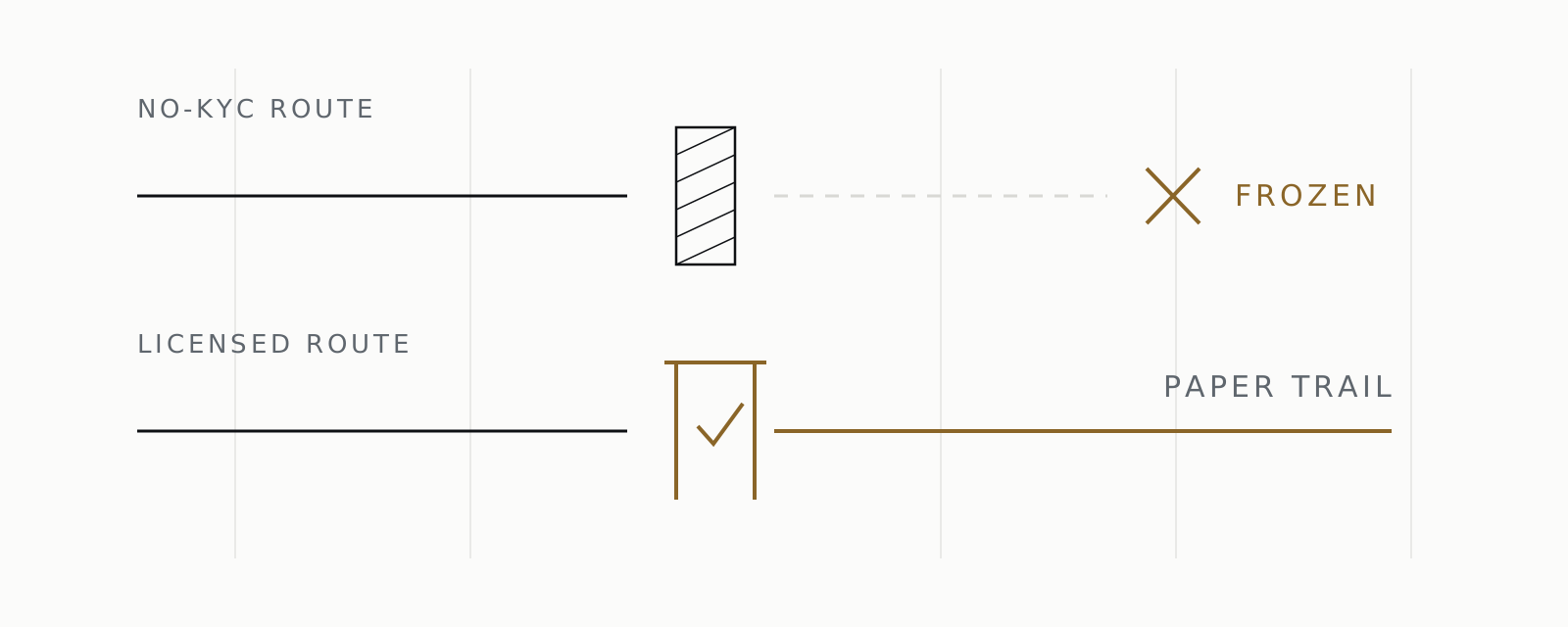
The real cost of no-KYC desks in the UAE
A no-KYC crypto desk in the UAE is, by definition, operating outside the licensed perimeter — identity checks are a legal requirement, not a courtesy. The real price shows up later: frozen bank transfers, funds you cannot explain to your bank, and no paper trail. Licensed desks remove the same friction legally.
KEY FACTS
| KYC obligation | Mandatory for licensed VASPs (VARA rulebooks + federal AML law) |
|---|---|
| Federal AML law | Federal Decree-Law No. 20 of 2018 |
| UAE FATF status | Removed from the grey list on 23 February 2024 |
| Licensed-desk onboarding | One business day in most cases |
| Meridian spread | 0.08%–0.40%, by ticket size, all-in in writing |
Source: VARA rulebooks, FATF and Meridian OTC published pricing bands, as of September 2026.
What does "no KYC" actually mean in the UAE?
A desk that converts USDT to dirhams in the UAE with no identity check is operating without a licence. Identity verification is a legal duty for licensed virtual-asset service providers under VARA's rulebooks and federal anti-money-laundering law — not an optional courtesy the desk can waive for you.
The federal framework is Federal Decree-Law No. 20 of 2018 on anti-money laundering, which obliges regulated businesses to identify their customers and report suspicious transactions. In Dubai, VARA applies the same standard to virtual assets: every licensed Broker-Dealer completes full KYC before the first trade.
Checking a desk takes one minute: ask for the licence number and look it up in VARA's public register. Ours is published in the licence section of our main page — VARA licence VL/24/03/017, held by Meridian Digital Assets FZE.
What happens when the money reaches your bank?
The most common cost of a no-KYC desk in the UAE is a frozen bank account. UAE banks screen inbound transfers for links to unlicensed virtual-asset flow, and a large credit from an unknown counterparty triggers a source-of-funds review before the money becomes available to you.
During that review the bank asks for evidence: a trade confirmation, a contract, a statement from a licensed provider. A no-KYC desk produces none of these, so the transfer sits frozen — reviews can run for weeks — and the bank may file a report with the UAE Financial Intelligence Unit and close the account entirely.
The pressure on banks is structural. The UAE was removed from the FATF grey list on 23 February 2024, and banks have tightened crypto-related monitoring to stay off it. This is why the legal route for cashing out crypto in Dubai exists: the receiving bank gets a clean paper trail and releases the money.
What is the legal risk to you as the seller?
The legal risk sits with the desk first and with you second. Running an unlicensed virtual-asset business in Dubai is a breach of VARA's regime; selling to such a desk is not a licensing offence, but it leaves you holding funds you cannot evidence to your bank or, if asked, to the authorities.
Under Federal Decree-Law No. 20 of 2018, handling money connected to criminal proceeds is an offence where you had reason to suspect the source. A stranger's wallet, a rate above the market and no paperwork is exactly the set of facts that reads as "reason to suspect".
None of this means every no-KYC trade ends in court. It means the attractive rate is a transfer of risk from the desk to you, priced at zero. For a specific situation, take advice from a UAE lawyer — this article is information, not legal advice.
How much does a no-KYC desk actually cost?
The quoted rate from a no-KYC desk is rarely the real rate. Desks that skip KYC typically do not publish a spread at all, so the cost hides inside the rate you are given — and the freeze risk at your bank comes on top of it.
| Route | Advertised cost | Realistic all-in cost | Paper trail | Bank risk |
|---|---|---|---|---|
| No-KYC desk | "Best market rate" | 1% – 3% hidden spread + freeze risk | None | High |
| Licensed OTC desk (bank settlement) | 0.08% – 0.50% | 0.08% – 0.50%, all-in, in writing | Contract, receipt, bank wire | Low |
| Regulated exchange | 0.10% – 1% + withdrawal fees | 0.10% – 1% + withdrawal fees | Account statements | Low–medium |
The desk that shows its spread is the cheap one; the desk that hides it prices the risk into your bank account.
On a 500,000 USDT sale the difference is arithmetic. At the 3.6725 peg that ticket is AED 1,836,250: a 2% hidden spread costs AED 36,725 before any freeze, while a 0.25% licensed-desk spread costs about AED 4,590 with a receipt your bank accepts. Our bands are published in the pricing section of the main page, with a calculator for your ticket size.
How do you cut the friction without cutting the corners?
Every legitimate shortcut is about doing the checks once and early, not skipping them. Four steps remove almost all of the waiting.
-
STEP 1
Open the account before you need it
You register once: a passport and proof of address for an individual, the licence and ownership documents for a company. Approval takes one business day in most cases — the full list is in our onboarding checklist. After that, KYC never touches a trade again.
-
STEP 2
Prepare source-of-funds evidence
Keep whatever shows where the USDT came from: exchange statements, a past sale contract, mining or business records. Handing this over with your first trade pre-answers the questions your bank would otherwise ask later.
-
STEP 3
Trade against a written quote
State the amount, receive one all-in price held for a defined window, then send USDT on the agreed network — TRC20 is the common, cheap rail. The sequence is the same as in our step-by-step guide to selling USDT in Dubai.
-
STEP 4
Settle to an account in your own name
A licensed desk pays only to your own account: AED by UAEFTS the same business day, USD by SWIFT in 2 to 5 business days. The wire itself is the paper trail — your bank sees a transfer from a licensed company, not a stranger.
What are the red flags of a no-KYC offer?
The red flags of a no-KYC crypto desk in the UAE are consistent enough to list, in descending order of importance:
- No licence number, or one that does not resolve in the VARA public register.
- "No documents at any size" — identity checks are a legal duty, so the offer is an admission the desk is unlicensed.
- Settlement offered to third-party accounts, or cash handovers for large amounts.
- A rate at or above the 3.6725 peg — better-than-arithmetic pricing is how the risk transfer gets funded.
- Messenger-only presence, pressure and countdown timers instead of a written quote window.
The bottom line on no-KYC desks in the UAE
"No checks" is not a feature; it is the desk telling you which laws it ignores, and the bill arrives at your bank, not theirs. One day of onboarding with a licensed desk buys the same speed permanently — same-day AED settlement, a written quote and a paper trail your bank accepts.
FAQ
Is it illegal to sell crypto to a no-KYC desk in the UAE?
Operating without a licence is the offence, and it sits with the desk. Your exposure is anti-money-laundering risk: you are left holding funds you cannot evidence, and the receiving bank can freeze the transfer and file a report. The clean route is a licensed desk.
Can a bank freeze my account after a crypto sale?
Yes. UAE banks review large inbound transfers for source of funds, especially crypto-linked ones. A licensed desk's contract and receipt usually answer the review in days; a no-KYC trade leaves no evidence, and the freeze can run for weeks or end in account closure.
How do I check whether a crypto desk is licensed in Dubai?
Ask for the licence number and search it in VARA's public register. Check that the legal entity name on the register matches the desk's contracts and bank details. No number, or a number that does not resolve, means unlicensed.
How long does KYC take at a licensed desk?
One business day in most cases: a passport and proof of address for individuals, the trade licence and ownership documents for companies. Once the account is approved, trades settle the same business day — the check happens once, not on every trade.
Trade with a paper trail your bank accepts
Meridian OTC is a VARA-licensed Broker-Dealer in Dubai, licence VL/24/03/017. Onboarding takes one business day; after that, all-in spreads of 0.08–0.40% by size and AED in your own account the same business day.
SOURCES
- VARA public register — licence status check, accessed 10 September 2026.
- VARA rulebooks — KYC/AML obligations for licensed VASPs, accessed 10 September 2026.
- FATF — Jurisdictions under Increased Monitoring, February 2024 (UAE removed from the grey list), accessed 10 September 2026.
- UAE Legislation portal — Federal Decree-Law No. 20 of 2018 on anti-money laundering, accessed 10 September 2026.
This guide is informational and is not legal, tax or investment advice, nor an invitation to buy or sell any virtual asset. Rules and figures are as of September 2026 — re-check the sources before acting. Virtual assets may lose their value in full or in part and are subject to extreme volatility.