
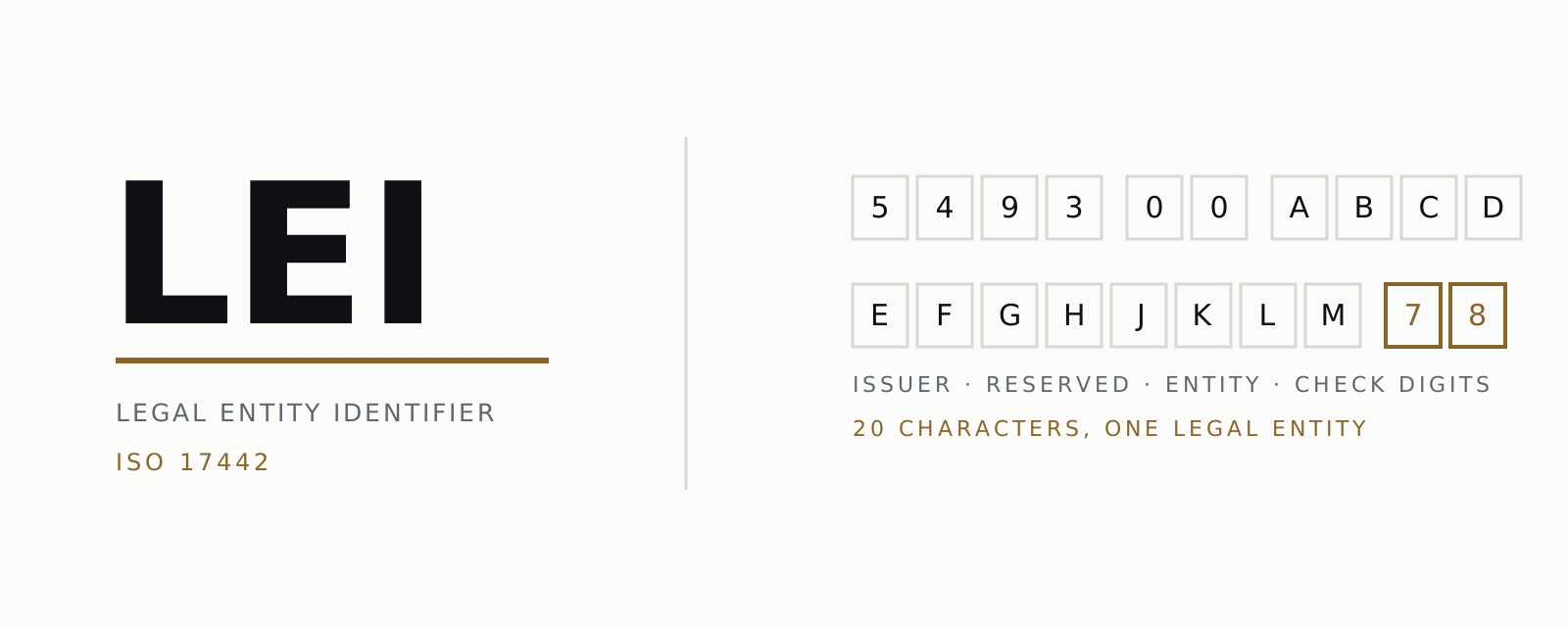
What is an LEI code?
An LEI code — short for Legal Entity Identifier — is a 20-character code that identifies a legal entity in financial transactions worldwide. Issued under the ISO 17442 standard and searchable free of charge in the GLEIF database, it confirms exactly which company sits on the other side of a trade.
KEY FACTS
| Full name | Legal Entity Identifier (LEI) |
|---|---|
| Standard | ISO 17442 |
| Format | 20 alphanumeric characters |
| System operator | GLEIF (Basel, Switzerland) |
| Where to check a code | search.gleif.org — free |
| Typical issue cost | ~USD 60–100, first year |
Source: GLEIF and ISO 17442, as of September 2026.
What does an LEI code contain?
An LEI code is 20 characters long and mixes letters and digits. The first four characters identify the issuer, the next two are always "00", the middle twelve identify the entity itself, and the final two are check digits that catch typing errors. The format is fixed by the ISO 17442 standard, so an LEI means the same thing in every country.
Behind the code sits a public record with two levels. Level 1 answers "who is who": legal name, registered address, country of incorporation and registration number. Level 2 answers "who owns whom": the entity's direct and ultimate parent companies, where these can be identified.
The practical use for traders is simple. Before you sell USDT in Dubai to or through a corporate counterparty, the LEI tells you exactly which legal entity you are dealing with — not a brand name or a website, but a registered company at a registered address.
Who runs the LEI system?
The LEI system is run by the Global Legal Entity Identifier Foundation — GLEIF — a non-profit organisation based in Basel, Switzerland. GLEIF was founded in 2014 under a mandate from the G20 and the Financial Stability Board, after the 2008 crisis showed how hard it was to see which entities stood behind a trade.
GLEIF does not issue codes itself. Issuance is done by accredited organisations known as Local Operating Units, and a Regulatory Oversight Committee of public authorities supervises the system. GLEIF maintains the free public database of every issued code — more than 3 million active records, as of September 2026.
How do LEIs work in the UAE?
In the UAE an LEI is obtained from any accredited issuer, not from a local authority — there is no UAE-specific version of the code. A Dubai company applies online, submits its trade licence and ownership documents, and normally receives the code within a few working days.
No UAE law obliges every company to hold an LEI, yet the code comes up constantly in practice. Banks request it for corporate accounts, the financial free-zone regimes use it in reporting, and OTC desks ask for it when onboarding a company — our own corporate onboarding includes it where the entity has one.
Why check a counterparty's LEI before selling USDT?
Checking a counterparty's LEI matters because large crypto trades in the UAE settle by bank wire between named legal entities — the same is true when you sell crypto from a UAE company account — and the name on a website proves nothing. The LEI lookup returns the exact registered name, jurisdiction and status of the company you are about to trade with.
Three fields deserve attention: the registration status (you want ISSUED, not LAPSED or RETIRED), the registered address, and the parent company in the Level 2 data. A lapsed LEI does not prove fraud, but it tells you the entity has stopped maintaining its public identity — a fair question before a seven-figure USDT sale.
The LEI check complements the licence check rather than replacing it. For a virtual-asset desk in Dubai, the first test is the VARA public register — ours is linked from the licence section of the main page — and the LEI then confirms the legal entity behind the licence. The full route is laid out in our guide to cashing out crypto in Dubai legally.
Example. A company in JLT sells 500,000 USDT — about AED 1,836,250 at the 3.6725 dollar peg. Before the trade, the desk looks up the company's LEI: the record shows the same legal name as on the trade licence, status ISSUED, renewal due in March 2027. The whole check takes two minutes and costs nothing.
How to check an LEI, step by step
Checking an LEI takes one free search in the GLEIF database, and the result should be matched against the documents you were given. The steps:
- Ask for the code. Request the counterparty's 20-character LEI or its exact registered legal name.
- Search the GLEIF database. Open search.gleif.org and enter the code or name — no account or fee needed.
- Match the record. Compare the legal name and registered address in the LEI record against the trade licence or invoice.
- Check the status. ISSUED means current; LAPSED means the annual renewal was missed.
- Keep a dated copy. Save a screenshot or PDF of the record for your compliance file.
If a company has no LEI, that alone proves nothing — many sound firms have never needed one. The red flag is a company that quotes a code which does not resolve, or resolves to a different entity than the one you are paying.
FAQ
Is an LEI mandatory for companies in the UAE?
No UAE rule requires every company to hold an LEI. Certain regulated activities and reporting regimes use the code, and banks and licensed desks often request it during corporate onboarding. Whether your entity needs one depends on what it does.
How much does an LEI cost?
Fees are set by each accredited issuer, not by GLEIF. Initial registration commonly runs to roughly USD 60–100, with annual renewal priced at a similar or slightly lower level. Looking up a code in the GLEIF database is free.
Does an LEI prove a company is trustworthy?
No. An LEI proves identity: a legal entity with that name and address exists and maintains its public record. It says nothing about solvency or conduct. For a Dubai virtual-asset desk, check the VARA licence as well.
What is the difference between an LEI and a trade licence number?
A trade licence number is issued by a UAE licensing authority and identifies a company locally. An LEI is a global code under the ISO 17442 standard, recognised across borders and used in financial transactions. A company can hold both; they serve different checks.
Trade with a desk that shows its credentials
Meridian OTC is a VARA-licensed Broker-Dealer in Dubai, licence VL/24/03/017. Spread 0.08–0.40% by ticket size, AED by UAEFTS the same business day, tickets from around 100,000 USDT. We expect to be checked — that is the point of this article.
SOURCES
- GLEIF — LEI search — free public lookup, accessed 10 September 2026.
- GLEIF — introducing the Legal Entity Identifier — system structure and governance, accessed 10 September 2026.
- ISO 17442 — Financial services: Legal entity identifier, accessed 10 September 2026.
- GLEIF — active LEI population surpasses 3 million in Q1 2026, accessed 14 September 2026.
- LEI United Arab Emirates — registration and renewal pricing (US$65 per year), accessed 14 September 2026.
- RapidLEI — how long does it take to issue an LEI code, accessed 14 September 2026.
- LEI Service — LEI pricing (US$58 registration and renewal), accessed 14 September 2026.
This guide is informational and is not legal, tax or investment advice, nor an invitation to buy or sell any virtual asset. Rules and figures are as of September 2026 — re-check the sources before acting. Virtual assets may lose their value in full or in part and are subject to extreme volatility.