
Push-to-card payouts: why cards are wrong for large settlements
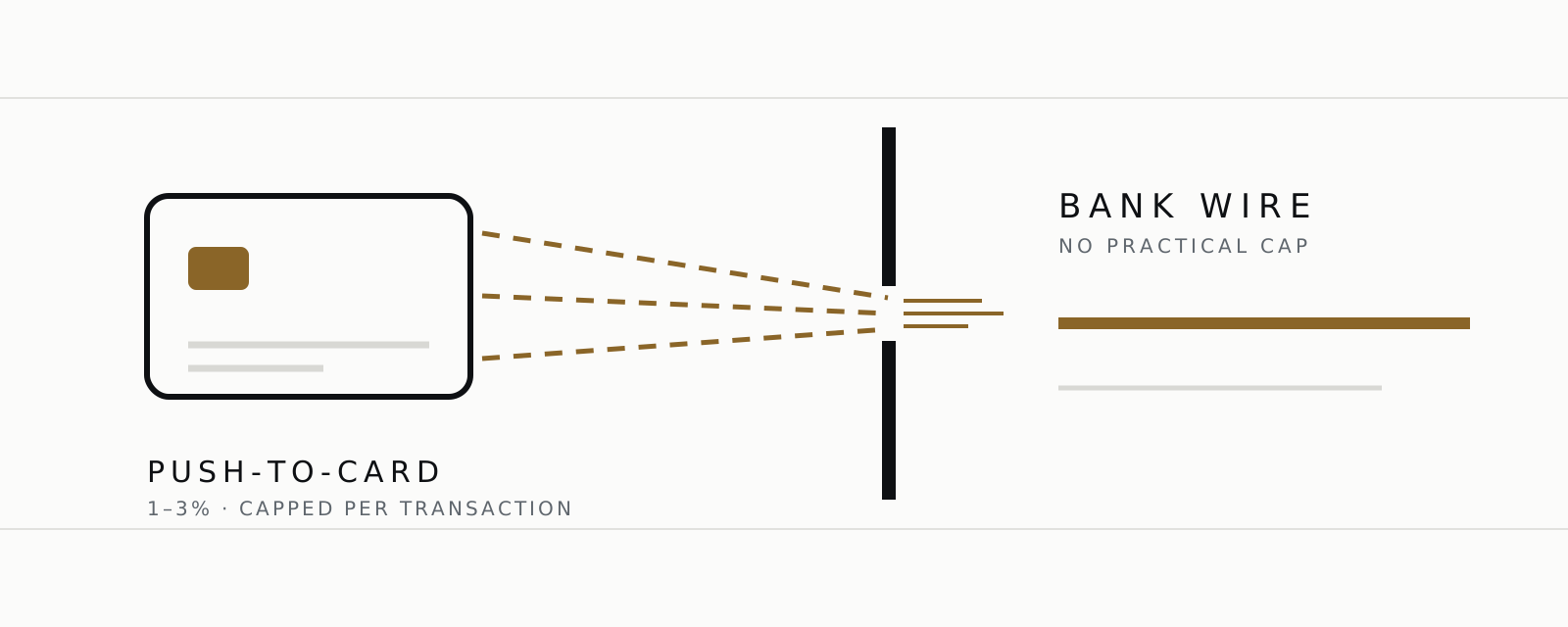
Push-to-card payouts send money straight to a Visa or Mastercard through Visa Direct or Mastercard Send. They are fast but expensive — typically 1–3% all-in — and capped in the low thousands per transaction. Above that size, a bank wire to your own account is cheaper, larger and cleaner.
KEY FACTS
| Push-to-card rails | Visa Direct (OCT), Mastercard Send |
|---|---|
| Typical all-in cost | 1%–3%, plus FX margin on cross-border |
| Practical ceiling | Low thousands USD per transaction (issuer-set) |
| AED wire alternative | Same business day (UAEFTS), no practical cap |
| USD wire alternative | 2–5 business days (SWIFT), no practical cap |
Source: Visa and Mastercard product documentation, as of September 2026.
What is a push-to-card payout?
A push-to-card payout is a payment sent directly to a Visa or Mastercard card number — an Original Credit Transaction on Visa Direct, or a MoneySend message on Mastercard Send. The sender needs only the 16-digit card number, and funds typically arrive within minutes, around the clock.
In crypto, this is the rail behind most "withdraw to your card" buttons on exchanges and e-money apps. The platform sells your USDT, then its payment processor credits the proceeds to your card. For the bank-settled alternative, see how to sell USDT in Dubai step by step.
The rail was engineered for refunds, gig-economy wages and remittances — frequent, small, urgent payments. Those design goals explain everything that follows: the speed, the fees and the ceiling.
How much does a push-to-card payout cost?
A push-to-card payout typically costs 1–3% all-in as of September 2026: a network fee, a processor markup and, on cross-border payouts, an FX conversion margin that often exceeds the visible fee. Neither Visa nor Mastercard sets end-user pricing — the processor does, and publishes it poorly.
Put that next to a desk trade settled by wire. Meridian's published spread is 0.08–0.40% by ticket size, and the wire itself is a fixed bank fee, not a percentage of the amount.
On a USD 500,000 settlement the arithmetic is brutal. A 2% card payout costs USD 10,000 before any FX margin; a 0.25% desk spread costs USD 1,250 with the wire included. The difference — roughly USD 8,750 — is the price of choosing the wrong rail.
Cost is half the story. The other half is how much the rail will carry at all.
| Rail | Typical all-in cost | Practical ceiling | Time to money |
|---|---|---|---|
| Push-to-card (Visa Direct / Mastercard Send) | 1% – 3% + FX margin | Low thousands USD per transaction | Minutes, 24/7 |
| Aani (instant AED) | Low fixed fee | AED 50,000 per transaction | Seconds |
| UAEFTS (AED wire) | Fixed bank fee | No practical cap | Same business day |
| SWIFT (USD / international) | Bank + correspondent fees | No practical cap | 2–5 business days |
The card rail is the fastest and the most expensive line in the table — and its ceiling sits orders of magnitude below what a wire carries.
Why are card payouts capped so low?
Push-to-card limits are set by the card network's programme rules and the receiving card issuer, not the sender, and commonly sit in the low thousands of US dollars per transaction: Visa's published default for a domestic person-to-person push is US$2,500, approved disbursement programmes get higher ceilings, and issuers can set lower caps of their own, with daily and monthly velocity limits behind them. No public register of UAE issuer caps exists as of September 2026, so the honest answer to "what is my limit" is: ask the bank that issued your card.
There is a second, softer limit: acceptance. Issuers screen inbound credits by merchant category, and crypto-adjacent categories are among the most frequently declined. A payout that lands on Monday can bounce on Thursday, and the issuer owes you no explanation.
Card credits are also reversible in a way wires are not. Network rules allow inbound credits to be returned, and an issuer reviewing unusual inbound volume can hold the funds while it asks questions.
For context: the UAE's instant account-to-account system caps single Aani transfers at AED 50,000, yet moves large daily volumes, because the cap is per transaction and the credit is not reversible by network rule. The card ceiling is lower, and the credit is softer.
When does push-to-card make sense?
Push-to-card makes sense for small, urgent payouts under a few thousand dollars, where the recipient values minutes more than basis points. Used as a retail rail, it works well. Used as a settlement rail for size, it fails on cost, capacity and finality at once.
- The amount is below roughly USD 5,000 and 2% is a known, acceptable price.
- It is 2 a.m. and no bank window is open anywhere.
- The recipient has no reliable bank account and the card effectively is the account.
- The payment is a one-off remittance, not a treasury movement.
Push-to-card is the wrong tool for six- and seven-figure settlements, property payments, company treasury moves, and anything your bank may later ask you to document.
Why is a bank wire the right rail for size?
A bank wire is the right rail for large settlements because it is priced as a fixed fee, capped only by your bank's comfort, and lands as an own-name credit with a paper trail. In the UAE, AED moves by UAEFTS the same business day — we explain how UAEFTS moves dirhams in a separate guide — and USD moves by SWIFT in two to five business days.
Compliance matters as much as cost. A wire from a VARA-licensed desk arrives with an identified sender and a trade confirmation behind it. A hundred card credits from a foreign processor arrive looking like precisely the pattern banks are trained to question.
This is why licensed desks, ours included, pay out only by wire to an account in your own name. Approval takes one business day in most cases — the document list is in our onboarding section — and once approved, the whole route from wallet to bank account fits inside a single trading day.
The bottom line on push-to-card payouts
Push-to-card is an excellent rail inside its design envelope: small, urgent, retail. Outside that envelope it is the most expensive and the most fragile way to receive money. For anything above the low thousands, the answer is the boring one — sell through a licensed desk and take the wire.
FAQ
Can I receive a large crypto payout straight to my card?
Technically yes, through Visa Direct or Mastercard Send, but issuer caps in the low thousands per transaction, percentage fees and possible issuer reviews make cards the wrong rail for size. A bank wire is the standard route for large settlements.
How much does a push-to-card payout cost?
Typically 1–3% all-in as of September 2026: a network fee, a processor markup and, on cross-border payouts, an FX conversion margin. Pricing is set by the payment processor, not by Visa or Mastercard.
What is the maximum amount I can receive by push-to-card in the UAE?
There is no single published figure. Each card issuer sets its own per-transaction and monthly caps, commonly in the low thousands of US dollars per transaction. Ask your issuing bank for its current limits.
Is a bank wire safer than a card payout for a large sum?
For large sums, yes. A wire to your own-name account is not reversible by network rule and arrives with a documented sender, while inbound card credits can be held or returned during an issuer review.
Settle by wire, not by card
Meridian OTC is a VARA-licensed Broker-Dealer in Dubai. All-in spread 0.08–0.40% by size, AED by UAEFTS the same business day, USD by SWIFT in two to five — always to an account in your own name.
SOURCES
- Visa Developer — Visa Direct for Card (Original Credit Transactions), accessed 10 September 2026.
- Mastercard Send — cross-border payments, accessed 10 September 2026.
- Central Bank of the UAE — payment systems (UAEFTS and Aani), accessed 10 September 2026.
- Visa Developer Community — Visa Direct transfer limits (default OCT limits, issuer limits and rolling velocity limits), accessed 14 September 2026.
- Khaleej Times — UAE banks restrict cryptocurrency-linked card transactions, March 2018, accessed 14 September 2026.
- Meridian OTC published pricing bands and onboarding requirements — Meridian OTC published pricing bands, September 2026.
This guide is informational and is not legal, tax or investment advice, nor an invitation to buy or sell any virtual asset. Rules and figures are as of September 2026 — re-check the sources before acting. Virtual assets may lose their value in full or in part and are subject to extreme volatility.