
Buying property in Dubai with USDT: the compliant structure
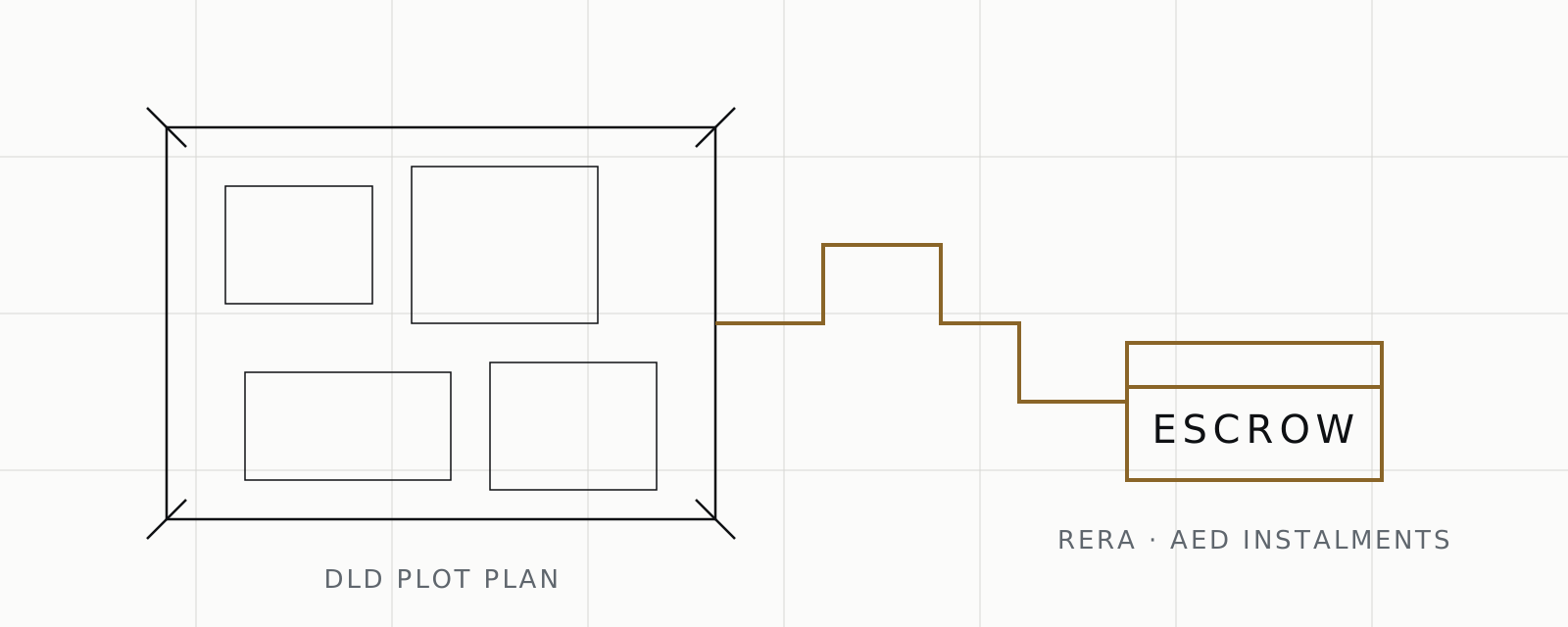
Yes — but the seller never touches your crypto. A VARA-licensed desk converts your USDT to AED and pays the developer's RERA escrow account for off-plan, or the trustee office at the Dubai Land Department for a resale. The contract, the escrow and the title deed all run in dirhams.
KEY FACTS
| Crypto-leg regulator | VARA (Dubai, outside the DIFC) |
|---|---|
| Property registrar | Dubai Land Department; RERA for off-plan escrow |
| DLD transfer fee | 4% of the purchase price |
| Meridian spread | 0.08%–0.40%, by ticket size |
| AED to escrow or seller | Same business day (UAEFTS) |
| Desk minimum | From around 100,000 USDT |
Source: Dubai Land Department published fees and Meridian OTC pricing bands, as of September 2026.
Can you buy property in Dubai with USDT legally?
Buying property in Dubai with USDT is legal when the conversion runs through a VARA-licensed provider and the seller is paid in AED. Two regulators divide the deal: VARA supervises the crypto leg, and the Dubai Land Department (DLD) with its regulatory arm RERA supervises the property leg. Check any desk in VARA's public register before you sign — our entry is linked from the licence section of the main page.
What makes the structure clean is what it does not contain: the sale agreement is priced in dirhams, the escrow receives dirhams, and the title deed registers a dirham consideration. Crypto appears only as the funding source behind the conversion, which is exactly how your bank and any future buyer will want it to read.
How does the compliant payment structure work?
The compliant structure has three parties and two currencies. You send USDT to a licensed desk; the desk converts it and pays AED to where Dubai law says buyer money must go — the project's RERA escrow account for off-plan, or a manager's cheque at a DLD trustee office for a resale.
For off-plan units, Dubai Law No. 8 of 2007 requires every buyer instalment to land in a project-specific escrow account registered with RERA, and the developer draws from it only against certified construction milestones. The account is held with a DLD-approved bank, not with the developer. If your instalment arrives in that account from a regulated desk, the law protects you exactly as it protects a buyer paying from a salary account.
For a resale, the money changes hands at a DLD registration trustee office, classically as a manager's cheque issued to the seller. The desk settles AED to your own UAE account by UAEFTS the same business day, and your bank issues the cheque for the appointment. Own-name settlement is non-negotiable here: a desk offering to pay "any account you like" fails the same test as a seller asking for cash.
What are the steps from USDT to title deed?
The sequence from USDT to a registered title deed has five steps, and the order matters. The conversion is step four, not step one — everything legal is agreed in dirhams first.
-
STEP 1
Get the desk account approved before you sign
You register once: passport and proof of address for an individual, licence and ownership documents for a company. Approval takes one business day in most cases — the document list is in our onboarding section. Doing this before the memorandum or SPA sets the completion clock is the single biggest speed-up available.
-
STEP 2
Sign the sale agreement with the price in AED
The SPA for an off-plan unit, or Form F for a resale, states the price and the payment schedule in dirhams. Crypto is your funding method, not the contract currency; an agreement "priced in USDT" is a document the DLD will not register.
-
STEP 3
Request a written quote for the USDT amount
You state the AED obligation and the desk returns one all-in USDT figure held for a defined window — price plus fees, nothing drifting between quote and fill. A dealer answers within the hour during dealing time, Sunday to Thursday, 09:00–18:00 GST.
-
STEP 4
Send USDT; the desk pays AED the same day
You send USDT on the agreed network only after accepting the written quote. The desk pays AED by UAEFTS the same business day — directly into the RERA escrow account for off-plan, or into your own account to fund the manager's cheque for a resale. Keep the settlement confirmation with the property file.
-
STEP 5
Register the transfer
Off-plan sales are registered on the DLD's Oqood system; resales are completed at the trustee office, where the title deed is issued in your name. The desk's wire confirmation and the escrow or trustee receipt together give you a complete paper trail from wallet to deed.
Which documents do you need for the purchase?
A USDT-funded purchase needs the standard Dubai buyer documents plus evidence for where the digital assets came from. Nothing on the list is unusual; the crypto-specific item is the source-of-funds file.
- Passport, and Emirates ID if you are a UAE resident.
- Proof of address issued within 90 days, for desk onboarding.
- The signed SPA (off-plan) or Form F (resale), priced in AED.
- Source-of-funds evidence for the USDT: bank statements, exchange records, wallet history — the full list is in our source-of-funds guide.
- For off-plan: the project's RERA escrow account details, taken from the developer's official registration — not from a message thread.
- For resales: the seller's title deed and the developer's no-objection certificate.
What does a USDT-funded purchase cost in fees?
A USDT-funded purchase costs the same government fees as any Dubai purchase, plus one extra line: the desk's conversion spread. The DLD transfer fee is 4% of the price as of September 2026, and our spread bands — 0.08% to 0.40% by size — are published on the pricing section of the main page.
| Cost line | Amount | Paid to | Note |
|---|---|---|---|
| DLD transfer fee | 4% of price | Dubai Land Department | Identical for cash and crypto-funded buyers |
| Trustee office fee | ~AED 4,000 + VAT | DLD registration trustee | Resale transfers |
| Desk conversion spread | 0.08% – 0.40% | The OTC desk | By ticket size; the only crypto-specific cost |
| Agency commission | Commonly ~2% | The broker | Set by agreement, not by law |
Government fees ignore your funding source entirely — on an AED 5,000,000 flat the DLD takes AED 200,000 either way, and the crypto route adds only the spread.
A worked example on an AED 5,000,000 apartment: at the 3.6725 peg the price is roughly 1,361,000 USDT. The DLD fee is AED 200,000, the trustee line about AED 4,200, agency commission around AED 100,000, and a 0.25% spread adds AED 12,500. Total non-price costs sit near AED 316,700 — of which the crypto-specific part is about 4%.
What are the red flags of "we take crypto directly"?
A developer that says it accepts crypto directly is not automatically a problem — some work with licensed payment processors that convert on their side. The details decide, and the red flags when buying Dubai property with USDT are:
- Payment requested to a private wallet rather than the project's RERA escrow account.
- No AED-denominated SPA — or a contract "priced in USDT" that the DLD cannot register.
- A "crypto discount" larger than the cost of conversion; the discount is often the escrow protection being quietly removed.
- A processor or desk you cannot find in the VARA public register.
- Pressure to skip your own checks on the project registration or the seller's title.
When a developer proposes receiving the coins itself, the questions multiply — pricing basis, custody, refunds, and what happens if construction stalls. We cover that structure, and the cases where it can still work, in our guide to developers accepting crypto directly.
The bottom line on buying Dubai property with USDT
The compliant way to buy property in Dubai with USDT looks boring by design: a dirham contract, a regulated conversion, and AED arriving where DLD rules say buyer money must arrive. If a counterparty's pitch is that crypto makes the paperwork disappear, the paperwork is what you were paying for.
FAQ
Can I pay a Dubai developer directly in USDT?
Some developers accept crypto through licensed payment processors that convert it to AED on their side. What you should not do is send USDT to a private wallet against an AED contract — your payment then exists nowhere in the documents that register your property.
Does off-plan money have to go through escrow in Dubai?
Yes. Under Dubai Law No. 8 of 2007, buyer instalments for an off-plan unit go into a project escrow account registered with RERA, and the developer draws against construction milestones. A request to pay any other account is a red flag.
Do I pay extra government fees when funding a purchase with crypto?
No. DLD and trustee fees are identical however you fund the purchase — 4% of the price for the transfer, as of September 2026. The only crypto-specific cost is the desk's conversion spread, 0.08% to 0.40% by size at Meridian.
How fast can the AED leg settle before a signing?
Once your desk account is approved, AED goes out by UAEFTS the same business day you trade. Approve the account before you agree the completion date, not after.
Fund a property purchase with same-day AED settlement
Meridian OTC is a VARA-licensed Broker-Dealer in Dubai. All-in spread 0.08–0.40% by size, published openly. AED by UAEFTS the same business day once your account is approved — straight into escrow or your own account.
SOURCES
- Dubai Land Department — property sale registration and fees, accessed 10 September 2026.
- Dubai Law No. 8 of 2007 concerning escrow accounts for real estate development (RERA escrow regime) — via the DLD portal, accessed 10 September 2026.
- VARA public register — licence status check, accessed 10 September 2026.
- Meridian OTC published pricing bands and onboarding requirements — Meridian OTC published pricing bands, September 2026.
- Engel & Völkers — How much is the real estate agent commission in Dubai? — market-standard 2% on secondary sales, set by agreement, accessed 14 September 2026.
This guide is informational and is not legal, tax or investment advice, nor an invitation to buy or sell any virtual asset or property. Rules and figures are as of September 2026 — re-check the sources before acting. Virtual assets may lose their value in full or in part and are subject to extreme volatility.