
What is escrow in UAE real estate?
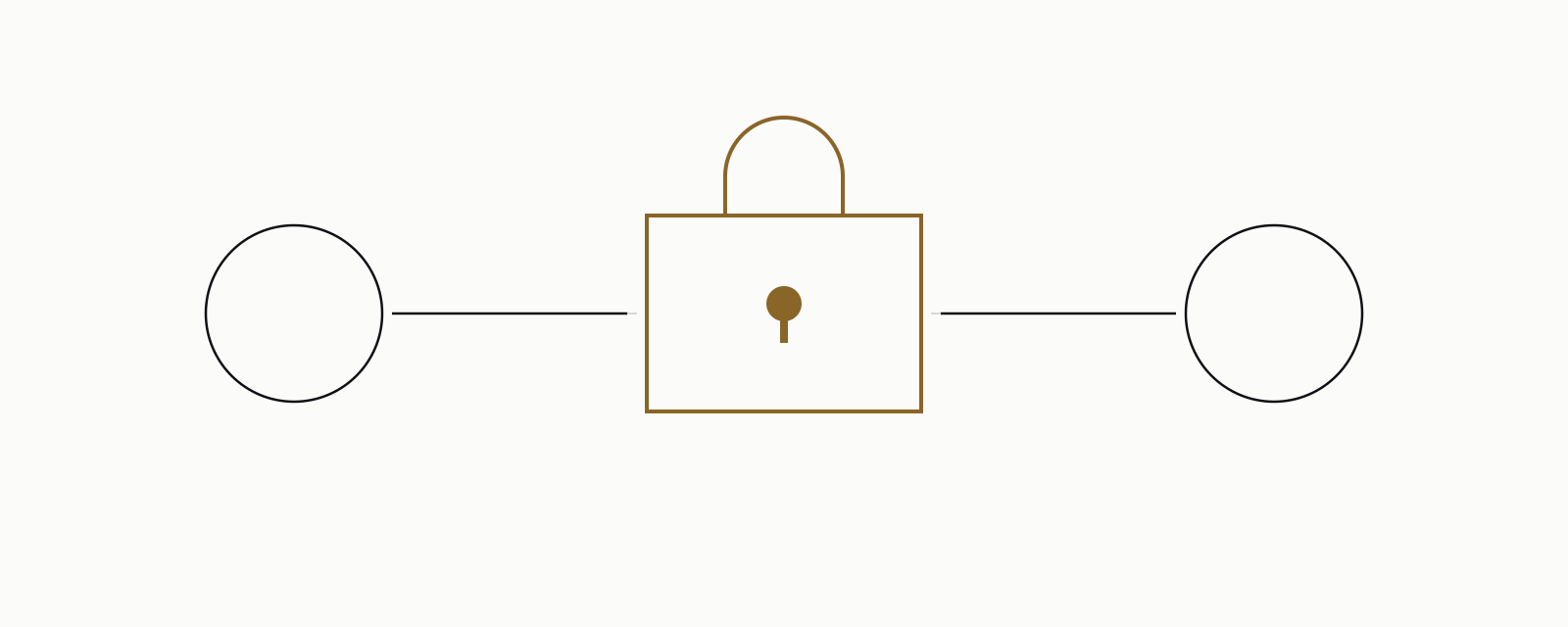
Escrow in UAE real estate is a RERA-registered trust account at an approved bank that holds buyer instalments for an off-plan project. The developer cannot touch the money until a certified construction milestone is reached; in Dubai this arrangement is mandatory under Law No. 8 of 2007.
KEY FACTS
| Legal basis (Dubai) | Law No. 8 of 2007 |
|---|---|
| Applies to | Off-plan sales only |
| Post-completion hold | 5% retained for one year |
| Crypto accepted | No — AED bank wires only |
| Conversion cost at Meridian | 0.08%–0.40% spread, by size |
Source: Dubai Land Department / RERA rules and Meridian OTC published pricing bands, as of September 2026.
How does escrow work in UAE real estate?
Escrow in UAE real estate works as a locked middle account: every off-plan instalment you pay goes into a RERA-registered trust account at an approved bank, and the developer receives money only when an engineering consultant certifies a construction milestone.
The legal base is Dubai Law No. 8 of 2007. A developer selling off-plan must register the project with the Dubai Land Department (DLD) and open a dedicated escrow — officially "trust" — account before taking a single dirham from buyers. Buyers paying from crypto convert first; that step is covered in our guide to cashing out crypto in Dubai legally.
Money leaves the account in tranches. A RERA-approved consultant certifies each milestone, the escrow agent releases the matching amount, and after completion 5% of the account's value stays locked for one year against defects, under the same law as of September 2026.
Where does escrow apply — and where does it not?
Escrow in the UAE applies to off-plan sales only. A ready property changes hands at a DLD trustee office, normally against manager's cheques, so no trust account sits in the middle of that deal, as of September 2026.
Other emirates run their own versions of the rule. Abu Dhabi regulates off-plan escrow under its own Law No. 3 of 2015; the details differ, but the principle is the same — buyer money never sits with the developer.
Why does escrow matter when you sell USDT?
Escrow matters when you sell USDT because the two systems never touch: a RERA trust account accepts AED bank wires only, so crypto must become dirhams at a licensed provider before it can fund a milestone, as of September 2026.
The desk's own-name settlement rule fits escrow neatly. Escrow agents post incoming wires against a named buyer and unit, and money arriving from third parties is commonly returned or held; a licensed desk pays only to an account in your own name, which is exactly the trail the escrow agent wants to see. Check any counterparty's licence in the VARA public register — ours is linked from the licence section of the main page.
Timing is the other reason. Milestone dates are fixed in the sale and purchase agreement, so the practical move is opening a desk account well before the first instalment — approval takes one business day in most cases, per our onboarding section.
Worked example: funding a milestone from USDT
Worked example, as of September 2026: an instalment of AED 2,000,000 falls due. You sell 550,000 USDT at a 0.15% spread — within our published spread bands of 0.08%–0.40% — and receive roughly AED 2,016,800 the same business day.
The arithmetic: 550,000 USDT converts at the 3.6725 peg to AED 2,019,875 before costs, and the 0.15% spread takes about AED 3,030. You wire AED 2,000,000 from your own account to the escrow account named in your agreement, and the remaining buffer absorbs any bank charges on the outgoing wire.
Convert one or two business days before the due date. The desk settles AED the same day you trade, so the margin exists for the onward bank wire, not for the conversion itself — the full sequence is in our guide to selling USDT in Dubai.
The bottom line on escrow in the UAE
Escrow in UAE real estate is buyer protection written into law: your money sits in a RERA trust account and moves only with the building. If the money starts as USDT, one extra step — conversion at a licensed desk into your own account — joins the two halves of a property purchase funded with USDT.
FAQ
Can a RERA escrow account accept USDT?
No. RERA-registered trust accounts are AED accounts at approved banks, and as of September 2026 no escrow arrangement in Dubai accepts crypto. You convert at a licensed desk first, then wire the dirhams yourself.
Does escrow apply to ready property in Dubai?
Only to off-plan sales. Ready property changes hands at a Dubai Land Department trustee office, normally against manager's cheques, with no trust account in the middle, as of September 2026.
Who regulates escrow accounts in the UAE?
In Dubai, the Real Estate Regulatory Agency (RERA), part of the Dubai Land Department, under Law No. 8 of 2007. Abu Dhabi runs its own off-plan escrow regime under Law No. 3 of 2015.
How do I pay an escrow instalment from crypto?
Sell USDT at a licensed desk, receive AED in your own bank account the same business day, then wire the dirhams to the escrow account named in your sale and purchase agreement, referencing your unit.
Convert USDT to escrow-ready AED
Meridian OTC is a VARA-licensed Broker-Dealer in Dubai. All-in spread 0.08–0.40% by size, published openly. AED lands in your own account by UAEFTS the same business day — ready for the escrow wire.
SOURCES
- Dubai Land Department — escrow (trust) accounts for off-plan projects under Law No. 8 of 2007, accessed 10 September 2026.
- VARA public register — licence status check, accessed 10 September 2026.
- Meridian OTC published pricing bands and onboarding requirements — Meridian OTC published pricing bands, September 2026.
This guide is informational and is not legal, tax or investment advice, nor an invitation to buy or sell any virtual asset. Rules and figures are as of September 2026 — re-check the sources before acting. Virtual assets may lose their value in full or in part and are subject to extreme volatility.