
Can Dubai developers accept crypto? The B2B settlement route
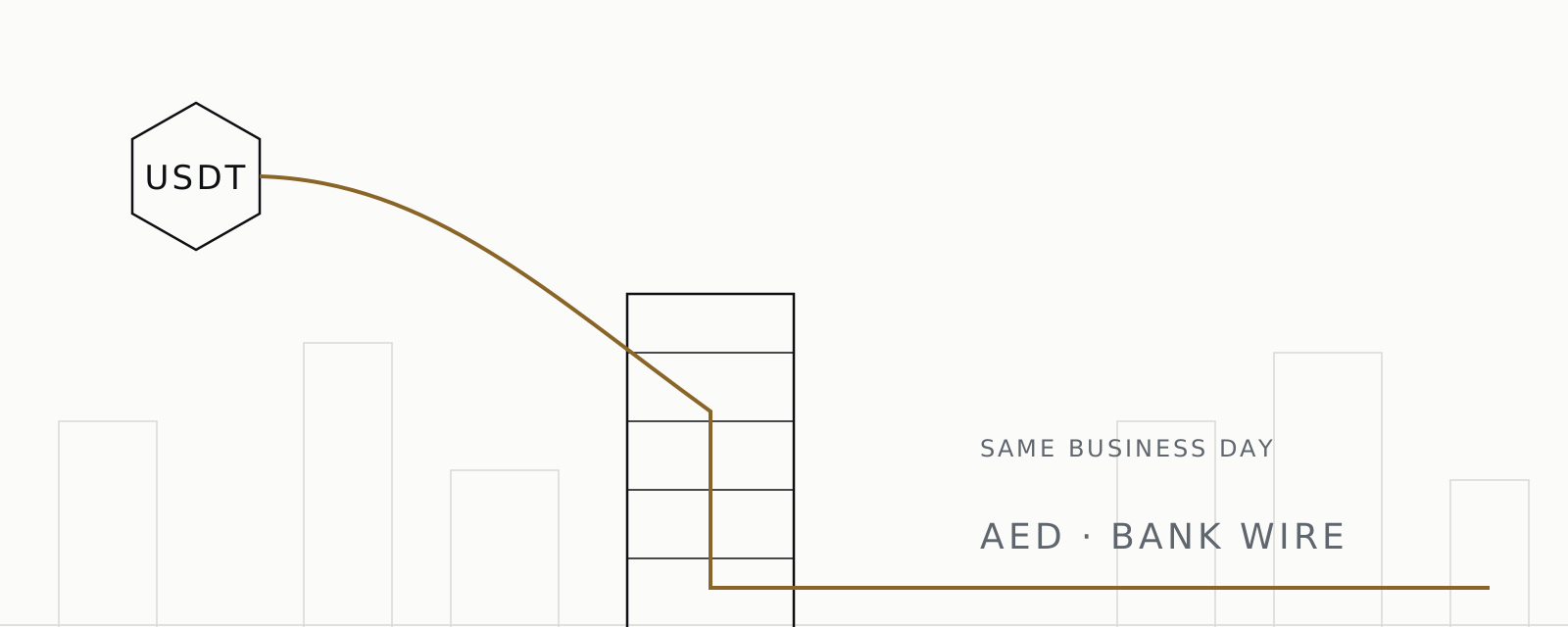
Yes. A Dubai developer can accept crypto from a buyer without touching it directly: a VARA-licensed provider onboards both parties, takes the buyer's USDT, converts it at a quoted spread and wires AED to the developer's own corporate account — usually the same business day. The developer's books show dirhams, not tokens.
KEY FACTS
| Regulator | VARA (Dubai, outside the DIFC) |
|---|---|
| Who gets onboarded | Both the developer and the buyer |
| Meridian spread | 0.08%–0.40%, by ticket size |
| AED settlement | Same business day (UAEFTS) |
| Payment account rule | Developer’s own-name corporate account only |
| Contract currency | AED — crypto is the payment rail |
Source: Meridian OTC published pricing bands and onboarding requirements, as of September 2026.
Is it legal for a Dubai developer to accept crypto?
Accepting crypto for Dubai property is legal when the conversion runs through a VARA-licensed provider — VARA has regulated virtual assets in Dubai, outside the DIFC, since 2022. The developer never takes tokens into its own wallet: the buyer's crypto goes to the licensed provider and the developer receives dirhams. Taking crypto directly, as an unlicensed business, is the version that creates regulatory risk.
The sale itself stays in dirhams on paper. The sale and purchase agreement is denominated in AED and the Dubai Land Department registers the transfer in AED; crypto is the settlement rail, not the contract currency. Before signing anything, check the provider's licence number in VARA's public register — it takes one minute.
How does the B2B settlement route work?
The B2B settlement route has five steps: the developer opens a corporate account with a licensed provider, the buyer completes identity checks, a written quote fixes the conversion, the buyer sends USDT, and the provider wires AED to the developer's own account. For an onboarded pair the full cycle fits inside one business day.
-
STEP 1
Onboard the developer's company
The provider takes the trade licence, ownership documents and corporate bank details once. Approval takes one business day in most cases; the full list sits in our onboarding section. Do this before the first crypto buyer appears, not after.
-
STEP 2
Sign the sale agreement in AED as usual
Nothing in the contract changes: the price, the payment schedule and the registration all stay in dirhams. Crypto only replaces the bank transfer the buyer would otherwise have sent — the buyer's side of that sequence is in our guide to funding a Dubai purchase with USDT.
-
STEP 3
Onboard the buyer
The provider, not the developer, runs the buyer's checks: passport, proof of address and source of funds. A clean file clears in about one business day; a buyer who resists this step is telling you something.
-
STEP 4
Fix the quote in writing
The provider returns one all-in price for the exact AED amount of the instalment or unit, held for a defined window. No verbal rates, no drift between the quote and the settlement.
-
STEP 5
Buyer sends USDT, developer banks AED
The buyer transfers USDT to the provider's address on the agreed network. Once it confirms, the provider pays AED by UAEFTS to the developer's own-name corporate account the same business day.
What does compliance look like on both sides?
Compliance in a crypto property settlement sits mostly with the licensed provider: it verifies the buyer's identity and source of funds, screens the wallet the USDT arrives from, and pays only to a corporate account in the developer's own name. The developer's side is simpler — keep the AED invoice, the written quote and the bank credit advice together as the audit trail for each unit.
The own-name rule runs in both directions. A provider offering to settle to a personal account, a third party or an offshore entity the developer does not own is operating outside the regulated perimeter. And a buyer whose coins trace back to mixers or sanctioned addresses will be rejected — better the buyer hears that at onboarding than on closing day.
What does crypto acceptance cost the developer?
The cost of accepting crypto through a licensed provider is the conversion spread, quoted all-in per ticket. Meridian's published band is 0.08% to 0.40% depending on size — see the pricing bands — and on large unit sales developers usually either pass it to the buyer or price it into the unit. Either way it is known before the buyer sends anything.
| Ticket (USDT) | Indicative spread | Conversion cost (AED) | AED credited |
|---|---|---|---|
| 500,000 | 0.30% | 5,509 | 1,830,741 |
| 2,000,000 | 0.15% | 11,018 | 7,333,983 |
| 5,000,000 | 0.10% | 18,363 | 18,344,138 |
Even at the widest band, converting an AED 18.4m unit costs a fraction of the brokerage fee on the same sale — the spread is not the expensive line in the deal.
Speed matters as much as cost at closing. AED goes out by UAEFTS the same business day once the buyer's transfer confirms; if the developer prefers USD to a dollar account, the wire goes by SWIFT and lands in two to five business days. The same route works one-to-one for an individual seller cashing out after a deal closes.
How is the USDT amount for an AED price fixed?
The USDT amount for an AED price is fixed by a written quote at the moment of conversion, and the peg does the rest: the dirham has been fixed to the US dollar at 3.6725 since 1997, and USDT tracks the dollar, so the USDT/AED rate is close to a constant. What moves between quotes is the spread, not the peg — the mechanics are in our USDT to AED explainer.
The quote window is short and defined, and once the buyer's transfer confirms at the quoted amount the AED leg is locked. Market risk between quote and settlement sits with the provider, not with the developer or the buyer.
What are the red flags in crypto property deals?
The red flags when a developer is offered a crypto settlement route are, in descending order of importance:
- An intermediary with no licence number, or one that does not resolve in the VARA public register.
- Settlement offered to a personal or third-party account — own-name only is the rule on both sides.
- A rate better than the 3.6725 peg; better-than-arithmetic pricing is paid for somewhere less visible.
- No written quote window — verbal prices drift against you when the ticket is large.
- Pressure to skip the buyer's onboarding “because it is a big client”. The size is exactly why the checks exist.
The bottom line for Dubai developers
Accepting crypto is a settlement decision, not a treasury decision: route the buyer's USDT through a VARA-licensed provider, keep the contract and the books in AED, and the developer's direct exposure to virtual assets is zero. Onboard the company once, before the first crypto buyer appears — that day of preparation is what makes a same-day close possible.
FAQ
Can a developer take crypto into its own company wallet?
It can, but receiving virtual assets as a business moves the developer towards regulated virtual-asset activity and wallet screening it is not set up for. The standard structure routes the crypto through a VARA-licensed provider and the developer books AED. Take legal advice on your specific model.
Does the buyer go through compliance checks too?
Yes. The provider onboards the buyer like any other client: identity, proof of address and source of funds, plus screening of the sending wallet. Approval usually takes one business day when the documents are complete.
How fast does the developer receive AED?
Once both parties are approved and the buyer's USDT transfer confirms, AED goes out by UAEFTS the same business day. A USD payout to the developer's dollar account goes by SWIFT and takes two to five business days.
Is the property priced in crypto or in AED?
In AED. The sale agreement and the Land Department registration stay in dirhams; the licensed provider quotes a fixed USDT amount equal to the AED price at the moment of conversion. Crypto is the payment rail, not the unit of account.
Take crypto payments, bank dirhams
Meridian OTC is a VARA-licensed Broker-Dealer in Dubai. We onboard the developer and the buyer, quote one all-in spread of 0.08–0.40% by size, and settle AED to your corporate account the same business day.
SOURCES
- VARA public register — provider licence status check, accessed 10 September 2026.
- Central Bank of the UAE — payment systems (UAEFTS), accessed 10 September 2026.
- Dubai Land Department — registration procedures, accessed 10 September 2026.
- Gulf News — Crypto payments in UAE explained: property purchases converted to dirhams before DLD registration (5 August 2026), accessed 14 September 2026.
- Meridian OTC published pricing bands and onboarding requirements — Meridian OTC published pricing bands, September 2026.
This guide is informational and is not legal, tax or investment advice, nor an invitation to buy or sell any virtual asset. Rules and figures are as of September 2026 — re-check the sources before acting. Virtual assets may lose their value in full or in part and are subject to extreme volatility.