
SWIFT from the UAE: timelines, costs and correspondent banks
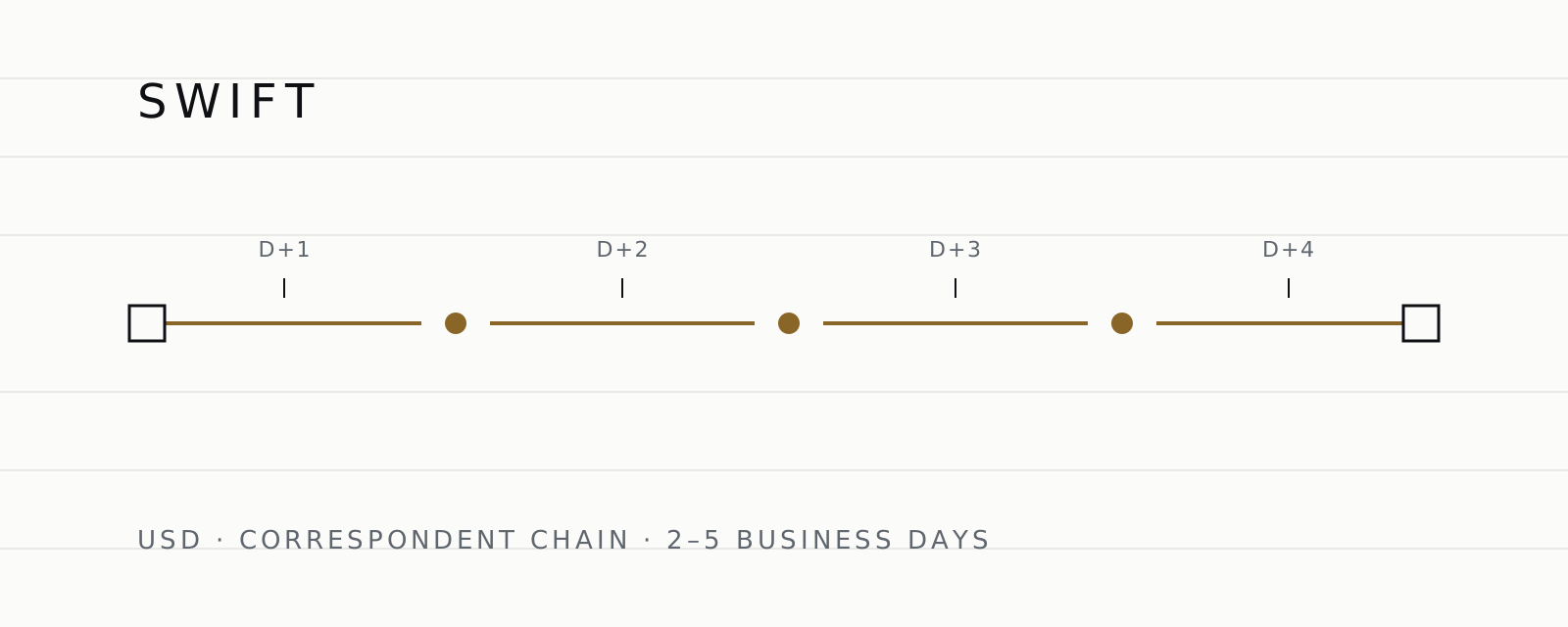
A USD wire from a UAE bank account travels the SWIFT network through one to three correspondent banks and lands in 2 to 5 business days. Cost depends on the fee option — OUR, SHA or BEN — and each correspondent's deduction. Most delays are cut-offs, holidays or compliance screening, not lost money.
KEY FACTS
| Rail | SWIFT (international USD wires) |
|---|---|
| Typical timeline | 2–5 business days |
| Fee instructions | OUR / SHA / BEN |
| Correspondent deductions | Varies by bank pair; each intermediary may deduct its own fee |
| Meridian USD settlement | 2–5 business days, own-name accounts only |
Source: SWIFT (payment mechanics) and Meridian OTC published settlement terms, as of September 2026.
How does a SWIFT payment from the UAE actually travel?
A SWIFT payment from the UAE does not go directly from your bank to the beneficiary's bank. The sending bank routes an instruction (the MT103 message) through the SWIFT messaging network, and the money itself moves across one to three correspondent banks — intermediaries that hold accounts for each other — before the beneficiary's bank credits the funds.
If your starting point is crypto, the chain begins after the trade: in a bank-settled sale of USDT in Dubai, the desk's bank releases the USD wire once the trade settles, and that wire enters the same correspondent chain as any other international transfer.
For USD, the final leg almost always clears in the United States, because dollars ultimately settle at the Federal Reserve. That is why US business days — not UAE ones — decide the value date of your payment.
How long does a SWIFT transfer from the UAE take?
A SWIFT USD transfer from the UAE takes 2 to 5 business days in most cases, as of September 2026. A clean payment released before the sending bank's cut-off with a single correspondent can land in 1 to 2 days. Each extra correspondent, missed cut-off, weekend or holiday adds roughly a day.
Three clocks matter. First, the sending bank's internal cut-off: wires approved after it wait for the next business day. Second, the UAE working week: Saturday and Sunday are the weekend, so Thursday afternoon in Dubai is already Thursday morning in New York — a late-Thursday wire can still clear in the US on Friday. Third, the US clearing day: on a US federal holiday, USD does not move at all.
For how SWIFT compares with the domestic rails — UAEFTS the same business day, Aani in seconds — see the rail-by-rail timing guide. The short version: if dirhams in a UAE account solve the problem, they arrive faster and cheaper.
What do OUR, SHA and BEN mean for the cost?
Every international SWIFT payment carries one of three fee instructions. OUR means the sender pays all fees and the beneficiary receives the full amount; SHA means each side pays its own bank while correspondents deduct in transit; BEN means every fee comes out of the amount sent. Where the exact figure matters — an invoice, a property payment — OUR is the standard instruction.
| Fee option | Sender bank fee | Correspondent fees | Beneficiary receives |
|---|---|---|---|
| OUR | Sender pays | Sender pays (grossed up) | Full amount sent |
| SHA | Sender pays | Deducted in transit | Amount minus deductions |
| BEN | Deducted from amount | Deducted in transit | Amount minus all fees |
OUR costs the sender more upfront but removes the guesswork; SHA and BEN are cheaper to send and unpredictable to receive.
Worked example with illustrative numbers: a USD 500,000 settlement sent SHA, with a USD 25 sender fee charged separately and two correspondents deducting USD 20 and USD 15 in transit, credits the beneficiary USD 499,965. Sent OUR, the same wire costs the sender roughly USD 65 in total charges and credits the full USD 500,000. As of September 2026, correspondent deductions on USD payments vary by bank pair and are rarely published in advance, so treat the deductions above as illustrative and ask your bank for its correspondent charges.
Wire fees sit on top of whatever you paid to get dollars in the first place. If the funds come from a USDT sale, the desk's spread is the larger cost — ours is 0.08% to 0.40% by ticket size, published in the pricing section with a calculator.
Why is a SWIFT payment delayed, and how do you read it?
A delayed SWIFT payment from the UAE is almost always waiting at a known checkpoint, not lost: the sending bank's compliance queue, a correspondent's sanctions screening, a missed cut-off, or beneficiary details that do not match. Payments linked to virtual-asset proceeds can draw extra source-of-funds questions from any bank on the chain.
The usual causes, in the order we see them:
- Compliance screening at a correspondent. The bank can freeze the clock and ask the sender for documents; nothing moves until the answer arrives.
- A holiday anywhere on the chain. A US federal holiday stops USD clearing outright, and a UAE holiday stops the sending bank.
- Beneficiary details that do not match the account name. The payment is held or returned, and a return takes about as long as the outbound leg.
- A missed cut-off at the sending bank — the cheapest day to lose, and the easiest to avoid.
To read a delay, ask the sending bank for two things on day one: the MT103 copy (the payment instruction itself, with all fields and deductions) and the UETR, the unique end-to-end transaction reference. Banks connected to SWIFT gpi can see which institution currently holds the payment; the UETR turns "where is my money" into a traceable query.
If the hold happens on the receiving side — your bank querying an inbound wire of crypto origin — that is a different conversation, covered in the account-freeze guide.
How do you make a USD settlement arrive faster?
Four things decide most of the timeline, and all four are in the sender's control. A licensed desk wires USD only to an account in your own name — which is also what keeps the receiving bank's questions short.
-
STEP 1
Approve the account before the trade
Desk onboarding takes one business day in most cases; the document list is in the onboarding section. A bank-settled wire cannot be released before approval exists, so the day you save here is the day the money arrives earlier.
-
STEP 2
Trade early in the day
A quote accepted before midday GST gives the desk's bank time to release the wire before its cut-off the same day. A trade accepted at 17:00 starts its banking clock the next morning.
-
STEP 3
Send OUR and check every beneficiary field
Use the account name exactly as the bank holds it, the full account number or IBAN, the bank's SWIFT/BIC and a clean purpose-of-payment line. One mismatched field costs more days than any correspondent.
-
STEP 4
Collect the MT103 and UETR on day one
Ask for both when the wire is released, not when you start worrying. If the money has not landed by day three, the reference is what turns a complaint into a trace.
What is the bottom line on SWIFT from the UAE?
SWIFT from the UAE is predictable once you separate the two clocks: the messaging is near-instant, and the money moves on correspondent and US clearing days. Budget 2 to 5 business days, send OUR when the exact amount matters, and keep the MT103 from day one. For anything time-critical in dirhams, the domestic rails are the faster answer.
FAQ
How long does a SWIFT transfer from the UAE take?
Most USD wires from UAE banks land in 2 to 5 business days. A payment sent before the cut-off with one correspondent can arrive in 1 to 2 days; holidays, weekends and compliance screening add the rest.
What is the difference between OUR, SHA and BEN?
OUR: the sender pays every fee and the beneficiary receives the full amount. SHA: fees are split, and correspondents deduct in transit. BEN: all fees come out of the amount sent. For exact-amount settlements, use OUR.
Can I track a SWIFT payment?
Yes. Ask your bank for the MT103 copy and the UETR — the unique end-to-end transaction reference. Banks connected to SWIFT gpi can see which institution currently holds the payment.
Why did my beneficiary receive less than I sent?
The wire went SHA or BEN and one or more correspondent banks deducted their fees in transit — commonly USD 10 to 60 per intermediary, as of September 2026. Your sending bank can request a deduction breakdown.
Need USD or AED settlement for a USDT sale?
Meridian OTC is a VARA-licensed Broker-Dealer in Dubai. AED settles the same business day by UAEFTS; USD goes by SWIFT in 2–5 business days, to own-name accounts only. Spread 0.08–0.40% by ticket size, published openly.
SOURCES
- SWIFT — gpi payment tracking, accessed 10 September 2026.
- BIS Committee on Payments and Market Infrastructures — correspondent banking, accessed 10 September 2026.
- Central Bank of the UAE — payment systems, accessed 10 September 2026.
- Meridian OTC published pricing bands and settlement terms — this site, September 2026.
This guide is informational and is not legal, tax or investment advice, nor an invitation to buy or sell any virtual asset. Rules and figures are as of September 2026 — re-check the sources before acting. Virtual assets may lose their value in full or in part and are subject to extreme volatility.