
Sell USDT and receive PKR: the UAE to Pakistan corridor
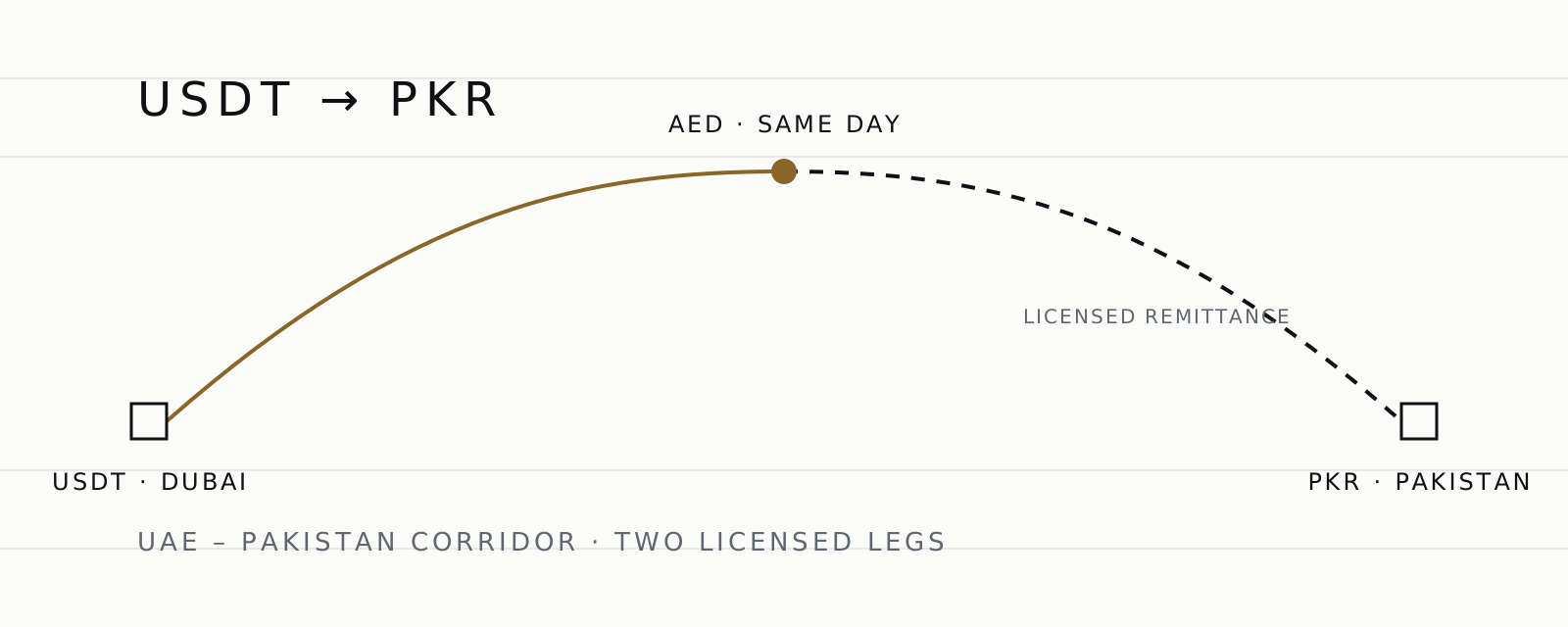
You sell USDT at a licensed UAE desk and receive AED the same business day, or USD in two to five days, into your own bank account. A licensed remittance provider then delivers PKR to the recipient in Pakistan. End to end: one to three business days.
KEY FACTS
| Route shape | Two legs: desk settlement (AED/USD), then remittance to PKR |
|---|---|
| Desk minimum | From around 100,000 USDT |
| Meridian spread | 0.08%–0.40%, by ticket size |
| AED leg | Same business day (UAEFTS) |
| USD leg | 2–5 business days (SWIFT) |
| PKR delivery | Same day to about 2 business days, provider-dependent |
Source: Meridian OTC published pricing bands, as of September 2026.
How does selling USDT for PKR actually work?
Selling USDT for PKR is a two-leg route, because licensed UAE desks settle in dirhams or dollars, not rupees. Leg one: you sell USDT at a licensed desk and receive AED or USD in your own account — the same mechanics as any sale of USDT in Dubai. Leg two: a licensed remittance provider converts that money and delivers PKR in Pakistan.
The UAE-to-Pakistan corridor is one of the busiest in the world. Pakistan received a record USD 41.6 billion in workers' remittances in fiscal 2025–26, up from USD 38.3 billion the year before, with the UAE the second-largest source after Saudi Arabia, according to State Bank of Pakistan data. Most of that flow already runs through licensed exchange houses, so the second leg is routine once your money is inside the banking system.
How long until the recipient has PKR?
The full USDT-to-PKR route takes one to three business days in most cases. The desk leg is the fast part: TRC20 USDT confirms in minutes, and AED goes out by UAEFTS the same business day you trade. The remittance leg adds anywhere from minutes to about two business days, depending on the provider's service, its cut-off times and the receiving bank — confirm before you send.
Taking USD instead of AED makes the route slower. The SWIFT leg takes two to five business days, and the receiving bank in Pakistan converts to PKR at its own rate. That stretches the route to roughly a week and adds a second FX conversion you do not control.
The biggest speed-up is boring: open the desk account before you need to send. Approval takes one business day in most cases, and it is the one step that cannot be compressed on the day itself.
Which route should you choose?
For most senders, selling USDT to AED and remitting through a licensed exchange house is the fastest compliant route to PKR. The alternatives trade speed for ticket size, or accept real risk.
| Route | Legs | Time to PKR | Main costs | Best for |
|---|---|---|---|---|
| Sell to AED, remit via licensed exchange house | 2 | 1–2 business days | Desk spread + remittance fee and FX margin | Most senders |
| Sell to USD, SWIFT to a Pakistani bank | 2 | 3–7 business days | Desk spread + SWIFT charges + bank FX margin | Large, fully documented transfers |
| P2P: USDT directly for PKR | 1 | Hours | Wide, unpublished spread + fraud risk | Small amounts — risky at size |
The AED route is the only one that is fast, cheap and documented at the same time; P2P is the only single-leg option and the riskiest.
On the USD option, correspondent banks take their charges in transit and the received amount drifts from the sent amount. Our guide to SWIFT transfers from the UAE explains why, and what to ask your bank before sending.
What documents do you need on each leg?
The desk leg needs identity and provenance; the remittance leg needs identity and recipient details. None of it is exotic, and the full desk list is in our onboarding section.
- Desk leg (UAE): passport or Emirates ID; proof of address issued within 90 days; source-of-funds evidence for larger tickets — the standard described in our guide to source of funds for crypto sales.
- Remittance leg: your ID, matching the desk records; the recipient's bank details — Pakistani IBANs are 24 characters starting with PK; a stated purpose of payment.
Name consistency matters more than any single document. The desk pays only an account in your own name, and the remittance provider expects the sender name to match that account. A mismatch is the most common cause of a held transfer.
What does the full corridor cost?
The cost of selling USDT for PKR is three items: the desk spread, the remittance fee and the FX margin on the rupee conversion. Only the first is fixed in advance: our spread runs 0.08% to 0.40% by ticket size, published on our pricing page.
Worked example: on a 500,000 USDT ticket the spread tier is 0.25%, which is USD 1,250 — about AED 4,590 at the 3.6725 peg. The remittance leg on the resulting AED 1.83 million adds a provider fee plus its USD-PKR margin, typically the smaller of the two costs at this size — compare the provider's live PKR rate with the interbank rate to see the margin.
Compare providers on the guaranteed delivered-PKR amount, not on headline fees. A "zero fee" remittance with a wider FX margin routinely delivers fewer rupees than a modest fee with a tight one.
What goes wrong on this corridor?
Most failures on the UAE-to-Pakistan corridor come from informal channels, P2P counterparties and name mismatches. All three are avoidable.
- Hundi and hawala networks are illegal in Pakistan, and the State Bank of Pakistan campaigns against them; if the money disappears there is no recourse.
- P2P counterparties paying PKR from unrelated third-party accounts expose your recipient to fraud claims and frozen accounts.
- Name mismatches between the desk payout account and the remittance sender trigger manual review on both ends.
- Splitting one large transfer into smaller ones to stay under review thresholds looks like structuring, because it is. Send once, with documents.
Keep the desk's trade confirmation and the remittance receipt. Together they are the paper trail your bank, and the recipient's bank, may ask to see.
The bottom line on selling USDT for PKR
Selling USDT and receiving PKR is a solved route: a licensed desk for the first leg, a licensed remittance provider for the second, one to three business days end to end. Set the account up before the day you need it, and compare the PKR leg on delivered rupees, not advertised fees.
FAQ
Can Meridian OTC pay PKR directly to a bank account in Pakistan?
No. Meridian settles in AED or USD to a bank account in your own name. The PKR leg is a separate remittance through a licensed exchange house or bank, which converts and delivers rupees to the recipient.
How long does the full USDT-to-PKR route take?
One to three business days in most cases. The desk trade and AED settlement complete the same business day; the remittance leg to PKR typically takes the same day to two business days, depending on the provider.
What documents do I need to sell USDT and send money to Pakistan?
For the desk: passport or Emirates ID, proof of address issued within 90 days and source-of-funds evidence for larger tickets. For the remittance: your ID, the recipient's bank details and a stated purpose of payment.
Is it legal to send crypto-sale proceeds to Pakistan?
Yes, when both legs run through licensed providers: a VARA-licensed desk in the UAE and an authorised remittance channel into Pakistan. Informal hundi or hawala channels are illegal in Pakistan and offer no recourse.
Sell USDT in Dubai, settle the same day
Meridian OTC is a VARA-licensed Broker-Dealer in Dubai. All-in spread 0.08–0.40% by size, published openly. AED by UAEFTS the same business day once your account is approved — ready for the remittance leg to Pakistan.
SOURCES
- VARA public register — licence status check, accessed 11 September 2026.
- Central Bank of the UAE — payment systems (UAEFTS), accessed 11 September 2026.
- State Bank of Pakistan — workers' remittances statistics and home-remittance rules, accessed 11 September 2026.
- Meridian OTC published pricing bands and onboarding requirements — this site, September 2026.
- Business Recorder — Overseas Pakistanis send $41.6bn in FY26 (9 July 2026) (SBP data; FY25 USD 38.3 billion), accessed 14 September 2026.
- IBAN.com — IBAN structure by country (PK 24 characters), accessed 14 September 2026.
This guide is informational and is not legal, tax or investment advice, nor an invitation to buy or sell any virtual asset. Rules and figures are as of September 2026 — re-check the sources before acting. Virtual assets may lose their value in full or in part and are subject to extreme volatility.