
USDT vs USDC in the UAE: liquidity, rails, costs
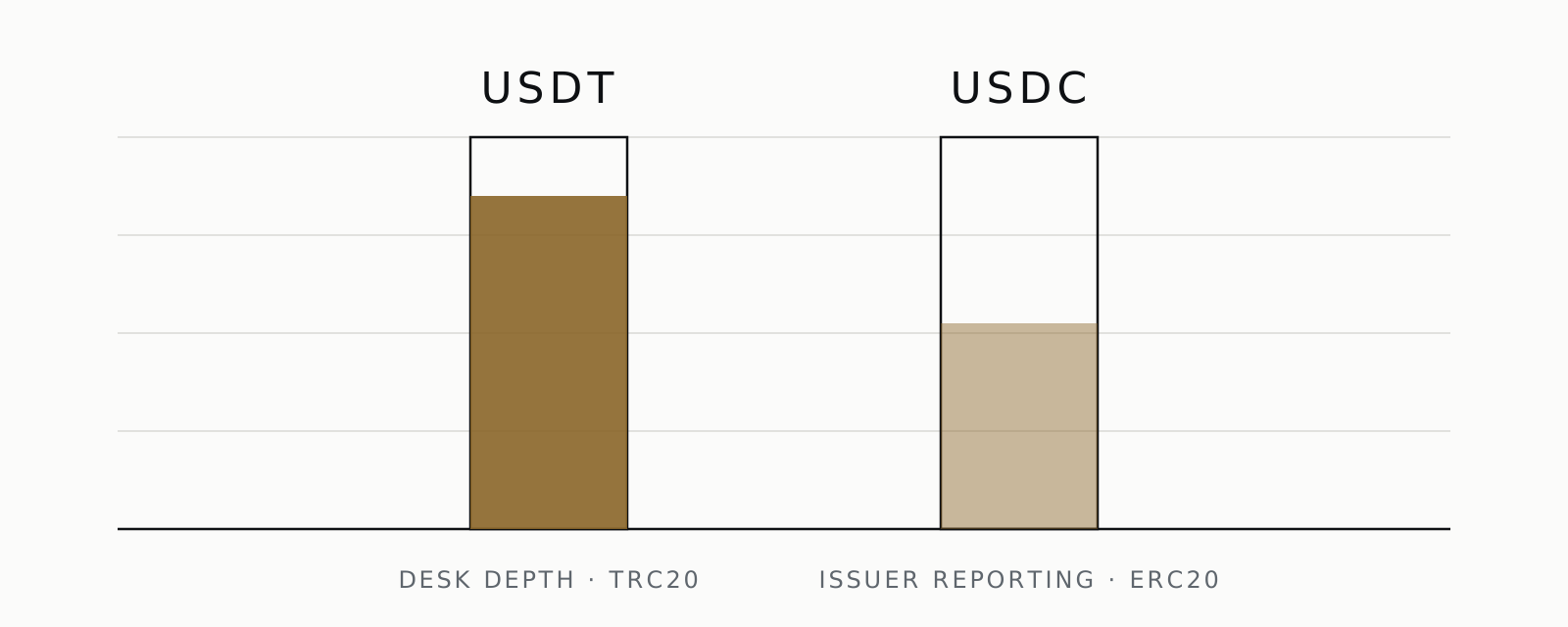
USDT and USDC are both dollar stablecoins, but in the UAE they are not interchangeable. USDT is the liquid default: every licensed Dubai desk quotes it, and it moves on the cheap TRC20 rail. USDC suits flows that need a US-regulated issuer with monthly reserve reports. The desk spread is the same for both.
KEY FACTS
| Larger coin by market value | USDT — the largest stablecoin |
|---|---|
| Main USDT rail in the UAE | TRC20 (Tron) |
| Main USDC rail | ERC20 (Ethereum) |
| Meridian spread — either coin | 0.08%–0.40%, by ticket size |
| Typical desk minimum | From around 100,000 USDT or USDC |
| Settlement | AED same business day (UAEFTS); USD 2–5 days (SWIFT) |
Source: Meridian OTC published pricing bands and desk practice, as of September 2026.
Which should you use in the UAE — USDT or USDC?
For most large conversions in the UAE, USDT is the practical choice and USDC is the reporting choice. USDT is what Dubai desks quote and hold in size; USDC is what you pick when the other side of the trade — an auditor, a fund administrator, a US counterparty — wants a US-regulated issuer with monthly reserve attestations. The published pricing bands are identical for either coin — 0.08% to 0.40% by ticket size.
Neither coin pays a yield, and neither should be held as an investment. Treat both as settlement instruments: you are choosing a rail and an issuer, not an asset to sit on. Neither can be spent inside the UAE either — payments are reserved for licensed dirham payment tokens.
How do USDT and USDC compare side by side?
USDT and USDC both track the US dollar and both redeem 1:1 through their issuers, but they differ in who stands behind them, how often reserves are reported and which network carries them in the UAE. The table below puts the differences that matter for a Dubai seller in one place.
| Attribute | USDT | USDC |
|---|---|---|
| Issuer | Tether (British Virgin Islands) | Circle (United States, NYSE-listed) |
| Position by size | Largest stablecoin by market value | Second-largest USD stablecoin |
| Reserve reporting | Quarterly attestations (BDO) | Monthly attestations (Big Four firm) |
| Common rail in the UAE | TRC20 (Tron) | ERC20 (Ethereum) |
| Typical network fee | Under a few dollars | Cents to a few dollars, varies with gas |
| Desk acceptance in Dubai | Default coin at every licensed desk | Widely accepted, thinner books |
USDT wins on liquidity and rail cost in the UAE; USDC wins on reporting frequency and issuer jurisdiction.
Which stablecoin is more liquid in the UAE?
USDT is the more liquid stablecoin in the UAE by a wide margin. Dirham stablecoin flow through licensed desks and regulated exchanges is overwhelmingly USDT, and the informal P2P market that benchmarks local rates trades almost entirely in USDT on Tron. As of September 2026, no USDC/AED market of comparable depth exists.
Liquidity shows up at the exit. A desk that can re-sell your coin within the hour quotes a tighter spread and pays faster — that is what makes the same-day AED settlement for USDT possible in the first place.
USDC is accepted — we take it on ERC20 — but the book is thinner. On a very large USDC ticket the desk may quote in tranches rather than one fill.
Which network should each coin move on?
USDT in the UAE moves mainly on TRC20, the Tron network; USDC moves on ERC20, the Ethereum network. Tron transfers confirm in about a minute and typically cost under a few dollars; Ethereum fees vary with congestion from cents to several dollars. As of September 2026, TRC20 remains the cheapest practical rail for size.
Both coins exist on other networks — Solana, BNB Chain and others — but a desk credits only the networks it lists in the quote. Sending on an unlisted network can strand funds, so confirm the rail before anything moves.
- Confirm the network in the written quote before sending anything.
- TRC20 addresses start with "T", ERC20 with "0x" — a mismatch is the first sign of a wrong rail.
- Send a small test amount on a new setup; a fifty-dollar test is cheap insurance on a seven-figure transfer.
- Fees are paid in the gas token — TRX on Tron, ETH on Ethereum — so keep a small balance of it in the sending wallet.
How do the issuers and reserves differ?
Tether and Circle both promise 1:1 redemption into US dollars, but they report differently. Tether, incorporated in the British Virgin Islands, publishes quarterly reserve attestations by BDO. Circle, a US-listed company, publishes monthly attestations by a Big Four firm and holds reserves mainly in cash and short-dated US Treasuries.
Direct redemption is institutional in both cases. Tether's terms set a 100,000-dollar minimum for direct redemption, and Circle redeems through Circle Mint accounts. Everyone else exits through a desk or an exchange — which is why desk liquidity matters more to a private seller than the issuer's redemption window. That redemption channel is also what pulls USDT back to par after a depeg.
In the UAE, Circle received in-principle approval from Abu Dhabi's ADGM FSRA in April 2025 and, in December 2025, a full Financial Services Permission to operate as a money services provider in ADGM. Tether holds no UAE licence — but what VARA licenses is the counterparty you trade with, not the coin. Check any desk in VARA's public register; our entry is linked from the licence section of the main page.
What does it cost to move and sell each coin?
Selling USDT or USDC through a desk costs the same spread; only the network fee differs. On a 1,000,000-dollar ticket at a 0.25% spread the cost is 2,500 dollars — AED 9,175 at the 3.6725 peg — identical for both coins. The peg arithmetic is covered in our piece on why the USDT/AED rate sits at 3.67.
On top of the spread you pay the on-chain fee once: under a few dollars on Tron for USDT, variable with gas on Ethereum for USDC. On any desk-sized ticket the network fee is noise — the spread dominates the cost.
Licensed desks in Dubai start around 100,000 dollars equivalent. Open the account before you need it: approval takes one business day in most cases, and the document list is in our onboarding section.
When should you pick USDC over USDT?
Pick the coin by what happens after the trade, not by brand preference.
- Choose USDT when you sell for AED or USD through a UAE desk — deepest books, fastest re-sale, cheapest rail.
- Choose USDT when your counterparty is in Asia or the CIS, where TRC20 USDT is the settlement default.
- Choose USDC when a US or EU counterparty, auditor or fund administrator specifies it.
- Choose USDC when you need monthly, audit-grade reserve reporting for your own books.
- Split the ticket when you are unsure — both coins settle to the same dirhams at the same spread.
The bottom line on USDT vs USDC in the UAE
USDT and USDC cost the same to sell at a UAE desk; they differ in liquidity, rail and reporting. That makes USDT the working coin for dirham conversions and USDC the coin for counterparties who need its issuer's reporting. Decide by where the money goes next, confirm the network in writing, and treat either coin as a way station, not a holding.
FAQ
Is USDC legal in the UAE?
Yes. Trading USDC or USDT through a VARA-licensed provider in Dubai is a regulated activity, and the licence attaches to the provider, not the coin. Verify any counterparty in VARA's public register before sending funds.
Which network should I use to send USDT to a Dubai desk?
TRC20 (Tron) is the standard rail in the UAE: confirmations in about a minute and fees typically under a few dollars, as of September 2026. Always confirm the network in the written quote before sending.
Can I sell USDC for AED in Dubai?
Yes. Licensed desks, including ours, accept USDC on ERC20 and settle AED by UAEFTS the same business day. Books are thinner than USDT, so very large tickets may be quoted in tranches.
Is USDT or USDC safer to hold?
Both are claims on an issuer's reserves. Circle publishes monthly attestations and Tether quarterly ones; neither coin is deposit-insured. Hold either as a settlement instrument and keep idle balances in a bank, not on-chain.
Convert either coin with same-day AED settlement
Meridian OTC is a VARA-licensed Broker-Dealer in Dubai. We take USDT on TRC20 and ERC20 and USDC on ERC20, from around 100,000 dollars equivalent. All-in spread 0.08–0.40% by size; AED by UAEFTS the same business day.
SOURCES
- Tether — transparency and reserve reports, accessed 10 September 2026.
- Circle — USDC reserve reports and attestations, accessed 10 September 2026.
- Tronscan — Tron network fees and confirmations, accessed 10 September 2026.
- VARA public register — licence status check, accessed 10 September 2026.
- Meridian OTC published pricing bands — Meridian OTC published pricing bands, September 2026.
- Circle — ADGM Financial Services Permission (9 December 2025), accessed 14 September 2026.
This guide is informational and is not legal, tax or investment advice, nor an invitation to buy or sell any virtual asset. Rules and figures are as of September 2026 — re-check the sources before acting. Virtual assets may lose their value in full or in part and are subject to extreme volatility.