
Dirham stablecoins: what exists and what they change
The UAE allows dirham-denominated payment tokens under a Central Bank licence, and the first of them has been approved. Foreign stablecoins like USDT remain virtual assets you can trade but cannot spend. For large sellers, settlement still runs through bank rails; the change is coming, not here.
KEY FACTS
| Regulator for payment tokens | Central Bank of the UAE (CBUAE) |
|---|---|
| Framework | Payment Token Services Regulation, in force since 2024 |
| Payment rule | Only licensed dirham payment tokens may pay for goods and services |
| USDT / USDC status | Virtual assets — tradable at licensed desks, not a means of payment |
| Live dirham tokens | AE Coin (licensed Dec 2024), Zand AED (approved Nov 2025), DDSC (approved to go live Feb 2026); RAKBANK holds in-principle approval (Jan 2026) |
Source: Central Bank of the UAE; VARA public register, as of September 2026.
What counts as an AED stablecoin in the UAE?
An AED stablecoin is a blockchain token designed to hold one-to-one value with the UAE dirham, backed by dirham reserves held with banks. The Central Bank of the UAE regulates these instruments as "dirham payment tokens", and only a token holding its licence may be used for payments inside the country.
An AED stablecoin is not a competitor to USDT on price. Because the dirham has been fixed to the dollar at 3.6725 since 1997 and USDT tracks the dollar — the arithmetic behind why 1 USDT sits at about 3.6725 AED — a dirham token and a dollar token are worth the same at the peg. What a dirham token changes is the settlement leg, not the rate.
What do the CBUAE payment token rules allow?
The Payment Token Services Regulation, issued by the Central Bank of the UAE and in force since 2024 with a transition that ran into 2025, reserves payments in the UAE for dirham payment tokens it has licensed. Foreign payment tokens such as USDT and USDC may be traded as virtual assets but cannot be used, accepted or promoted to pay for goods and services in the country.
Licensing is the strict part. An issuer must back the token with dirham-denominated reserves, redeem at par, and meet the Central Bank's custody and prudential requirements. A token marketed to UAE residents without that licence is operating outside the payment perimeter, whatever its website claims.
The regulatory split matters: the Central Bank owns the payment-token question, while VARA licenses virtual-asset dealing in Dubai outside the DIFC. Trading USDT at a VARA-licensed desk is untouched by the payment-token rules — the rules bite only when a token is used to pay for something.
Which AED stablecoins exist as of September 2026?
The regulated dirham-token landscape as of September 2026 is still short: three CBUAE-approved payment tokens, one bank with in-principle approval, one announced product whose launch has not been confirmed, and the Digital Dirham, which is not a stablecoin at all.
| Initiative | Type | Status (Sep 2026) | Purpose |
|---|---|---|---|
| AE Coin (AED Stablecoin LLC) | Dirham payment token | First token licensed by CBUAE (December 2024) | Retail and business payments |
| Zand AED (Zand Trust / Zand Bank) | Dirham payment token | Approved by CBUAE, November 2025 | Multi-chain settlement on public blockchains |
| DDSC (IHC, FAB, Sirius) | Dirham payment token | Approved to go live, February 2026 | Institutional payments and settlement on ADI Chain |
| RAKBANK dirham stablecoin | Dirham payment token | In-principle approval, January 2026; not yet a full licence | Bank-issued payments |
| Tether dirham token (with Phoenix Group) | Dirham payment token | Announced August 2024; no launch confirmed as of September 2026 | Payments and remittances |
| Digital Dirham | Central bank digital currency | Pilots incl. mBridge; phased rollout — check CBUAE for the current stage | Wholesale and retail settlement |
Three regulated dirham payment tokens hold CBUAE approval today; everything else is either unlaunched, awaiting a full licence, or a central bank instrument, not a stablecoin.
The thin list is itself the finding. Anyone pitching you an "AED stablecoin" beyond this table should be checked against the Central Bank's register before you touch it — an unlicensed dirham token is not a shortcut, it is an unregulated IOU with extra steps.
What would an AED payment token change for large settlements?
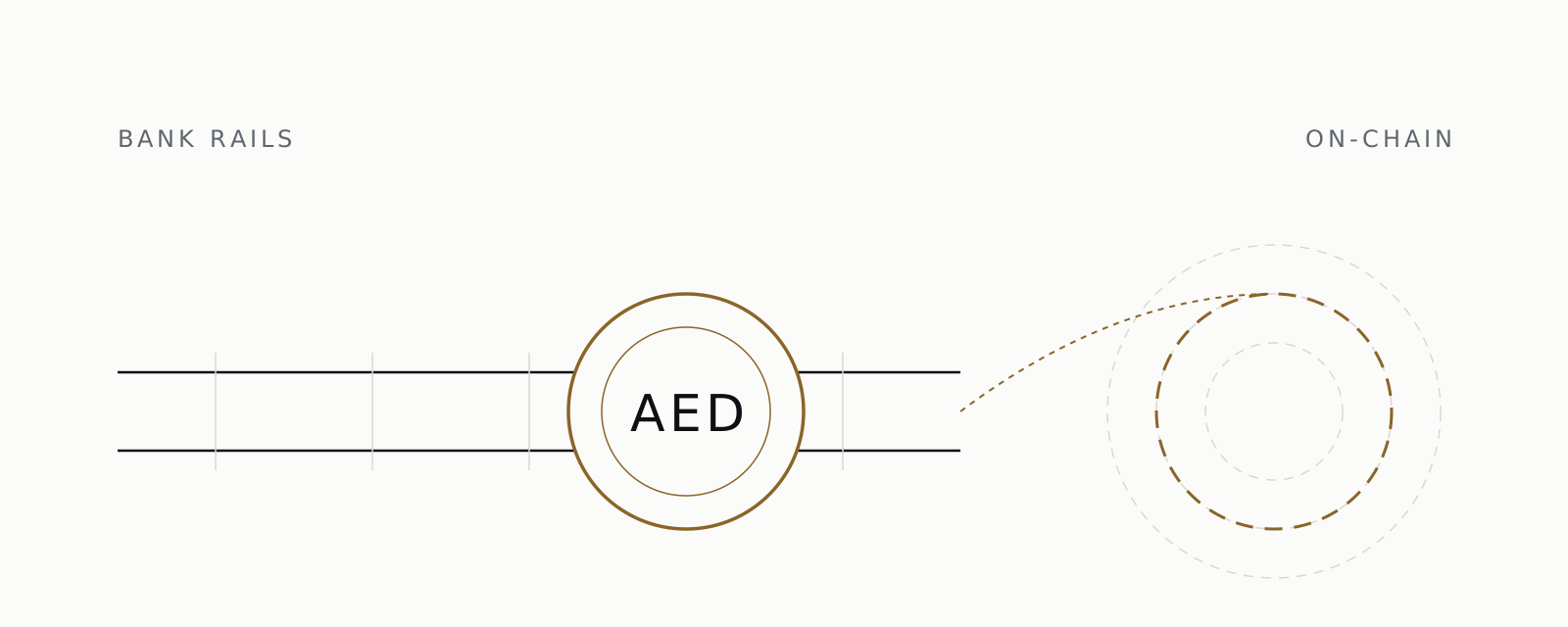
A licensed AED payment token would add an on-chain dirham leg to settlement: conversion and payout could complete at any hour of any day, including weekends, instead of waiting for banking windows. As of September 2026 that is not how large OTC trades settle in practice — the dirham side still moves through the banking system.
Today's mechanics at a licensed desk: you accept a written all-in quote, send USDT, and the desk wires AED to your own account through the same-day UAEFTS bank rail. It works, but it stops at 14:00 cut-offs, Fridays, and public holidays, because banks stop.
When adoption matures, three things change: settlement becomes 24/7, delivery-versus-payment can be atomic (the token and the dirham token move in the same transaction, so neither side carries the other), and the weekend gap disappears. The gate is not the technology — it is whether banks accept large token-sourced inflows without friction, and that is decided bank by bank.
What stays the same for USDT sellers?
For a client converting size today, nothing operational has changed: the trade is USDT for dirhams at a licensed desk, settled by bank wire to an account in your own name. The constants:
- The price. Still the 3.6725 peg plus the provider's spread — ours is a published 0.08%–0.40% by ticket size, on the pricing section of the main page.
- Own-name settlement. A licensed desk pays only an account in your name, token or no token. Offers to pay "any account you like" remain a walk-away signal.
- Identity and source of funds. KYC on large conversions is a legal requirement in the UAE; a payment token does not anonymise a dirham.
- The legal route. Unchanged: sell through a licensed desk with bank settlement, not through a counterparty whose selling point is the absence of questions.
The bottom line on dirham stablecoins
Dirham payment tokens are real, regulated and — as of September 2026 — thin on the ground: three approved tokens, one bank with in-principle approval, one announced, and a central bank currency that is a different animal. They describe where UAE settlement is heading, not how you convert size this week. The operative facts stay: licensed counterparty, written all-in quote, own-name bank account.
FAQ
Are AED stablecoins legal in the UAE?
Dirham payment tokens licensed by the Central Bank of the UAE are legal and regulated. Foreign stablecoins such as USDT can be traded as virtual assets through licensed providers but cannot be used to pay for goods and services.
Can I pay for goods in Dubai with USDT?
No. Under the CBUAE payment token rules, only licensed dirham payment tokens may be used or promoted for payments in the UAE. USDT is treated as a virtual asset you can buy and sell, not as a means of payment.
Is the Digital Dirham a stablecoin?
No. The Digital Dirham is a central bank digital currency issued directly by the Central Bank of the UAE, tested in pilots including the mBridge cross-border project. A stablecoin is issued by a private company against reserves; a CBDC is central bank money.
Do AED stablecoins change how I cash out USDT?
Not yet. As of September 2026, large USDT conversions still settle through a licensed desk, with AED paid by UAEFTS bank wire to your own account the same business day. An on-chain dirham leg is a future option, not the current rail.
Convert USDT to AED on today's bank rails
Meridian OTC is a VARA-licensed Broker-Dealer in Dubai. All-in spread 0.08–0.40% by size, published openly. AED reaches your own account by UAEFTS the same business day once the account is approved.
SOURCES
- Central Bank of the UAE — Payment Token Services Regulation, accessed 14 September 2026.
- Central Bank of the UAE — payment systems (UAEFTS), accessed 10 September 2026.
- VARA public register — licence status check, accessed 10 September 2026.
- Tether — announcement of a dirham-pegged token with Phoenix Group (August 2024), accessed 14 September 2026.
- Zand — Zand launches the UAE's first AED-backed stablecoin on public blockchain (17 November 2025), accessed 14 September 2026.
- The Asian Banker — CBUAE approves UAE dirham-backed stablecoin DDSC for operational launch (13 February 2026), accessed 14 September 2026.
- Khaleej Times — RAKBANK gets UAE Central Bank approval for dirham-backed stablecoin (January 2026), accessed 14 September 2026.
This guide is informational and is not legal, tax or investment advice, nor an invitation to buy or sell any virtual asset. Rules and figures are as of September 2026 — re-check the sources before acting. Virtual assets may lose their value in full or in part and are subject to extreme volatility.