
When USDT leaves the dollar: depeg history and what to watch
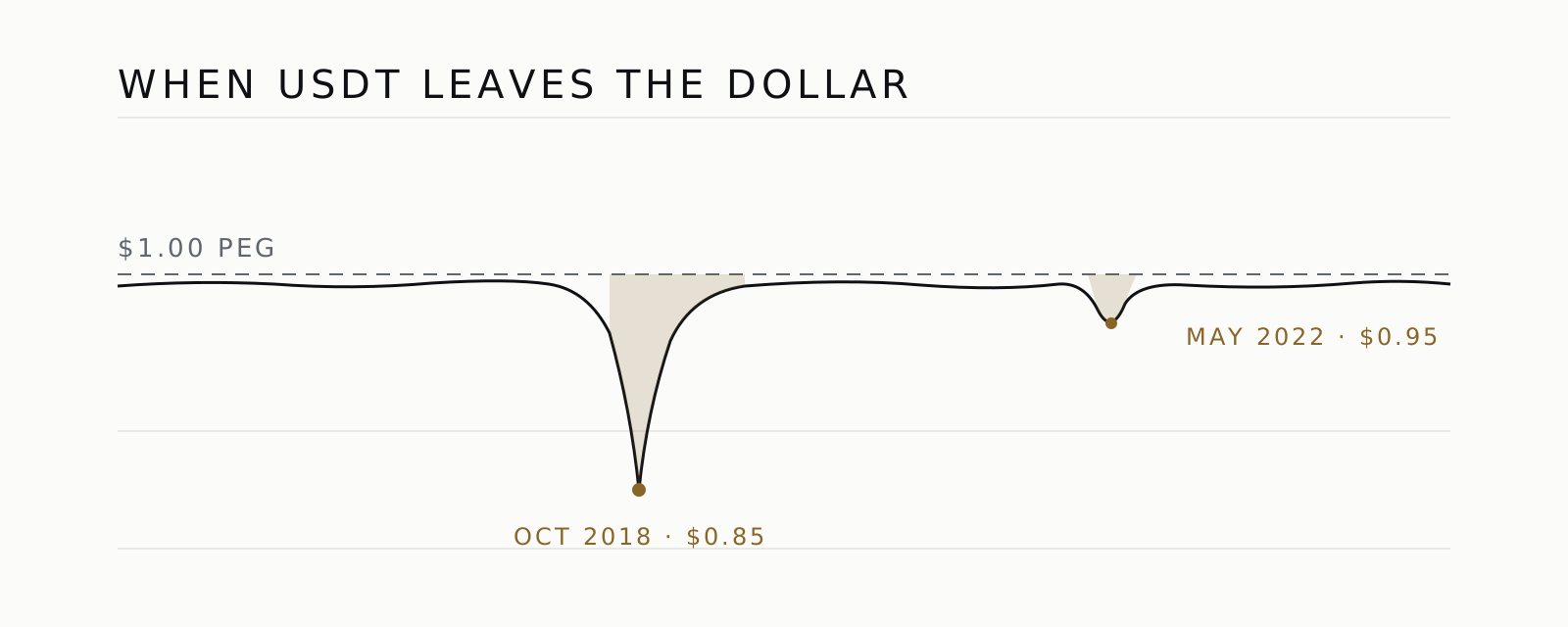
USDT has briefly left its one-dollar peg several times — to about $0.85 in October 2018 and $0.95 in May 2022 — and recovered each time because Tether kept honouring redemptions at par. Here are the dated episodes, the causes, the signals to watch, and what our desk does during stress.
KEY FACTS
| Deepest deviation on record | About $0.85, 15 October 2018 |
|---|---|
| May 2022 stress test | Trough near $0.95; ~$7bn redeemed in 48 hours |
| Typical recovery time | Hours to about three weeks |
| Direct redemption with Tether | Verified customers, from 100,000 USDT, with a fee |
| Meridian policy during stress | Quoting continues; spreads widen; AED settles same day |
Source: Tether statements and reported exchange data, as of September 2026.
When has USDT actually left the dollar?
USDT has left its one-dollar peg in a handful of short episodes since 2017. The deepest was October 2018, when it traded near $0.85 on some venues; the most watched was May 2022, when it touched about $0.95 after the TerraUSD collapse. None lasted longer than roughly three weeks, which is why the USDT/AED rate sits at 3.67 as a near-constant in calm periods.
The episodes below are the exceptions — every one of them temporary, as of September 2026.
| Episode | Date | Trough | Trigger | Back near $1 |
|---|---|---|---|---|
| Bitfinex banking crisis | 15 Oct 2018 | ~$0.85 | Doubts over Bitfinex's banking and Tether's reserves | ~3 weeks |
| TerraUSD contagion | 12 May 2022 | ~$0.95 | Stablecoin-wide panic after UST collapsed | Days; ~$7bn redeemed in 48h |
| SVB / USDC depeg | Mar 2023 | Premium above $1.00 | Flight out of USDC after Silicon Valley Bank failed | Days |
| Curve pool imbalance | Jun 2023 | ~$0.997 | Heavy one-sided selling in a single liquidity pool | Hours |
Every deviation so far has been measured in hours to weeks — because redemption at par, not the screen price, is the real peg.
Trough prices are venue-specific. In October 2018 USDT printed $0.85 on one exchange while sitting closer to $0.92 on others — a gap between venues is part of the same episode, not a separate one. And the deviation cuts both ways: in March 2023 USDT traded above $1 as money fled USDC.
What causes a USDT depeg?
A USDT depeg happens when selling pressure on exchanges overwhelms the arbitrage that normally pulls the price back to $1. That arbitrage exists because verified customers can redeem USDT with Tether at par; anything that slows redemptions or shakes confidence in the reserves pushes the market price away from the peg.
The causes, in order of how often they have mattered:
- Reserve confidence. Doubts about what backs USDT drove the 2018 episode and sit behind every smaller scare since.
- Banking access. Tether's fiat rails have been cut before; each disruption slows redemptions and widens the deviation.
- Contagion. May 2022 (TerraUSD) and March 2023 (USDC and Silicon Valley Bank) moved USDT without anything happening at Tether itself.
- Venue liquidity. One large seller in a thin pool can drag a single exchange's price while the wider market holds at par.
The recovery mechanism is arithmetic. At $0.97, an arbitrageur who can redeem at par earns roughly 3% minus fees by buying on the market and redeeming with Tether — and that buying is what pulls the price back. This is why a shrinking USDT supply during a scare is the safety valve working, not the peg failing: in May 2022 Tether processed about $7 billion of redemptions in 48 hours and the price returned to $1 within days.
What should you watch during a depeg scare?
During a depeg scare, watch three things: whether Tether's attestations keep coming on schedule, whether redemptions are clearing, and whether the discount sits on one venue or everywhere. The first two tell you about Tether; the third tells you whether the story is about Tether at all.
- The attestation. Tether publishes quarterly reserve attestations prepared by BDO, as of September 2026. A delayed or heavily qualified report is the red flag that matters most.
- Redemption velocity. A fast-falling USDT supply during a scare means redemptions are clearing — the mechanism working in real time.
- Cross-venue spreads. One exchange at $0.97 while others hold $0.999 is a liquidity problem at that venue, not a broken peg.
- The wider stablecoin market. Trouble at USDC or another large coin drags USDT around even when Tether is quiet — compare the two issuers in our USDT vs USDC guide for the UAE.
- Duration. Hours of discount is noise; a discount that persists for days with no recovery trend is a different class of signal.
What does a depeg mean for selling USDT in Dubai?
For a seller in Dubai, a depeg changes the price of the trade, not its plumbing. The AED leg is anchored to the dirham's own peg of 3.6725 per dollar, held by the CBUAE since 1997, so what moves is how many dollars your USDT is worth on the day you sell.
A worked example at 1,000,000 USDT. At par, that is $1,000,000, or AED 3,672,500 before the spread. With USDT at $0.98 it is $980,000, or AED 3,599,050 — a difference of AED 73,450 that no desk can quote away, because it sits in the asset, not in the fee.
Which is the one rule of a stressed market: if someone quotes you full par during a visible depeg, ask where the difference is coming from. The answer is usually the settlement leg — and that is where the risk moves to.
What does our desk do when USDT depegs?
Meridian OTC keeps quoting through a depeg, with wider spreads and shorter quote windows. The desk prices off where USDT actually clears — the market price, cross-checked against the redemption value — and settles AED by UAEFTS the same business day as normal.
In practice, four things change and three do not:
- Spreads widen beyond the usual published 0.08–0.40% bands when market depth thins — we state the all-in number at quote time, as always.
- Quote windows shorten, because a price held for an hour is a different promise in a market moving 2% in a day.
- AED settlement is unchanged: same business day by UAEFTS, to your own account only. The stress is in the USDT/USD leg, not in the dirham.
- USD by SWIFT still takes 2–5 business days and can sit at the slow end if correspondent banks review flows.
- Our minimum ticket, around 100,000 USDT, is unchanged — and happens to match Tether's own redemption minimum.
If you can wait, waiting has historically cost little: every episode to date ended back at par. That is a record, not a promise — we will not quote you a future price, and neither should anyone else. If you need certainty today, request a written quote and the number on it is the number you get.
The bottom line on USDT depeg risk
USDT's depegs have been short, shallow after 2018, and always ended by redemption at par. Watch the attestations, the redemptions and the cross-venue spreads — and treat any quote of full par during a visible depeg as a warning sign about the counterparty, not a gift.
FAQ
Has USDT ever completely lost its peg?
No. The deepest deviation on record is about $0.85 in October 2018, and USDT recovered within weeks. Tether honoured redemptions at par throughout, and that redemption door is what ended each episode.
Can I redeem USDT directly with Tether?
Yes, if you pass Tether's own verification: redemptions at par start at 100,000 USDT and carry a fee. The process takes days, not hours, so most sellers below very large size use an OTC desk instead.
What happens to my AED payout if USDT is below $1?
Your payout follows the dollar value of USDT on the day, converted at the 3.6725 dirham peg. At $0.98, one million USDT is worth AED 3,599,050 before the spread, not AED 3,672,500.
Is USDC safer than USDT?
Different, not strictly safer. USDC fell to about $0.87 in March 2023 when part of its reserves sat in a failing bank. Both coins have depegged and recovered; the difference is where each issuer holds its reserves.
Sell USDT with a desk that prices stress honestly
Meridian OTC is a VARA-licensed Broker-Dealer in Dubai. All-in spread 0.08–0.40% by size in normal markets, stated at quote time in stressed ones. AED by UAEFTS the same business day once your account is approved.
SOURCES
- Tether — Transparency — reserve attestations and reported supply, accessed 10 September 2026.
- Protos — History of Tether's peg — dated record of USDT price deviations, accessed 10 September 2026.
- Tether — statement on May 2022 redemptions — ~$7bn processed in 48 hours, accessed 10 September 2026.
- Circle — USDC and Silicon Valley Bank — the March 2023 contagion episode, accessed 10 September 2026.
This guide is informational and is not legal, tax or investment advice, nor an invitation to buy or sell any virtual asset. Rules and figures are as of September 2026 — re-check the sources before acting. Virtual assets may lose their value in full or in part and are subject to extreme volatility.