
USDT transfer vs USD wire: which leg is slower
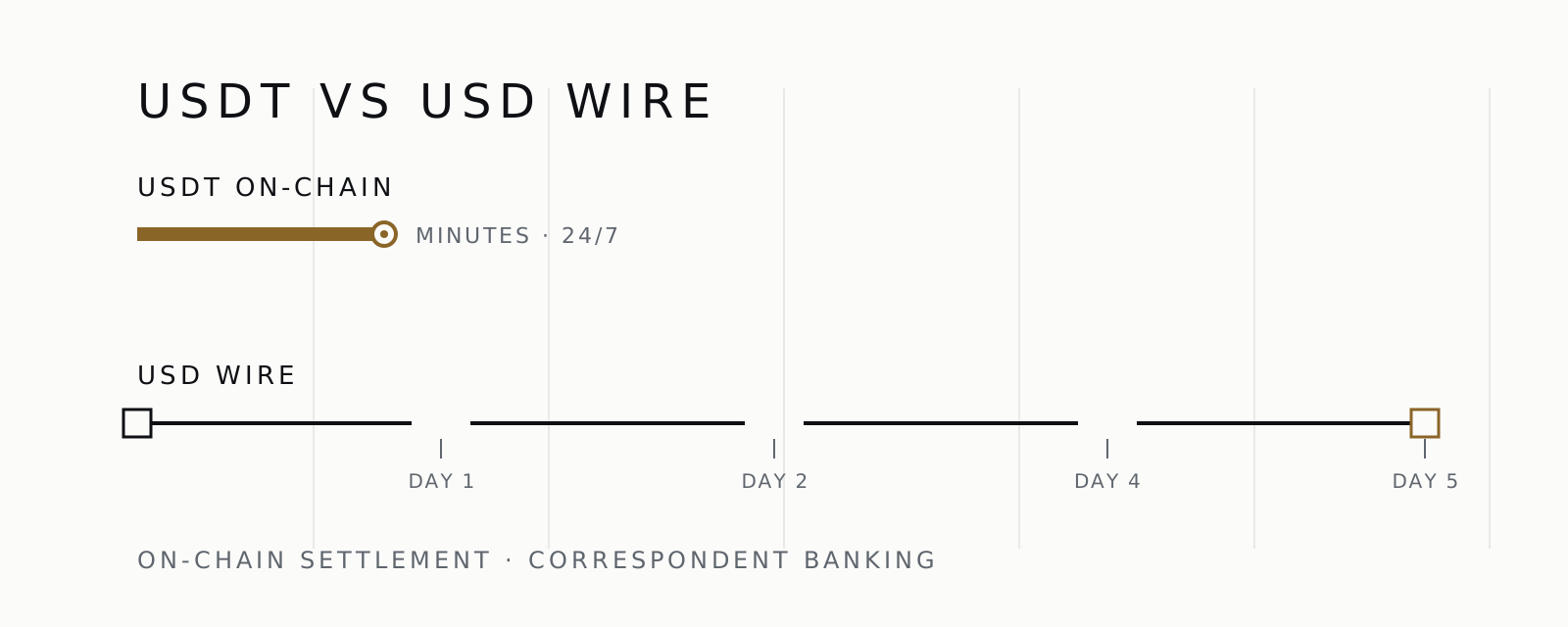
The USD wire is the slow leg, not the USDT transfer. A USDT payment on TRC20 confirms in minutes, around the clock; a USD wire from the UAE travels through SWIFT correspondent banks and lands in 2–5 business days. When you sell USDT for dollars, nearly all the waiting happens after the crypto leg is done.
KEY FACTS
| USDT leg (TRC20) | Minutes, any day, any hour |
|---|---|
| USDT leg (ERC20) | Minutes, plus a variable gas fee |
| USD wire (SWIFT) | 2–5 business days |
| AED alternative (UAEFTS) | Same business day |
| Meridian OTC spread | 0.08%–0.40%, by ticket size |
Source: SWIFT, TRON and Ethereum network documentation, Meridian OTC published pricing bands, as of September 2026.
Which leg is slower: USDT on-chain or USD by SWIFT?
The USD wire is slower by roughly two orders of magnitude. A USDT transfer confirms on-chain in minutes and runs around the clock; a USD wire moves through SWIFT correspondent banks and takes 2–5 business days from the UAE, as of September 2026. The mechanics of that delay are covered in our guide to SWIFT USD transfers from the UAE.
This flips the intuition most sellers bring to a first trade. The crypto leg feels risky and slow; the bank leg feels safe and fast. Measured in hours from handshake to usable funds, the opposite holds.
Where does the time go in a USDT transfer?
A USDT transfer has three timed steps: broadcasting the transaction, waiting for network confirmations, and the recipient crediting the funds. On TRC20 the full sequence usually completes in minutes; on ERC20 it is minutes plus a gas fee that moves with congestion.
- Broadcast. Your wallet signs and sends the transaction in seconds, at any hour, on any day of the year.
- Confirmations. TRON produces blocks continuously, so a payment is visible almost at once; the desk then waits the agreed number of confirmations before acting. Network-by-network timings are in our guide to USDT settlement times by network.
- Crediting. A licensed desk credits you against a written quote, so the on-chain wait is the only variable on this leg.
Cost is where the two networks differ. TRC20 fees are low and stable; the ERC20 gas fee for a USDT transfer varies with congestion — a matter of cents at the quiet gas prices seen in mid-September 2026, but historically several dollars, and occasionally far more, when the network is busy. Neither changes the answer: the on-chain leg is measured in minutes.
Where does the time go in a USD wire?
A USD wire from the UAE passes through one to three correspondent banks before it reaches the beneficiary, and every hop adds its own processing queue, cut-off time and compliance screening. SWIFT reports that nearly all gpi-tracked payments are credited within 24 hours, and roughly half within 30 minutes, but the realistic tail from the UAE runs to 2–5 business days.
The days are lost in four places:
- Cut-offs. A wire instructed after the sending bank's daily cut-off starts moving the next business day.
- Correspondent hops. Each intermediary bank re-processes the payment in its own timezone and its own queue.
- Weekends and holidays. The US weekend, the UAE weekend and US federal holidays all freeze the chain; a Thursday-afternoon wire can lose three days to the calendar alone.
- Compliance review. Any bank in the chain can hold the payment for source-of-funds questions, and crypto-origin funds get asked more often than most.
The rails compared, step by step
Set side by side, each settlement rail has the same five stages — the difference is how long each stage takes and when the rail is open at all.
| Stage | USDT (TRC20) | USDT (ERC20) | USD wire (SWIFT) | AED (UAEFTS) |
|---|---|---|---|---|
| Rail is open | 24/7 | 24/7 | Business days only | UAE business days |
| Sender action | Minutes from any wallet | Minutes from any wallet | Bank form or app | Bank instruction |
| Processing | Seconds to minutes | Minutes, plus gas | 1–3 correspondent hops | Same session |
| Compliance review | Desk KYC once, upfront | Desk KYC once, upfront | Possible at any hop | Standard screening |
| Funds usable | Minutes | Minutes | 2–5 business days | Same business day |
The bank rails, not the blockchain, decide when your money is usable — AED by UAEFTS is the fastest fiat exit, USD by SWIFT the slowest.
How do you cut days off the slow leg?
You cannot speed up SWIFT itself, but you can remove the delays around it. The four moves below routinely save one to three business days on a USDT-to-fiat trade.
- Open the account before the trade day. KYC approval at a licensed desk takes one business day in most cases — do it the week before, not the morning of. The document list is in our onboarding section.
- Trade early in the UAE day. A trade agreed by noon gives the desk time to send the fiat leg before the bank cut-off; a trade agreed at 17:00 starts tomorrow.
- Take AED when the dirham works for you. UAEFTS settles the same business day, and the AED is pegged to the dollar at 3.6725, so you are not taking FX risk against USD. The mechanics are in our UAEFTS explainer.
- Keep settlement own-name. A wire to an account in your own name clears screening far more reliably than any third-party instruction, and a licensed desk will not offer anything else.
Speed is free at a good desk; the price is the spread. Ours is published — 0.40% at 100,000 USDT down to 0.08% at 10,000,000 — on our pricing bands, so a quote carries no timing surprises either.
The bottom line on USDT vs USD wires
The blockchain is the fast part of the trade: USDT moves in minutes, every day of the year. The days sit in the correspondent banking chain, so plan around it — pre-approved account, early trade, AED settlement where possible — and the whole trade fits inside one business day.
FAQ
Is a USDT transfer faster than a USD bank wire?
Yes, by a wide margin. USDT on TRC20 confirms in minutes at any hour; a USD wire from the UAE takes 2 to 5 business days through SWIFT correspondent banks, as of September 2026. The on-chain leg is almost never the bottleneck.
Why does a SWIFT wire take days when USDT takes minutes?
A wire passes through one to three correspondent banks, each with its own cut-off times, screening queues and weekends. A blockchain has one ledger running continuously, so there are no hops and no banking hours.
How long does an ERC20 USDT transfer take compared with TRC20?
Both confirm in minutes. The difference is cost, not speed: ERC20 charges a variable gas fee that rises with network congestion, while TRC20 fees are low and stable, which is why TRC20 is the common USDT rail in the UAE.
Can I receive USD faster than 2–5 business days when selling USDT?
Not through SWIFT, which has no express lane. If speed matters, take AED by UAEFTS — it settles the same business day — and convert to USD locally, or keep proceeds at a UAE bank that credits international wires quickly.
Sell USDT with settlement timed to your deadline
Meridian OTC is a VARA-licensed Broker-Dealer in Dubai, flow from around 100,000 USDT. All-in spread 0.08–0.40% by size, AED by UAEFTS the same business day, USD by SWIFT with the timeline stated in writing upfront.
SOURCES
- SWIFT — SWIFT gpi — cross-border payment tracking and speed, accessed 11 September 2026.
- Central Bank of the UAE — payment systems (UAEFTS), accessed 11 September 2026.
- TRON developer documentation — block production and confirmations, accessed 11 September 2026.
- Ethereum.org — gas and fees, accessed 11 September 2026.
- Etherscan — Ethereum gas tracker — live gas price and ERC20 transfer cost, accessed 14 September 2026.
- Deutsche Bank flow — SWIFT gpi: a progress report — share of gpi payments credited within 24 hours and 30 minutes, accessed 14 September 2026.
- Meridian OTC published pricing bands and settlement terms — this site, September 2026.
This guide is informational and is not legal, tax or investment advice, nor an invitation to buy or sell any virtual asset. Rules and figures are as of September 2026 — re-check the sources before acting. Virtual assets may lose their value in full or in part and are subject to extreme volatility.