
Crypto and taxes in the UAE: what individuals and companies owe
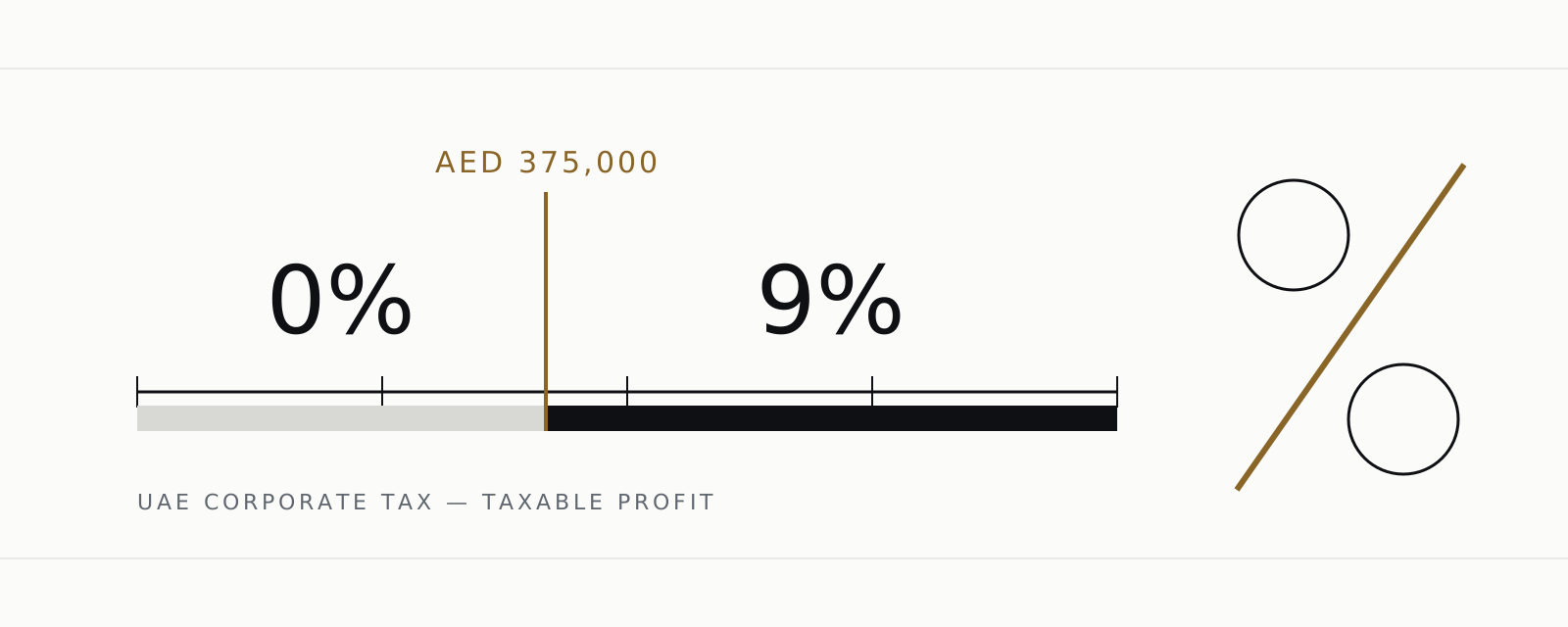
Individuals pay no personal income tax and no capital gains tax on crypto in the UAE. Companies pay 9% Corporate Tax on taxable profit above AED 375,000, including gains on virtual assets. Transfers and conversions of virtual assets are exempt from VAT. Positions as of September 2026.
KEY FACTS
| Personal income tax on crypto gains | None — 0% |
|---|---|
| Corporate Tax (companies) | 9% above AED 375,000 of taxable profit; 0% up to it |
| VAT on buying, selling or converting crypto | Exempt, retroactive to 1 January 2018 |
| VAT on services billed at an explicit fee | Standard-rated 5% |
| Corporate Tax in force since | Financial years starting on or after 1 June 2023 |
Source: Federal Tax Authority and UAE Ministry of Finance, as of September 2026.
Do individuals pay tax on crypto gains in the UAE?
No. The UAE levies no personal income tax and no capital gains tax, so an individual's profit from buying and selling virtual assets is not taxed federally, as of September 2026. There is also no wealth tax and no inheritance tax on crypto holdings.
The answer changes when the activity is wrapped in a company. If you trade through a licensed entity, the profit belongs to that entity and falls under Corporate Tax, not the personal regime. Frequent, organised trading can also read as a business activity to a bank or an auditor, even where no tax is charged.
Untaxed is not undocumented. When a large conversion lands in your account the bank asks where the money came from, and a trade through a desk whose VARA licence you can check leaves the paper trail that answers that question.
How are companies taxed on crypto in the UAE?
Companies pay UAE Corporate Tax at 9% on taxable profit above AED 375,000 and 0% up to that threshold, for financial years starting on or after 1 June 2023, as of September 2026. Gains on virtual assets — trading profit, tokens held as inventory, crypto accepted as payment — count toward taxable income like any other profit.
A worked example: a company with AED 900,000 of taxable profit pays nothing on the first AED 375,000 and 9% on the remaining AED 525,000 — AED 47,250 of Corporate Tax. The threshold applies to total taxable profit, not to crypto gains separately.
Free zones complicate the picture. A Qualifying Free Zone Person pays 0% on qualifying income, but whether proprietary virtual-asset trading counts as qualifying income is a facts-and-circumstances question under the relevant Cabinet decisions — one for your auditor, not for a rule of thumb. The mechanics of selling crypto through a company account are a separate guide.
Is crypto subject to VAT in the UAE?
No VAT is charged on transferring or converting virtual assets in the UAE, as of September 2026. Cabinet Decision No. 100 of 2024 added virtual assets to the VAT-exempt financial services from 15 November 2024, and the Federal Tax Authority confirmed in Public Clarification VATP040 that the exemption for transfers and conversions applies retroactively from 1 January 2018.
| Transaction | VAT treatment | In effect |
|---|---|---|
| Buying or selling crypto for AED or USD | Exempt | Retroactive to 1 January 2018 |
| Crypto-to-crypto conversion | Exempt | Retroactive to 1 January 2018 |
| Keeping or managing virtual assets, no explicit fee | Exempt | From 15 November 2024 |
| Custody or other services billed at an explicit fee or commission | Standard-rated 5% | From 15 November 2024 |
The asset transfer is exempt; a service billed at an explicit fee is not — and for businesses, "exempt" also means no input VAT recovery on the related costs.
Exempt is not the same as zero-rated. A business whose supplies are exempt cannot recover input VAT on the costs behind them, which is the main quiet consequence of the 2024 change for crypto companies. That input-VAT question is worth an hour of an accountant's time before your first filing.
Under the FTA's Public Clarification VATP040, the transfer of ownership and conversion of virtual assets is exempt from VAT (retrospectively from 1 January 2018), so a desk's spread on a conversion is not a VAT-able service charge; explicit fees for keeping or managing virtual assets remain taxable. Our own cost of execution is a published spread of 0.08% to 0.40% by ticket size — a margin on the rate, not a separate service charge.
What records should you keep even when no tax is due?
Keep complete transaction records even where no UAE tax is due: trade dates, the AED value at the time of each trade, wallet addresses and counterparty details. VAT-registered businesses must keep records for five years under FTA rules, and banks routinely ask for source-of-funds evidence on large inbound transfers.
The situations that change the no-tax answer, in descending order of how often we see them at the desk:
- Trading through a company or holding a commercial licence for trading — Corporate Tax applies to the entity's profit.
- Tax residency in another country — your home rules can follow you; see the next section.
- Staking, mining or yield earned by an entity as a business activity — generally taxable business income under the Corporate Tax Law; confirm the treatment for your structure with an adviser or the FTA.
- Salary paid in crypto — still untaxed for a UAE-resident employee, but an overseas employer's payroll reporting is worth checking on both ends.
Our onboarding document list doubles as a decent record-keeping skeleton: it is the same evidence a bank will ask for later.
Does your home country still tax your crypto?
UAE residency does not cancel another country's claim on you, as of September 2026. Countries that tax worldwide income — the United States is the standard example — tax their citizens on crypto gains wherever they live. Most other countries tax by residence, so what matters is a properly documented break of tax residency, not the flight ticket.
Information flows are tightening too. The UAE has committed to the OECD Crypto-Asset Reporting Framework, with first automatic exchanges of crypto account data expected in 2028. Once live, UAE platforms will report non-resident clients' activity to home-country tax authorities automatically.
Nothing in this article is tax advice. The rules above are the federal baseline; your residency history and structure decide what actually applies to you, and a UAE tax adviser earns their fee on exactly those two facts.
The bottom line on crypto and taxes in the UAE
For individuals the UAE answer is short: no income tax, no capital gains tax, no VAT on the trades themselves, as of September 2026. For companies the answer is 9% above AED 375,000 of total taxable profit, with a free-zone caveat that needs professional confirmation.
In both cases the working habit is the same: trade through a licensed counterparty, keep the records, and do not assume another country has stopped counting. When the time comes to convert, the legal cash-out route for Dubai is the one built for banks to accept.
FAQ
Is there income tax on crypto profits in the UAE?
No. The UAE has no personal income tax and no capital gains tax, so an individual's crypto profits are not taxed federally, as of September 2026. If you trade through a company, the company's profit falls under Corporate Tax instead.
Do companies pay Corporate Tax on crypto gains?
Yes. A company's taxable profit includes gains on virtual assets and is taxed at 9% above the AED 375,000 threshold and 0% up to it, as of September 2026. Qualifying Free Zone Persons may pay 0% on qualifying income, which is a facts-and-circumstances test.
Is VAT charged on buying or selling crypto in the UAE?
No. Transfers and conversions of virtual assets are exempt from VAT, retroactively from 1 January 2018 under Cabinet Decision No. 100 of 2024. Services billed at an explicit fee, such as custody at a commission, can still be standard-rated at 5%.
Will the UAE report my crypto to other countries?
The UAE has committed to the OECD Crypto-Asset Reporting Framework, with first automatic exchanges expected in 2028. Once live, UAE platforms will report non-resident clients' crypto activity to home-country tax authorities automatically.
Sell crypto with a paper trail your bank accepts
Meridian OTC is a VARA-licensed Broker-Dealer in Dubai (licence VL/24/03/017). Every trade settles to an account in your own name with full documentation — AED by UAEFTS the same business day, USD by SWIFT in 2–5 business days.
SOURCES
- UAE Ministry of Finance — Corporate Tax FAQ, accessed 10 September 2026.
- UAE Government portal — Corporate tax, accessed 10 September 2026.
- Federal Tax Authority — VAT Public Clarification VATP040, virtual assets, accessed 10 September 2026.
- UAE Ministry of Finance — UAE signs the CARF Multilateral Competent Authority Agreement (go-live 2027, first exchanges 2028), accessed 14 September 2026.
This guide is informational and is not legal, tax or investment advice, nor an invitation to buy or sell any virtual asset. Rules and figures are as of September 2026 — re-check the sources before acting. Virtual assets may lose their value in full or in part and are subject to extreme volatility.