
VARA explained: how Dubai's virtual asset regulator works
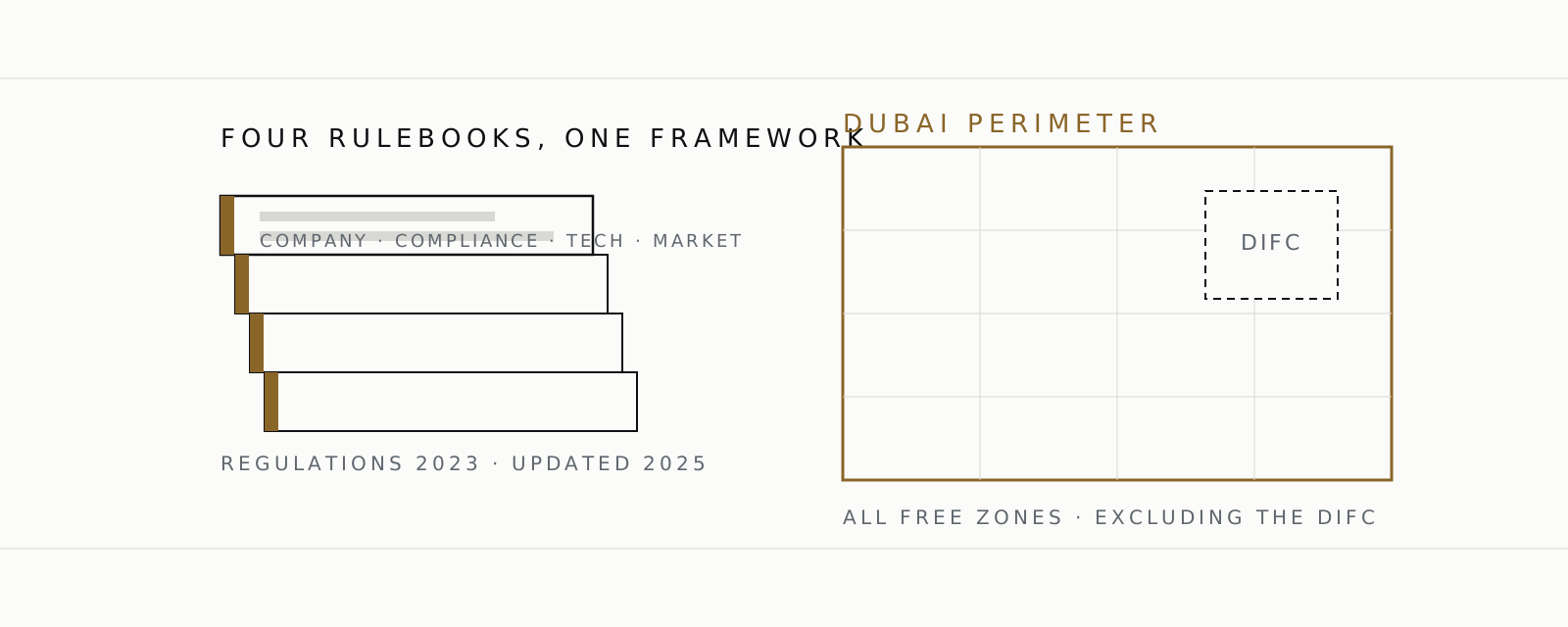
The Virtual Assets Regulatory Authority (VARA) is Dubai's dedicated crypto regulator, created by Law No. (4) of 2022. It licenses exchanges, broker-dealers and custodians across the emirate — except the DIFC — under a rulebook framework last updated in 2025. Its marketing rules apply even to unlicensed firms.
KEY FACTS
| Established | Law No. (4) of 2022, Emirate of Dubai |
|---|---|
| Perimeter | All of Dubai incl. free zones, excluding the DIFC |
| Framework | VA and Related Activities Regulations 2023, updated May 2025 |
| Compulsory rulebooks | Four: Company; Compliance & Risk; Technology; Market Conduct |
| Marketing rules | In force since 1 October 2024; fines up to AED 10 million |
Source: VARA regulations and rulebooks, as of September 2026.
What is VARA and what does it regulate?
The Virtual Assets Regulatory Authority (VARA) is Dubai's standalone regulator for cryptocurrencies and other virtual assets, established by Law No. (4) of 2022. Its perimeter covers the entire emirate, including the free zones, with one carve-out: the DIFC keeps its own regulator. Every licence is public — our one-minute licence check shows how to confirm any firm's status.
In practice, any firm exchanging, brokering, custodying or transferring crypto in or from Dubai needs a VARA licence before it touches a client. Dubai describes VARA as the world's first regulator dedicated solely to virtual assets.
Which activities need a VARA licence?
VARA licenses by activity, not by company label: a firm holds a licence for each regulated activity it performs. The 2023 Regulations originally set out seven; Schedule 1 now lists eight, the 2025 rulebook update having added Category 1 virtual-asset issuance to the licensed perimeter as well.
- Advisory — personalised recommendations on virtual assets.
- Broker-Dealer — arranging and executing client trades, the licence an OTC desk holds.
- Custody — holding clients' virtual assets.
- Exchange — operating a trading venue.
- Lending and Borrowing — virtual-asset credit facilities.
- Management and Investment — managing virtual-asset portfolios.
- Transfer and Settlement — moving virtual assets between parties.
A desk that also holds client funds overnight needs both Broker-Dealer and Custody permissions. When you check a licence, the activities listed in the register entry matter as much as the firm's name.
How do VARA's rulebooks work?
Every VARA licensee follows four compulsory rulebooks — Company, Compliance and Risk Management, Technology and Information, and Market Conduct — plus the rulebook for each activity it is licensed for. The whole framework sits under the Virtual Assets and Related Activities Regulations 2023, last revised in May 2025.
The Company rulebook sets governance and capital. Compliance and Risk Management covers AML, sanctions screening and the travel rule; Technology and Information covers wallet security and key management; Market Conduct covers market abuse and fair dealing.
For a client, the practical consequence is this: a licensed desk must verify your identity and source of funds, keep records, and settle in line with written terms. The paperwork that feels slow is the rulebook working as designed.
How does a firm get a VARA licence?
VARA licensing runs in stages: application, In-Principle Approval, then a full licence once the operational conditions are met. The process is measured in months, not weeks — VARA publishes no standard timeline, and how long it takes depends on the completeness of the application — and supervision continues after the licence is granted.
-
STEP 1
File the application and disclosures
The firm submits corporate documents, ownership structure, business plan and policy manuals to VARA, directly or through a free zone. Incomplete disclosure is the most common reason applications stall.
-
STEP 2
Receive In-Principle Approval
VARA reviews the model, the people and the capital, then issues an In-Principle Approval listing the conditions the firm must meet before it may serve clients. An IPA is not a licence and does not permit regulated activity.
-
STEP 3
Meet the conditions and operate under supervision
With systems live, compliance officers appointed and capital in place, VARA issues the full licence. From then on the firm files regular reports, sits through inspections and can be fined or suspended for breaches.
What do VARA's marketing rules require?
Since 1 October 2024, VARA's Regulations on the Marketing of Virtual Assets and Related Activities govern any promotion of virtual assets in or targeting the UAE. They apply to unlicensed firms, foreign platforms and influencers, not just licensees, and breaches carry fines of up to AED 10 million per violation.
The rules require marketing to be fair, clear and not misleading: no implied guarantees of returns, a visible risk disclaimer, and records kept. Promoting a regulated activity generally requires the promoter to be licensed for that activity, or formally approved by a firm that is.
Enforcement is real. In October 2025 VARA sanctioned 19 firms in a single action for unlicensed operations and marketing breaches, with fines of AED 100,000 to AED 600,000 and cease-and-desist orders. A polished Instagram ad is not evidence of a licence.
How does VARA differ from SCA, DFSA and FSRA?
The UAE has four regulators whose rules touch crypto, split by territory and asset class. VARA covers virtual assets in Dubai outside the DIFC; the SCA is the federal onshore regulator; the DFSA regulates inside the DIFC; the FSRA regulates inside Abu Dhabi's ADGM.
| Regulator | Territory | Covers | Framework basis |
|---|---|---|---|
| VARA | Dubai, incl. free zones, excl. DIFC | Virtual assets and VASPs | Law No. (4) of 2022; VA Regulations 2023 |
| SCA | Onshore UAE, federal level | Securities; virtual assets outside VARA's perimeter | Cabinet Resolution No. (111) of 2022 |
| DFSA | DIFC only | Financial services; crypto tokens | Crypto Token regime (2022, amended) |
| FSRA | ADGM only (Abu Dhabi) | Financial services; virtual assets | FSRA virtual asset framework (2018) |
For a spot USDT sale with bank settlement in Dubai, the licence that matters is VARA's; the other three govern different territories or asset classes.
The Dubai–Abu Dhabi split runs deeper than the table shows. For the practical differences — banking, licensing routes, enforcement culture — see how crypto rules differ between Dubai and Abu Dhabi.
What does a VARA licence mean for you as a client?
A VARA licence tells you a desk has met capital, custody and conduct requirements and answers to a regulator — it does not insure your money. It gives you three practical things: a verifiable register entry, defined complaint channels, and a firm whose settlement conduct is supervised.
Meridian OTC operates under VARA licence VL/24/03/017 as a Broker-Dealer; the register entry is linked from the licence section of our main page. Our spreads — 0.08% to 0.40% by ticket size — are published openly, as the framework expects: see our pricing bands.
Licensed does not mean risk-free. Virtual assets can lose their value in full, and a licence is the floor for a counterparty, not a recommendation of one.
The bottom line on VARA
VARA is a full regulator, not a registration stamp: activity-based licences, four compulsory rulebooks, marketing rules with seven-figure fines and public enforcement actions. For a client in Dubai the usable part is simple — trade only with firms whose licence and activities you have checked in the register. The process of selling USDT through a licensed desk builds on exactly that foundation.
FAQ
Is VARA the only crypto regulator in the UAE?
No. VARA covers Dubai outside the DIFC; the SCA regulates virtual assets federally elsewhere onshore; the DFSA covers the DIFC and the FSRA covers Abu Dhabi's ADGM. Which one applies depends on where the firm is based and where it serves clients.
How do I check whether a firm is licensed by VARA?
Look the firm up in VARA's public register on vara.ae; the entry shows its licensed activities and status. Any legitimate desk will give you its licence number on request and it will resolve in the register.
Does a VARA licence guarantee my money is safe?
No. A licence sets capital, custody and conduct requirements and gives you a regulator to complain to; it is not deposit insurance. Virtual assets remain high-risk and can lose their value in full or in part.
Do VARA's marketing rules apply to unlicensed firms?
Yes. Since 1 October 2024 the Marketing Regulations apply to anyone promoting virtual assets in or targeting the UAE, licensed or not, including foreign platforms and influencers. Fines run up to AED 10 million per violation.
Trade with a VARA-licensed desk
Meridian OTC is a VARA-licensed Broker-Dealer in Dubai, licence VL/24/03/017. All-in spread 0.08–0.40% by size, published openly. AED by UAEFTS the same business day once your account is approved.
SOURCES
- VARA — official website: Virtual Assets and Related Activities Regulations 2023, rulebooks and Marketing Regulations 2024, accessed 10 September 2026.
- VARA public register — licence status check, accessed 10 September 2026.
- Securities and Commodities Authority (SCA) — federal framework, accessed 10 September 2026.
- Dubai Financial Services Authority (DFSA) — DIFC crypto token regime, accessed 10 September 2026.
- ADGM Financial Services Regulatory Authority (FSRA) — virtual asset framework, accessed 10 September 2026.
- VARA Rulebook — Schedule 1, VA Activities — current list of licensed activities, accessed 14 September 2026.
This guide is informational and is not legal, tax or investment advice, nor an invitation to buy or sell any virtual asset. Rules and figures are as of September 2026 — re-check the sources before acting. Virtual assets may lose their value in full or in part and are subject to extreme volatility.