
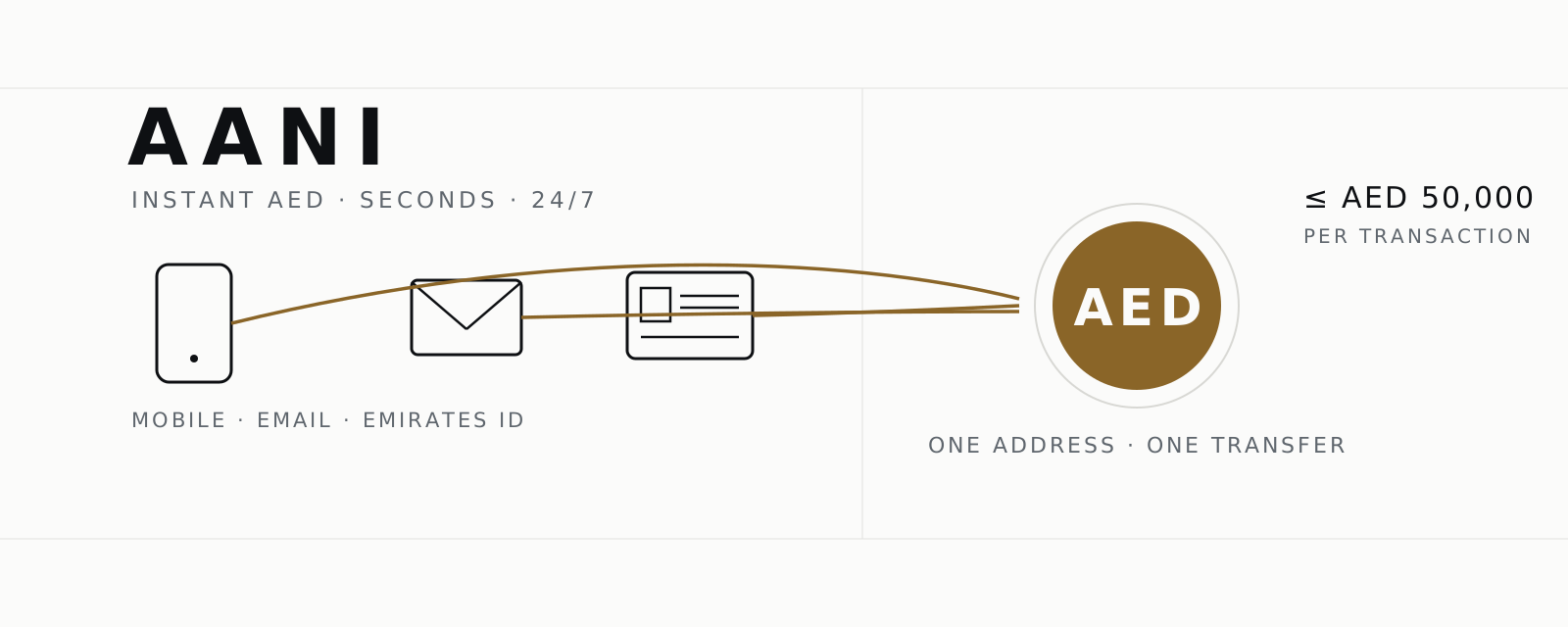
What is Aani? The UAE's instant payment system
Aani is the UAE's instant payment platform, operated by Al Etihad Payments, a Central Bank subsidiary. It moves dirhams between bank accounts in seconds, 24/7, addressed by mobile number, email or Emirates ID — capped at AED 50,000 per transfer. Here is where it fits when you sell USDT in Dubai.
KEY FACTS
| Operator | Al Etihad Payments (CBUAE subsidiary) |
|---|---|
| Launched | October 2023 |
| Speed | Seconds, 24/7 including weekends |
| Scheme cap | AED 50,000 per transaction |
| Addressing | Mobile number, email, Emirates ID or QR — no IBAN needed |
| Fee | Set by your bank; many charge nothing |
Source: Al Etihad Payments and participating banks' published tariffs, as of September 2026.
How does Aani work in the UAE?
Aani works by replacing the IBAN with a proxy: you pay to a mobile number, email address or Emirates ID, and the platform routes the dirhams to the recipient's bank account in seconds. Al Etihad Payments, the payments subsidiary of the Central Bank of the UAE, launched Aani in October 2023 on the national Instant Payment Platform, and licensed banks offer it inside their own apps.
According to Al Etihad Payments, Aani settles transfers around the clock, including weekends and public holidays. The platform itself sets no fee: pricing belongs to your bank, and most participating banks charge nothing for Aani transfers as of September 2026 — but each bank publishes its own tariff and can change it without any change to Aani.
The scheme cap is AED 50,000 per transaction, while your bank's own limit sits underneath it and is often lower. Some banks cap mobile-number transfers at AED 10,000 and allow the full AED 50,000 only to an IBAN. We track the bank-by-bank picture in our article on Aani payment limits and crypto settlement.
Aani vs UAEFTS: which rail carries which payment?
Aani and UAEFTS are both Central Bank of the UAE infrastructure, but they carry different sizes of payment. UAEFTS is the real-time gross settlement system for high-value AED transfers between banks; Aani is the retail instant layer for everyday amounts.
| Rail | Cap per transaction | Speed | Typical use |
|---|---|---|---|
| Aani | AED 50,000 (scheme) | Seconds, 24/7 | Everyday payments, small transfers |
| UAEFTS | No retail cap | Same business day | High-value wires, property, OTC settlement |
Anything above AED 50,000 — including almost every OTC settlement — travels by UAEFTS; Aani is for the amounts below that line.
For the mechanics of the high-value rail, see our explainer on what UAEFTS is and how it settles. The short version: UAEFTS payments are final, bank-to-bank, and sized for amounts Aani was never built to carry.
Why does Aani matter when you sell USDT?
Aani matters to a USDT seller mainly as a boundary line: it tells you which proceeds can arrive in seconds and which must travel as a bank wire. Licensed desks in Dubai settle by UAEFTS to an account in your own name, precisely because desk tickets start around 100,000 USDT — far above the AED 50,000 Aani cap.
Where Aani genuinely fits is below the desk minimum: moving a few thousand dirhams of exchange proceeds, paying a deposit, or splitting a smaller amount with a family member. Those are Aani-sized payments, and they arrive in seconds with no IBAN to type.
What does not fit is breaking a large settlement into Aani-sized pieces. Repeated sub-limit inbound transfers are exactly the pattern bank monitoring is built to catch, and splitting a payout this way invites the account review you were trying to avoid.
A worked example: Aani vs a desk settlement
Say you sell 150,000 USDT at the 3.6725 dollar peg: proceeds of AED 550,875. Over Aani that is eleven transfers of AED 50,000 plus one of AED 875 — twelve separate inbound payments, assuming your bank even allows the full cap on every one.
Over a licensed desk the same sale is one UAEFTS wire, sent the same business day to your own-name account. At a 0.25% spread the cost is AED 1,377 — you can convert the band into money at your ticket size with the calculator on our pricing section.
FAQ
Is Aani free to use?
Aani itself sets no fee; pricing belongs to your bank. Most participating banks charge nothing for Aani transfers as of September 2026, but each bank publishes its own tariff and can change it at any time.
What is the maximum Aani transfer?
The scheme cap is AED 50,000 per transaction. Your bank's own limit sits underneath it and is often lower — some banks cap mobile-number transfers at AED 10,000 while allowing the full AED 50,000 to an IBAN.
Can I receive OTC sale proceeds over Aani?
Desk-size settlements are far above the AED 50,000 cap, so a licensed desk pays by UAEFTS wire to an account in your own name. Aani suits everyday amounts below the desk minimum, not six-figure payouts.
Is Aani the same as UAEFTS?
No. Aani is the retail instant layer running on the national Instant Payment Platform; UAEFTS is the real-time gross settlement system for high-value AED payments between banks. Both are Central Bank of the UAE infrastructure.
Selling above Aani's limit?
Meridian OTC is a VARA-licensed Broker-Dealer in Dubai. All-in spread 0.08–0.40% by ticket size, published openly. AED by UAEFTS the same business day to your own account, once onboarding is done.
SOURCES
- Al Etihad Payments — operator of Aani, accessed 10 September 2026.
- Central Bank of the UAE — payment systems (UAEFTS), accessed 10 September 2026.
- Meridian OTC published pricing bands and onboarding requirements — Meridian OTC published pricing bands, September 2026.
This guide is informational and is not legal, tax or investment advice, nor an invitation to buy or sell any virtual asset. Rules and figures are as of September 2026 — re-check the sources before acting. Virtual assets may lose their value in full or in part and are subject to extreme volatility.