
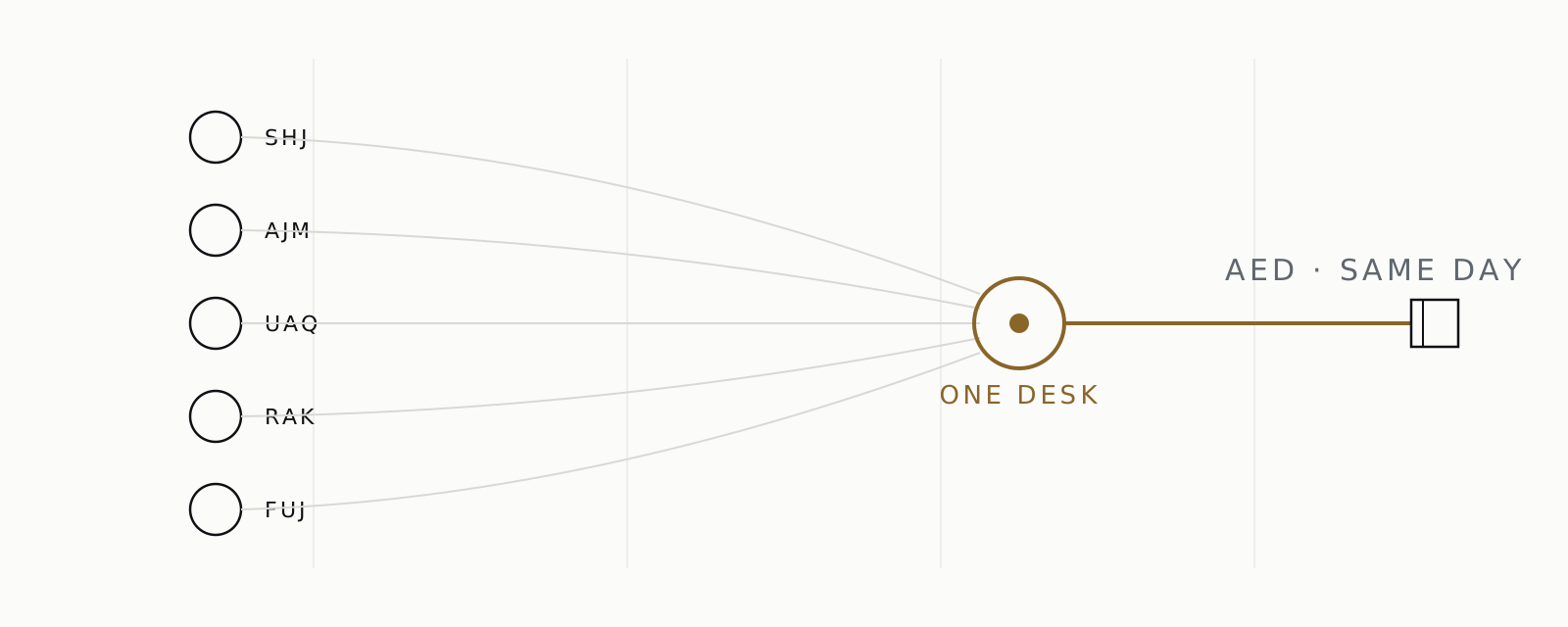
Selling USDT from Sharjah: Sharjah banks, federal rules and a Dubai desk
Sharjah has no virtual-asset regulator and no licensed desk of its own, so a Sharjah seller uses a VARA-licensed Dubai desk remotely, under federal rules set by the Capital Market Authority and the AML law. The dirhams reach Sharjah Islamic Bank, Bank of Sharjah, United Arab Bank or any UAE account by UAEFTS the same business day.
KEY FACTS
| Local regulator | None in Sharjah — the federal Capital Market Authority (CMA, the former SCA) applies onshore |
|---|---|
| Desk regulator | VARA (Dubai) — Meridian licence VL/24/03/017 |
| AML / KYC law | Federal Decree-Law No. 10 of 2025 — applies in every emirate |
| Sharjah-headquartered banks | Sharjah Islamic Bank, Bank of Sharjah, United Arab Bank — all on UAEFTS |
| Sharjah company licences accepted | SAIF Zone, Hamriyah Free Zone, Shams and mainland — same onboarding as a Dubai licence |
| Meridian spread | 0.08%–0.40%, by ticket size |
| AED / USD settlement | Same business day (UAEFTS) / 2–5 business days (SWIFT) |
Source: VARA public register, CBUAE, Latham & Watkins on Federal Decree-Laws 32 and 33 of 2025, the banks' own pages and Meridian OTC published pricing bands, as of September 2026.
Is it legal to sell USDT from Sharjah?
Selling USDT from Sharjah is legal when the counterparty holds a licence, and that licence will be a Dubai or a federal one — Sharjah has no virtual-asset regulator of its own. Cabinet Resolution 111 of 2022 made the federal Securities and Commodities Authority, since 1 January 2026 the Capital Market Authority (CMA), the supervisor for every emirate that has not set up a local licensing authority. Dubai set one up, VARA; Sharjah, as of September 2026, has not.
Identity and anti-money-laundering rules are federal too. Federal Decree-Law No. 10 of 2025 replaced the 2018 law on 14 October 2025 and binds virtual-asset providers wherever the client lives, so "no KYC because you are not in Dubai" is not a thing a licensed desk can offer. The desk process itself — approval, written quote, transfer, wire — is the one in our pillar guide to selling USDT through a licensed Dubai desk; this page covers the Sharjah side: the regulator, the banks and the logistics.
Who regulates a USDT sale made from Sharjah?
A USDT sale made from Sharjah is regulated at two levels: the desk's own licence — VARA for a Dubai desk — and the federal framework under the Capital Market Authority (the former SCA), which supervises virtual-asset activity onshore across the UAE outside the financial free zones. No Sharjah authority sits between the two, and none is needed for the trade to be lawful.
| Layer | Authority | Reach | Where to check |
|---|---|---|---|
| Desk licence | VARA | Dubai desks outside the DIFC | VARA public register |
| Federal virtual-asset framework | CMA (former SCA) | Onshore UAE — Sharjah, Ajman, UAQ, RAK, Fujairah included | CMA website (sca.gov.ae) |
| AML and identity checks | Federal Decree-Law No. 10 of 2025 | Every emirate, every licensed provider | CBUAE Rulebook |
| Payment rail | Central Bank of the UAE (UAEFTS) | Every UAE bank, in every emirate | CBUAE payment systems |
Takeaway: three of the four layers are federal, and the fourth is the desk's licence — geography never appears in the table.
We are not aware of a licensed OTC desk headquartered in Sharjah or the other northern emirates, as of September 2026. A desk based there would need the CMA's licence rather than VARA's; if one quotes you, apply the same test and find its entry in the CMA's register before you send anything. The sector remains concentrated in Dubai, and a Sharjah seller trades with a Dubai desk over distance.
Which Sharjah banks receive the settlement, and how fast?
Any Sharjah bank receives the settlement the same business day, because UAEFTS is a federal rail run by the Central Bank. Three banks are headquartered in the emirate — Sharjah Islamic Bank (founded 1975, converted to Islamic banking in the early 2000s), Bank of Sharjah (established 1973, the emirate's first commercial bank) and United Arab Bank (incorporated 1975) — and all three settle dirhams through it, as does every Dubai or Abu Dhabi bank with a Sharjah branch.
For an Islamic bank the inbound credit is a plain dirham transfer from a licensed company's corporate account; the question the bank asks is source of funds, not product structure. What varies between banks is appetite for crypto-linked inflows, which each bank sets for itself — the pattern is described in how UAE banks treat crypto-linked inflows.
USD is the exception: it leaves by SWIFT in 2 to 5 business days whatever the emirate. In either currency a licensed desk pays only to an account in your own name, and the wire shows a licensed sender — the two facts that keep a first large credit at a Sharjah bank a short conversation.
Can a Sharjah free-zone company sell USDT?
Yes. A company licensed in SAIF Zone, Hamriyah Free Zone, Sharjah Media City (Shams) or on the Sharjah mainland onboards with a Dubai desk on the same documents as a Dubai company: trade licence, ownership documents, and the signatory's passport and Emirates ID. The desk settles to the company's own-name account, which may sit at a Sharjah bank or at any other UAE bank.
Two points matter for companies. The account name must match the licence exactly, and the desk's trade confirmation is the record both the auditor and the bank will ask for; the company-side sequence is in selling crypto into a UAE company account.
How do you sell USDT from Sharjah without the drive to JLT?
A bank-settled sale from Sharjah is four remote steps: onboarding with a Sharjah address, naming the receiving account, a written quote, and the wire. An approved account completes the sequence within one trading day, and the desk's office in Dubai stays a place you never had to visit.
-
STEP 1
Onboard remotely with a Sharjah address
Passport and a proof of address issued within 90 days — a Sharjah tenancy contract or a SEWA bill works the same as a Dubai one. Companies add the licence, free-zone or mainland, and ownership documents. Approval takes one business day in most cases; the full list is in our onboarding section.
-
STEP 2
Name the receiving account up front
Give the desk the IBAN of the own-name account that will receive the dirhams — at Sharjah Islamic Bank, Bank of Sharjah, UAB or any other UAE bank — so beneficiary verification is finished before trade day, not during it.
-
STEP 3
Take the quote in writing, then send
The desk returns one all-in price held for a defined window, by phone, Telegram or email. You send USDT on the agreed network only after accepting it — never to a courier who offers to "meet in Sharjah with cash".
-
STEP 4
Receive AED the same business day
The wire leaves the desk's corporate account over UAEFTS and lands in your Sharjah account with the same day's value date, in full. USD, if you prefer it, follows by SWIFT in 2 to 5 business days.
What does it cost to sell USDT from Sharjah?
The cost is the desk's spread over the 3.6725 peg, and nothing for distance. Our bands — 0.08% to 0.40% by ticket size — are published in the pricing section with a calculator for your ticket.
Worked example: 150,000 USDT at a 0.40% band. Gross 150,000 × 3.6725 = AED 550,875; the spread costs AED 2,203.50 and the UAEFTS leg deducts nothing, so AED 548,671.50 arrives. A Dubai seller with the same ticket pays the same, because the spread is quoted on size, not on emirate — and why the peg itself barely moves is explained in our USDT to AED rate guide.
What are the red flags for a Sharjah seller?
The red flags for a seller in Sharjah, Ajman or Ras Al Khaimah, in descending order of importance:
- A "Sharjah desk" with no entry in VARA's register or the CMA's — there is no local regulator that could have licensed it.
- Cash meetings in industrial areas or car parks. They sit outside every perimeter, and a large cash deposit at a Sharjah bank starts the review the wire avoids.
- "No KYC because you are outside Dubai." The AML law is federal, and a desk skipping it is telling you what else it skips.
- Payment offered to a third-party account, or a rate better than the 3.6725 peg.
- Countdown pressure instead of a written quote with a defined window.
The bottom line on selling USDT from Sharjah
Selling USDT from Sharjah is the Dubai desk process with the federal layer doing the work: the CMA and the AML law apply in every emirate, and UAEFTS treats Sharjah Islamic Bank, Bank of Sharjah and UAB exactly like a Dubai bank. Onboard with your Sharjah address, name the receiving account early, insist on a written quote, and let the wire cross the emirate border instead of you.
FAQ
Does Sharjah have its own crypto regulator?
No. Sharjah has not set up a local virtual-asset licensing authority, as of September 2026. Onshore activity falls under the federal Capital Market Authority (the former SCA), and a Dubai desk you use is licensed by VARA.
Can I receive the dirhams at Sharjah Islamic Bank, Bank of Sharjah or UAB?
Yes. All three are headquartered in Sharjah and settle through UAEFTS, so an AED wire from a licensed desk lands the same business day, in full, provided the account is in your own name.
Can a SAIF Zone or Hamriyah company sell USDT through a Dubai desk?
Yes. A Sharjah free-zone or mainland company onboards on its trade licence and ownership documents, and the desk pays to the company's own-name account. The trade confirmation serves as the audit record.
Do I need to travel to Dubai to sell USDT from Sharjah?
No. Onboarding, quoting and settlement are fully remote: documents go by secure upload, the quote comes in writing, and AED arrives in your own bank account by UAEFTS. You never need to visit the desk.
Can I sell USDT for physical cash in Sharjah?
Cash handovers exist, but most sit outside the regulated perimeter and a large unexplained cash deposit can trigger a bank review. A bank wire to your own account from a licensed desk leaves a clean paper trail.
Sell USDT from Sharjah without the drive to Dubai
Meridian OTC is a VARA-licensed Broker-Dealer in Dubai serving clients across the UAE. All-in spread 0.08–0.40% by size, published openly. AED by UAEFTS to Sharjah Islamic Bank, Bank of Sharjah, UAB or any UAE bank the same business day once your account is approved.
SOURCES
- VARA public register — licence status check, accessed 10 September 2026.
- Securities and Commodities Authority, now the Capital Market Authority (CMA) — federal virtual-asset licensing, accessed 14 September 2026.
- Latham & Watkins — Federal Decree-Laws 32 and 33 of 2025: the SCA reconstituted as the Capital Market Authority from 1 January 2026, accessed 14 September 2026.
- Cabinet Resolution No. 111 of 2022 regulating virtual assets and their service providers, accessed 14 September 2026.
- CBUAE Rulebook — Federal Decree-Law No. 10 of 2025 on anti-money laundering, accessed 14 September 2026.
- Central Bank of the UAE — UAE Funds Transfer System (UAEFTS), accessed 14 September 2026.
- Sharjah Islamic Bank — about us, accessed 14 September 2026.
- Bank of Sharjah — about us, accessed 14 September 2026.
- United Arab Bank — our history, accessed 14 September 2026.
- Invest in Sharjah — Sharjah free zones, accessed 14 September 2026.
- Meridian OTC published pricing bands and onboarding requirements — this site, September 2026.
This guide is informational and is not legal, tax or investment advice, nor an invitation to buy or sell any virtual asset. Rules and figures are as of September 2026 — re-check the sources before acting. Virtual assets may lose their value in full or in part and are subject to extreme volatility.