
What is address and account whitelisting?
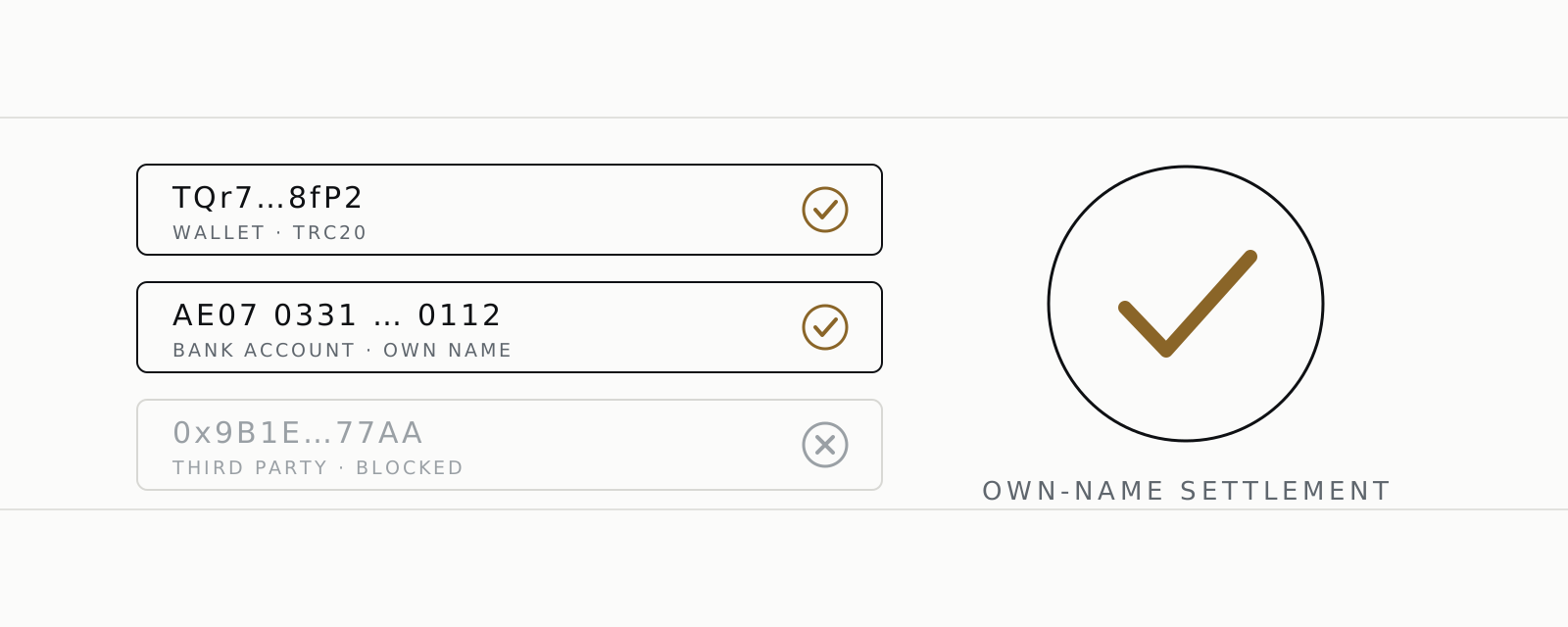
Address and account whitelisting is a security rule that restricts where your money can go: crypto withdrawals only to pre-approved wallet addresses, and fiat payouts only to bank accounts in your own verified name. Regulated OTC desks in the UAE apply it to every settlement.
KEY FACTS
| What it is | A pre-approved list of payout destinations |
|---|---|
| What it covers | Wallet addresses and own-name bank accounts |
| Ownership rule | IBAN name must match the verified account holder |
| Meridian minimum ticket | From around 100,000 USDT |
| Settlement after approval | AED same business day (UAEFTS); USD 2–5 days (SWIFT) |
Source: Meridian OTC onboarding practice, as of September 2026.
How does whitelisting work in the UAE?
In the UAE, whitelisting is set up when you open an account with a licensed desk: you register your wallet addresses and bank accounts, prove you own them, and every later settlement is restricted to that list. Adding a new destination means repeating the check, not sending an email. The document side of this is covered in the onboarding section.
For a wallet address, ownership proof is a small test transfer or a signed message from that address. For a bank account, the IBAN must match the name on your identity file: a corporate trade settles to the corporate account, a personal trade to the personal one.
At a VARA-licensed desk this is not an optional security feature; it is part of anti-money-laundering control. New destinations normally sit in a short review before they can receive funds; ask the desk how long its review takes.
Why does whitelisting matter when you sell USDT?
Whitelisting matters because the biggest losses in large USDT sales come from the settlement leg, not the price: addresses swapped by clipboard malware, "pay my partner's account" requests and mule accounts. A fixed destination list makes those routes impossible by default.
It also keeps your bank relationship clean. A licensed desk pays only to your own account, so the incoming wire matches your identity file — the paper trail a UAE bank expects when a seven-figure transfer arrives from a virtual-asset provider.
The inverse is the simplest desk test there is. A counterparty that offers to pay "any account you like" is describing an unlicensed flow, whatever its website says; the licence number in the licence section and the VARA public register are where that claim gets checked. The full trade sequence sits in the guide to selling USDT in Dubai.
A whitelisted settlement, in numbers
A client sells 500,000 USDT on an approved account. At the 3.6725 peg that is AED 1,836,250 gross; at a 0.25% spread the cost is AED 4,591, so AED 1,831,659 goes out by UAEFTS the same business day — strictly to the IBAN registered at onboarding. The bands by ticket size are published in the pricing section, as of September 2026.
Mid-trade, the client asks to split the payout between his own account and a supplier's. The desk refuses the second leg: the supplier is not whitelisted, and no instruction by phone, messenger or email overrides that. The refusal is the control working, not the desk being difficult.
How do you set up whitelisting at an OTC desk?
Setting up whitelisting takes one onboarding session — one business day in most cases — and happens before your first trade.
-
STEP 1
Open the account
Passport and proof of address for an individual; trade licence and ownership documents for a company.
-
STEP 2
Register your bank accounts
Give every IBAN you plan to settle to. Each must be in the same name as the verified account holder.
-
STEP 3
Register your wallet addresses
One address per network you will use (TRC20, ERC20), each confirmed with a small test transfer as proof of ownership — the check that stands in for travel-rule data when funds come from a self-hosted wallet.
-
STEP 4
Trade against the fixed list
Quotes, transfers and wires now run only to registered destinations. Changes go through re-verification, not chat.
Do this before the day you need the money. A bank account added on settlement day can push the wire to the next business day.
The bottom line on whitelisting
Whitelisting trades a small one-time setup for a settlement path that cannot be quietly redirected. If a desk treats third-party payouts as a feature, the feature is the red flag.
FAQ
Is whitelisting the same as KYC?
No. KYC establishes who you are; whitelisting fixes where money can move — only to wallet addresses and bank accounts approved under that verified identity. The two controls work together: KYC without whitelisting leaves the settlement leg open to redirection.
Can I add a new bank account after onboarding?
Yes, but it goes through the same verification as the original account: the IBAN must match your verified name, and the change takes effect after review, not instantly. Register every account you might use before the day you need to trade.
Can a trade settle to a company account if I onboarded as an individual?
No. An individual account settles to personal IBANs in the same name; a company needs its own onboarding, and its trades settle to the corporate account. Mixing the two is exactly what own-name settlement is designed to block.
Does whitelisting stop address-poisoning scams?
It removes the payoff. Address poisoning relies on you copying a lookalike address from your transaction history; when the desk pays only to pre-registered destinations, a swapped or poisoned address is not on the list and cannot receive funds.
Trade with own-name settlement by default
Meridian OTC is a VARA-licensed Broker-Dealer in Dubai. Every account settles only to whitelisted, own-name destinations — AED by UAEFTS the same business day once your account is approved.
SOURCES
- VARA public register — licence status check, accessed 10 September 2026.
- Central Bank of the UAE — payment systems (UAEFTS), accessed 10 September 2026.
- Meridian OTC onboarding practice and published pricing bands, September 2026.
This guide is informational and is not legal, tax or investment advice, nor an invitation to buy or sell any virtual asset. Rules and figures are as of September 2026 — re-check the sources before acting. Virtual assets may lose their value in full or in part and are subject to extreme volatility.