
What is the FSRA? ADGM's financial regulator in plain terms
The FSRA is the Financial Services Regulatory Authority — the independent regulator of all financial services conducted in or from Abu Dhabi Global Market (ADGM), the capital's financial free zone. Since 2018 it has also licensed virtual-asset firms inside ADGM; outside the free zone it has no remit.
KEY FACTS
| Full term | Financial Services Regulatory Authority |
|---|---|
| Jurisdiction | Abu Dhabi Global Market (ADGM), Al Maryah Island |
| Mandate | All financial services in or from ADGM |
| Virtual-asset framework | Since June 2018 — the first in the region |
| Dubai equivalent | VARA (virtual assets, Dubai outside the DIFC, since 2022) |
| Licence check | ADGM public registers (adgm.com) |
Source: ADGM / FSRA, as of September 2026.
How does the FSRA work in the UAE?
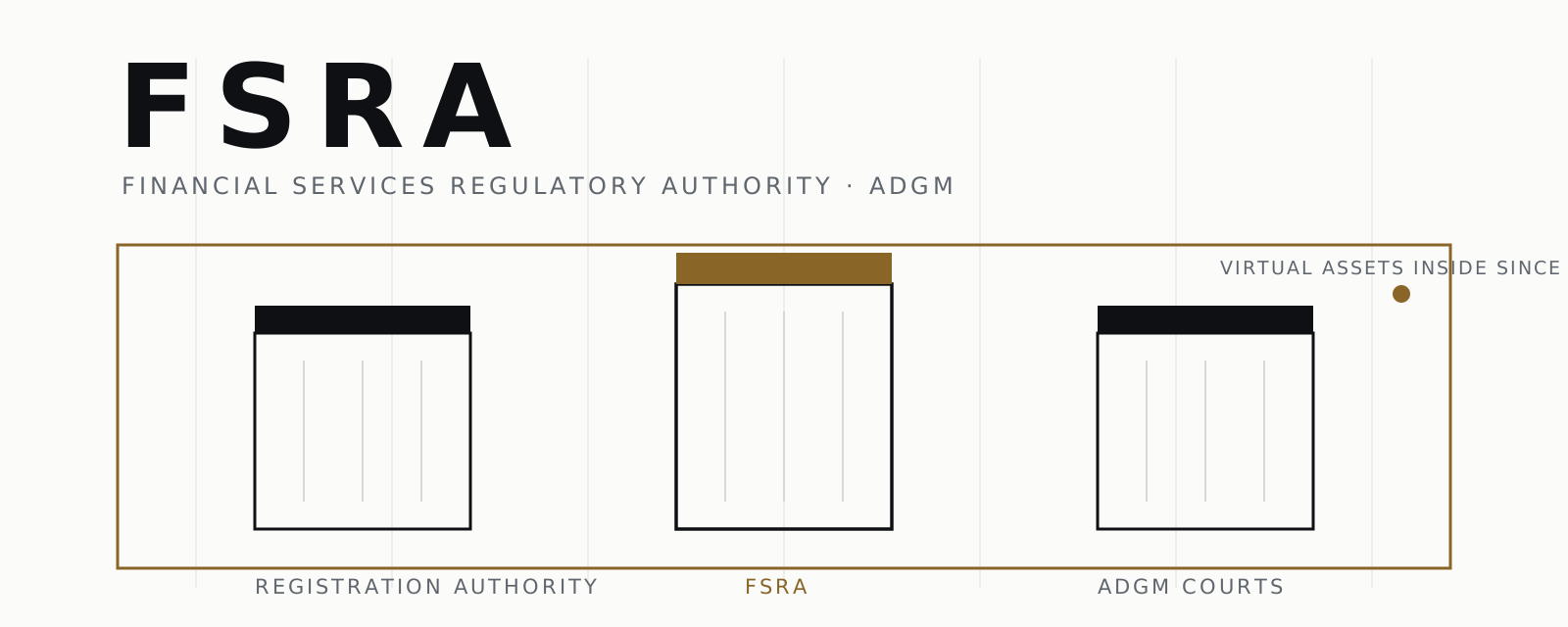
The FSRA is one of three independent authorities that run ADGM, Abu Dhabi's financial free zone, alongside the Registration Authority and the ADGM Courts. It authorises, supervises and — where needed — fines every firm conducting financial services in or from the free zone: banks, brokers, fund managers and, since 2018, virtual-asset companies.
ADGM sits on Al Maryah Island in Abu Dhabi and operates under its own legal system based on English common law. The FSRA's rulebook is built on the Financial Services and Markets Regulations 2015, extended to crypto through its June 2018 virtual-asset framework — four years before Dubai's VARA framework appeared.
For virtual assets the FSRA licenses specific activities — dealing, custody, operating a trading venue — and admits only tokens it has accepted for use inside ADGM. Firms outside the free zone, even elsewhere in Abu Dhabi, answer to other regulators.
How is the FSRA different from VARA?
The FSRA and VARA do the same job in different places: the FSRA regulates all finance inside ADGM in Abu Dhabi, while VARA regulates only virtual assets in Dubai outside the DIFC free zone. VARA, created by Dubai Law No. 4 of 2022, is the newer and narrower of the two authorities.
| Attribute | FSRA | VARA |
|---|---|---|
| Jurisdiction | ADGM (Abu Dhabi) | Dubai, outside the DIFC |
| Mandate | All financial services | Virtual assets only |
| Virtual-asset regime since | 2018 | 2022 |
| Legal basis | FSMR 2015 (English common law) | Dubai Law No. 4 of 2022 |
| Licence register | ADGM public registers | VARA public register |
For a seller the practical difference is geography: an ADGM firm answers to the FSRA, a Dubai desk to VARA — and you check each in its own register.
The two regimes are peers, not rivals. ADGM was the first jurisdiction in the region with a full virtual-asset framework; VARA was the first regulator anywhere dedicated solely to virtual assets. For the wider map of who regulates what, see Dubai and Abu Dhabi crypto rules compared.
Why does the FSRA matter when you sell USDT?
The FSRA matters when you sell USDT because it tells you which register to check when your counterparty is based in Abu Dhabi. A desk operating from ADGM should hold an FSRA permission; a desk in Dubai should appear in VARA's register — our guide shows how to check a Dubai desk's VARA licence in one minute.
The licence behind the desk determines the rules protecting your settlement: segregation of client money, capital requirements, audit. An ADGM-based counterparty with an FSRA permission sits inside a framework that has supervised crypto since 2018; a Dubai desk with no VARA licence sits outside the perimeter entirely.
If you are selling from the capital, the flow itself looks the same as in Dubai: written quote, USDT transfer, bank wire to your own account. Our walkthrough of selling USDT in Abu Dhabi covers the ADGM angle step by step.
Checking the licence on a 750,000 USDT sale
Regulation does not change the arithmetic of a sale — it changes who stands behind the desk. Take a 750,000 USDT conversion through a licensed desk, as of September 2026:
- Gross at the 3.6725 peg: 750,000 × 3.6725 = AED 2,754,375.
- Spread at 0.20% — inside Meridian's published 0.08%–0.40% band — costs AED 5,508.75, leaving roughly AED 2,748,866 net.
- Settlement: AED by UAEFTS the same business day, or USD by SWIFT in 2–5 business days, to an account in your own name.
The numbers are identical whether the desk answers to the FSRA or to VARA. What differs is the first check you run: an ADGM permission on the ADGM public registers for an Abu Dhabi firm, a VARA licence for a Dubai one. If the register shows nothing, the rate on offer is irrelevant.
The bottom line on the FSRA
The FSRA is Abu Dhabi's answer to the same question VARA answers in Dubai: who watches the firms handling your money. Before any large sale, match the desk's address to the right register — and treat a licence claim that resolves nowhere as the end of the conversation. To see what a licensed Dubai desk charges, the pricing bands on our main page convert the spread into money at your ticket size.
FAQ
Is the FSRA the same as ADGM?
No. ADGM is the financial free zone itself; the FSRA is one of its three independent authorities, alongside the Registration Authority and the ADGM Courts. The FSRA is the one that licenses and supervises financial firms, including virtual-asset companies.
Does the FSRA regulate crypto desks in Dubai?
No. Dubai outside the DIFC is regulated by VARA, and the DIFC by the DFSA. A Dubai-based desk pointing to an FSRA licence is a red flag: the FSRA's remit stops at the ADGM boundary in Abu Dhabi.
Which came first, the FSRA framework or VARA?
The FSRA's. ADGM introduced its virtual-asset framework in June 2018, the first in the region. VARA was created in March 2022 as the world's first regulator dedicated solely to virtual assets.
How do I check whether a firm is FSRA-regulated?
Search the ADGM public registers for the firm's legal name and permission type. For a Dubai desk, use VARA's public register instead. A licensed firm gives you its legal name and licence details without being asked twice.
Sell USDT through a desk inside the perimeter
Meridian OTC is a VARA-licensed Broker-Dealer in Dubai (VL/24/03/017). All-in spread 0.08–0.40% by size, published openly. AED by UAEFTS the same business day once your account is approved.
SOURCES
- ADGM — Financial Services Regulatory Authority, accessed 11 September 2026.
- ADGM — public registers — licence and permission checks, accessed 11 September 2026.
- VARA — Virtual Assets Regulatory Authority (Dubai Law No. 4 of 2022), accessed 11 September 2026.
- Meridian OTC published pricing bands and onboarding requirements — Meridian OTC published pricing bands, September 2026.
This guide is informational and is not legal, tax or investment advice, nor an invitation to buy or sell any virtual asset. Rules and figures are as of September 2026 — re-check the sources before acting. Virtual assets may lose their value in full or in part and are subject to extreme volatility.