
Family offices and crypto in the UAE: governance before size
A family office in the UAE can hold crypto legally, but the order matters: write the mandate, assign the decision, choose custody — and only then size the position. Size without governance is how seven-figure mistakes get made. A VARA-licensed desk covers the execution leg with bank settlement.
KEY FACTS
| Regulator | VARA (Dubai, outside the DIFC) |
|---|---|
| Legal status | Legal for family offices via licensed providers |
| Typical desk minimum | From around 100,000 USDT |
| Meridian spread | 0.08%–0.40%, by ticket size |
| AED settlement | Same business day (UAEFTS), own-name accounts only |
Source: Meridian OTC published pricing bands, as of September 2026.
Why does governance come before size?
Governance comes before size because every crypto problem a family office meets later — an unauthorised trade, a lost key, an unexplained bank transfer — is a governance failure, not a market one. A written mandate that names who decides, where assets sit and how trades settle turns crypto from a family argument into an operating procedure.
The UAE makes this easier than most jurisdictions because the perimeter is clear. In Dubai outside the DIFC, VARA licenses brokers, custodians and exchanges, and any counterparty can be checked against its public register in a minute — ours is linked from the licence section of our main page.
None of this requires a large allocation. A family office can adopt the full governance stack at 1% of investable assets and scale it later; what it cannot do is retrofit governance after a bad trade.
Who should own the crypto decision in a family office?
In a family office, the crypto decision should sit with an investment committee or a named principal operating under a written mandate — not with whichever family member follows the market most closely. The mandate is usually an annex to the investment policy statement, the document banks and auditors already know.
A one-page crypto mandate states:
- The maximum allocation as a percentage of investable assets, and who may change it.
- The approved asset list — for most offices, bitcoin and stablecoins such as USDT — and approved counterparties.
- Who signs off a trade: one signature below a threshold, two above it.
- Where assets are held and who controls the keys.
- What gets reported to the family, and how often.
Two signatures above a threshold sounds bureaucratic until the first convincing phishing email arrives.
How should a family office custody crypto?
A family office has three custody options: self-custody with hardware wallets or multisig, a third-party custodian, or no custody at all — settling trades through a desk while assets stay in a structure the office already controls. The right choice depends on how long the office intends to hold, not on trade size.
| Custody model | Who holds the keys | Ongoing cost | Best for |
|---|---|---|---|
| Self-custody (hardware / multisig) | The office itself | Hardware and setup only | Long-term holders with in-house discipline |
| Third-party custodian | A licensed custodian | Annual fee, basis points of assets | Offices that need audit-grade safekeeping |
| No custody (desk settlement) | No one — assets move only on trade day | Built into the spread | Tactical allocations, entries and exits |
Offices that trade a few times a year often skip a custodian entirely and let settlement itself be the control point.
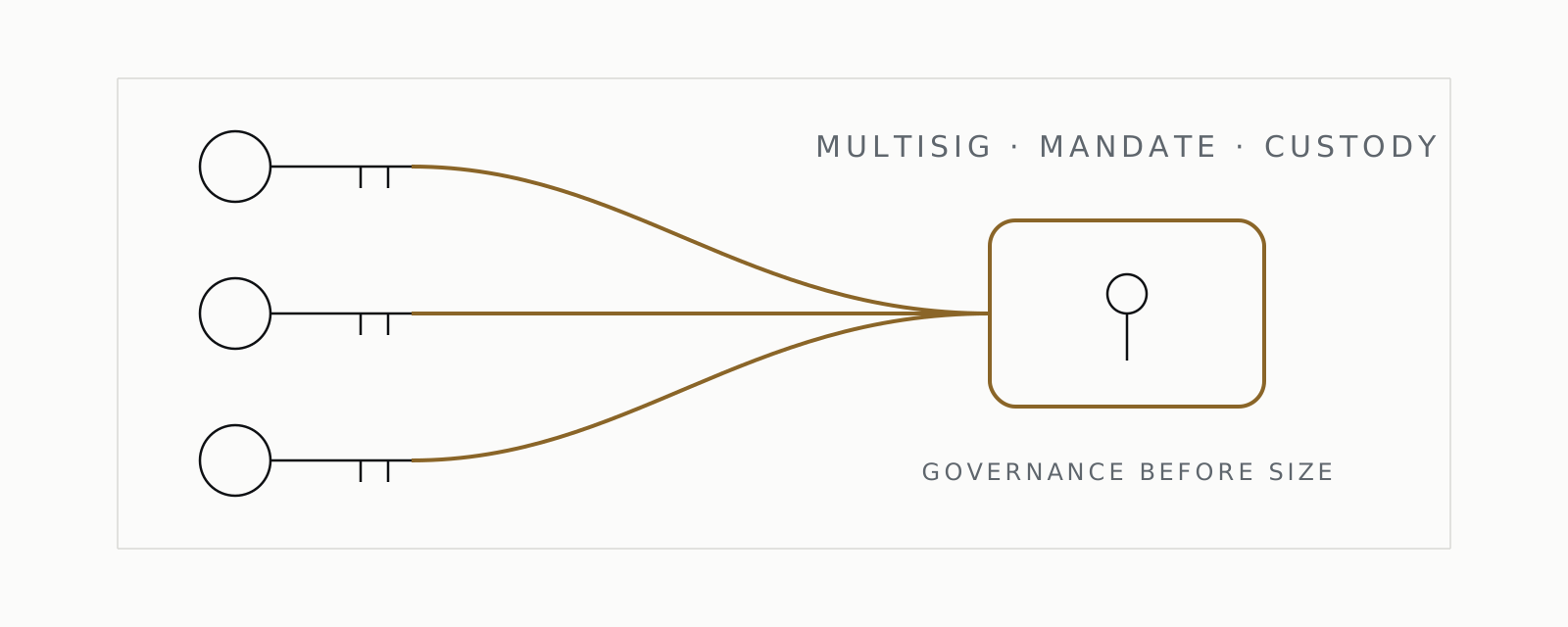
Self-custody fails in families for human reasons: one person holds the seed phrase, then travels, falls ill or falls out with the others. Multisig — where, say, two of three keyholders must sign — fixes most of this for the price of some discipline.
When does a desk beat an exchange for a family office?
For a family office, an OTC desk beats an exchange once the ticket is large enough that slippage, withdrawal limits and compliance queues cost more than the desk's spread — in practice, from around 100,000 USDT. Below that, a regulated exchange with an entity account is usually the simpler route.
The difference is structural. An exchange fills an order against a public order book in slices, then queues the withdrawal; a desk gives one written price for the full size and settles AED to the office's own bank account by UAEFTS the same business day (USD by SWIFT in 2–5 business days). Our bands — 0.08% to 0.40% by size — are published in the pricing section.
For the office's accountant, the desk route also produces cleaner evidence: one confirmation, one wallet transfer, one bank line. A licensed desk pays only to an own-name account, which matches how family offices are expected to move money anyway.
What reporting should a family office expect?
A family office should expect four records for every crypto trade: the written quote and confirmation, the on-chain transaction reference, the bank settlement advice, and a period-end valuation in AED or USD. Together these are what an external auditor and the family's bankers will ask for.
Valuation needs a stated policy — which price source, which cut-off time — set before the first trade, not during the audit. Because the dirham has been pegged to the dollar at 3.6725 since 1997, USDT-to-AED reporting carries almost no FX noise; our USDT to AED rate guide explains why.
Reporting to the family itself can be one page a month: position, cost basis, valuation and any movements. The entity documents a desk asks for at account opening — licence and ownership papers for the office vehicle — are listed in our onboarding section.
What does an implementation checklist look like?
A workable implementation sequence for a family office in the UAE has five steps. It takes weeks, not quarters.
-
STEP 1
Write the mandate
Allocation cap, approved assets, sign-off matrix, custody rule — one page, annexed to the investment policy statement. Cost: internal time.
-
STEP 2
Choose the custody model
Pick from the table above and document who holds the keys and what the recovery procedure is. Test the recovery procedure before funding anything.
-
STEP 3
Open execution accounts before you need them
Approval at a licensed desk takes about one business day; doing it before the first trade is urgent is the biggest speed-up available. You can request a quote and open an account in one step.
-
STEP 4
Run a pilot trade
A small first ticket tests the full path end to end: quote, wallet transfer, bank settlement, reporting pack. Fix what breaks at small size.
-
STEP 5
Review annually
Re-check counterparty licences in the VARA public register, re-approve the asset list and update the valuation policy. Governance that is not re-read is decoration.
The bottom line for family offices
A family office in the UAE does not need a large crypto allocation to need crypto governance. Write the mandate at 1%, pick custody, open the accounts, and let size follow when the family is ready — not the other way round.
FAQ
Is it legal for a family office to hold crypto in the UAE?
Yes. No UAE rule prohibits a family office from holding virtual assets; in Dubai the providers the office uses — broker, custodian, exchange — must be licensed by VARA outside the DIFC. Structuring and tax questions belong with the office's own advisers.
How much crypto should a family office hold?
That is the family's own allocation decision, made with its advisers — no desk should answer it for them. What governance should fix in advance is the cap, the sign-off rules and the custody model, whatever the percentage turns out to be.
Can a family office trade crypto through a personal exchange account?
It can, but it usually should not: assets and trades belong in the office's own entity for clean reporting and succession. From roughly 100,000 USDT per trade, a licensed OTC desk is normally the cleaner route than a retail account.
What is the minimum size to use an OTC desk in Dubai?
Most licensed desks in Dubai start around 100,000 USDT. Below that, a regulated exchange is usually the cheaper route, and a reputable desk will say so rather than take the ticket.
Governance first, execution when you are ready
Meridian OTC is a VARA-licensed Broker-Dealer in Dubai working with family offices and their vehicles. All-in spread 0.08–0.40% by size, AED settled by UAEFTS the same business day to own-name accounts.
SOURCES
- VARA public register — licence status check, accessed 10 September 2026.
- Central Bank of the UAE — payment systems (UAEFTS), accessed 10 September 2026.
- Meridian OTC published pricing bands and onboarding requirements — Meridian OTC published pricing bands, September 2026.
This guide is informational and is not legal, tax or investment advice, nor an invitation to buy or sell any virtual asset. Rules and figures are as of September 2026 — re-check the sources before acting. Virtual assets may lose their value in full or in part and are subject to extreme volatility.